September 24, 2026
Leo: the Sickle, Regulus and the galaxies of northern spring
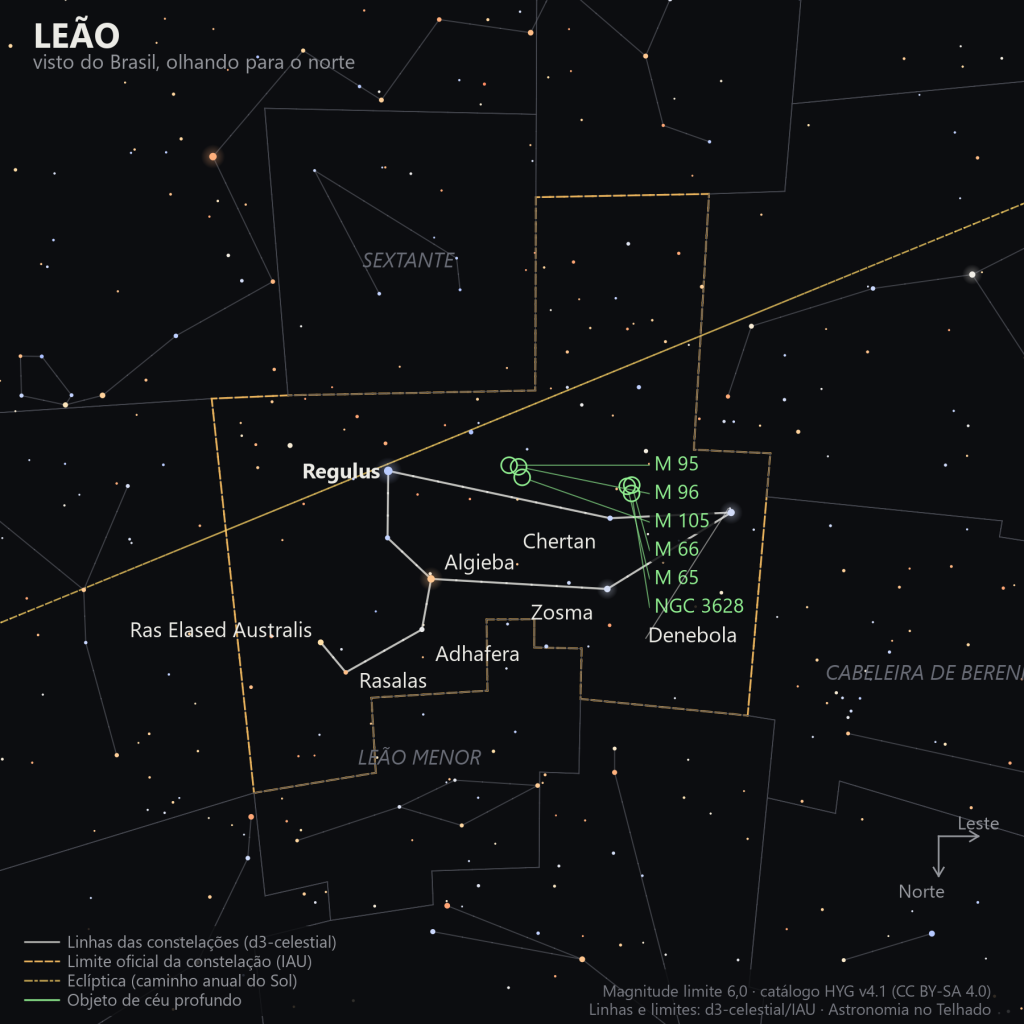
Few constellations are as easy to recognize as Leo. A mirrored question mark of bright stars forms the head and chest of the beast, a well-defined triangle sketches the back and tail, and at the foot of the figure shines Regulus, one of the most famous stars of the zodiac. For those of us in Brazil there is a curious detail: because Leo passes north of the zenith, we see it upside down compared with northern-hemisphere charts. In this guide you will learn how to find it, get to know its stars, understand why the Sun crosses Leo in August and September, and discover the best it has to offer for a telescope: a row of galaxies that make Leo the constellation of "galaxy season."
Text under review. This is a test article, written from reference sources; the sources are listed at the end.
How to find Leo
Leo is a large zodiacal constellation, covering about 947 square degrees, located between Cancer and Virgo (Mourão, entry Leo, p. 464; Moore, The Observer's Year, nights of May 2 and 3, p. 133-134). Ridpath describes the pattern as a reclining lion, with the Sickle, six stars in the shape of a backward question mark, marking the head and chest (Ridpath, p. 177).
When. The constellation culminates, that is, reaches its highest point in the sky, around 9 p.m. at the end of April, which is why the Brazilian autumn is the best season to observe it. Before that it climbs in the east early in the evening; afterward it sinks in the west and, from June on, sets early.
Where. Because the center of the constellation lies north of the celestial equator, in Brazil you should look north. The maximum altitude it reaches depends on your latitude. We calculated how high Regulus (declination about +12°) and Denebola (about +14.6°) climb:
| City | Maximum altitude of Regulus | Maximum altitude of Denebola |
|---|---|---|
| Boa Vista (RR) | 81° | 78° |
| Manaus (AM) | 75° | 72° |
| Recife (PE) | 70° | 67° |
| Brasília (DF) | 62° | 60° |
| Rio de Janeiro (RJ) | 55° | 52° |
| Porto Alegre (RS) | 48° | 45° |
| Chuí (RS) | 44° | 42° |
Altitudes calculated from the star coordinates in SIMBAD and the approximate latitude of each city (maximum altitude = 90° minus the difference between latitude and declination); values rounded.
Everywhere in Brazil, Leo culminates north of the zenith, and in much of the country it passes quite high in the sky, which guarantees excellent conditions for a telescope.
Step by step.
- Early on an April evening, look north and find the Sickle: a mirrored question mark, with the brightest star, Regulus, at the base of the "handle."
- East of the Sickle (to the right, for someone facing north), find the triangle of the back, formed by Zosma, Chertan and Denebola. Denebola marks the tail.
- To confirm, use a reference from the autumn sky: the line from Regulus to Denebola points to Arcturus, in Boötes, and Leo forms, together with Spica, Arcturus, Denebola and Cor Caroli, the so-called autumn diamond (Vieira, p. 83-84). Another clue: Ursa Major appears inverted and low in the north when the Southern Cross is at its highest, and the alignment of Dubhe and Merak leads to Regulus (Vieira, p. 83).

The stars of Leo
| Star | Position | Visual brightness (mag.) | Spectral type | Approximate distance |
|---|---|---|---|---|
| Regulus (alpha) | foot of the Sickle | 1.4 | B8 IVn (blue-white) | about 79 light-years |
| Algieba (gamma) | Sickle, under the head | 2.0 to 2.2 (combined) | K1 III + G7 III | about 130 light-years |
| Denebola (beta) | tail | 2.1 | A3 Va | about 36 light-years |
| Zosma (delta) | hip | 2.5 | A5 IV | about 58 light-years |
| Ras Elased Australis (epsilon) | tip of the Sickle | 3.0 | G1 IIIa | about 230 light-years |
| Adhafera (zeta) | Sickle | 3.4 | F0 IIIa | about 230 light-years |
| Chertan (theta) | back | 3.3 | A2 IV | about 160 light-years |
| Rasalas (mu) | head | 3.9 | K2 IIIb | about 125 light-years |
Brightnesses, spectral types and parallaxes taken from SIMBAD (CDS, Strasbourg). Distances come from Hipparcos satellite parallaxes (3,261.56 divided by the parallax in milliarcseconds) and are "about" values; older books give different figures (for Regulus, for example, Mourão gives 68 light-years; Moore, 85; Philip's, 77; Vieira, 84; Kambič, 78).
Regulus, the "little king" (Vieira, p. 83), is the 21st brightest star in the sky, a triple system according to Kambič (p. 316-317), and the faintest of the stars traditionally ranked as first magnitude: the next one, Adhara, has magnitude 1.50, a minimal difference (Moore, night of April 3, p. 104). It was one of the four Persian "royal stars," alongside Aldebaran, Antares and Fomalhaut, which marked the seasons (Mourão, entry Regulus, p. 677; Moore, p. 103-104). The name comes, according to Mourão, from a mistake by Ptolemy in calling it the "little king," the origin of the Latin Regulus. It is 130 times more luminous than the Sun and has a companion of magnitude 7.7, 4.3 arcseconds away, easy to see in a telescope, as well as a 13th-magnitude star 217 arcseconds away that has no connection to it (Moore, p. 104). Regulus lies only half a degree from the ecliptic, which makes it one of the few bright stars the Moon can occult. In 1959 it was even occulted by the planet Venus, an extremely rare event (Moore, p. 104).
Algieba is one of the finest double stars in the sky. The primary is orange and the companion, of magnitude 3.5, is yellow-green, with a separation of a little over 4 arcseconds and an orbital period of 619 years, according to Moore (night of April 4, p. 104-105). Ridpath and Philip's speak of about 600 years (Ridpath, p. 177; Philip's, p. 224), and Mollise gives the separation as 4.4" (p. 112). Algieba lies very close to the radiant of the Leonids (Moore, p. 105).
Denebola is the tail. Moore notes that the ancients described it as first magnitude, and today it is at 2.1; he doubts, however, that there has been a real drop in brightness (Moore, night of April 6, p. 106). It is about 36 light-years away.
Colors in binoculars. Besides Algieba, Rasalas (mu) and Alterf (lambda), both of K type, with magnitudes 3.9 and 4.3, have an orange tint (Moore, night of April 5, p. 105).
An almost invisible neighbor. Near Regulus there is a 13th-magnitude red dwarf, Wolf 359, about 7.8 light-years from us, closer than Sirius. It has only 0.00002 of the Sun's luminosity and for a few years was considered the least luminous normal star known (Moore, night of April 5, p. 105). It needs a medium-sized telescope and a detailed chart.
Deep-sky objects: galaxy season
Leo lies far from the plane of the Milky Way: that is why there are almost no nebulae or star clusters, but in exchange you look out of our galaxy and see thousands of others. Mollise reminds us that in the northern-hemisphere spring (our autumn) we look out of the plane of the Milky Way and it is galaxy time; for any of them, good transparency and steady seeing count for more than aperture (Mollise, p. 104-105). Philip's highlights five 9th-magnitude galaxies: M 65, M 66, M 95, M 96 and M 105 (entry Leo, p. 224).
The Leo Triplet: M 65, M 66 and NGC 3628
Under the lion's back, near Iota Leonis (a 4th-magnitude star south of Chertan), lies the most famous group in Leo. M 65 — spiral galaxy and M 66 — spiral galaxy form a pair some 30 to 35 million light-years away, discovered by Pierre Méchain in 1780. M 65 is almost edge-on, and M 66, half a degree away, is larger and less massive (Moore, night of April 9, p. 108; Mollise, p. 105-107; Kambič, p. 319). A small telescope shows both easily, but the spiral arms only appear in larger telescopes and in photographs (Moore, p. 108). Kambič notes that, with Leo high, M 66 is the first to appear in binoculars; near culmination M 65 shows up (p. 319).
The third member of the trio is NGC 3628 — Hamburger Galaxy, seen edge-on, with a dark lane of dust through the middle. Mollise gives magnitude 10.3 and about 12 arcminutes, but requires an 8-inch (20 cm) telescope or larger (p. 107).
To find the trio, use Theta (Chertan) and Iota Leonis as guides, with the star 73 Leonis as an intermediate point, according to Kambič (p. 319, fig. 9.12).
The group of M 95, M 96 and M 105
Closer to Regulus lies another group of galaxies, that of M 95 and M 96, with M 105 next to them, in the so-called Leo I group, about 38 million light-years away (Kambič, p. 320-321). M 96 — spiral galaxy is the more conspicuous spiral of the two; M 95 — barred spiral galaxy lies beside it and is fainter, and M 105 — elliptical galaxy, small and bright, looks like a globular cluster in the telescope (Moore, p. 108-109). M 105 was added to Messier's catalog later, although it too was discovered by Méchain (Moore, p. 108). They lie between Regulus and Iota Leonis; M 105 and M 96 are the first to appear, and M 95 is rarely seen in binoculars (Kambič, p. 320-321).
With a medium telescope and a dark sky, NGC 2903 (magnitude 9.1) and NGC 3521, the "Little Sunflower" (Mollise, p. 108 and 111), are also worth a look; they are not on the chart.
Mythology and history
The Nemean lion. According to Greek mythology, the constellation represents the Nemean lion, slain by Hercules as the first of his twelve labors. The animal had an impenetrable hide, and the hero, after trying arrows in vain, had to strangle it (Ridpath, p. 177; Mourão, entry Leo, p. 464; Philip's, entry Leo, p. 224).
The lion and the Nile. Mourão records that, at the time the figure was created, the Sun was in Leo at the northern-hemisphere summer solstice, and that for the Egyptians the Sun's entry into Leo coincided with the flooding of the Nile (Mourão, entry Leo, p. 464; Vieira, p. 24). Moore mentions that, in 1552, William of Salisbury wrote that anyone born under it would have "a royal birth" (p. 104): a historical curiosity with no scientific basis.
The zodiac and the Sun in Leo
The zodiac is the band of sky about 8° on either side of the ecliptic, the apparent path of the Sun; the Sun, the Moon and the planets pass through it (except Pluto, according to Philip's, p. 445; Mourão, entry zodíaco, p. 885). The ecliptic makes an angle of about 23.5° with the celestial equator (Ridpath, p. 132). Leo is crossed by it: notice on the chart that the golden line passes right beside Regulus, about half a degree away (Moore, night of April 3, p. 104), and runs south of the triangle of the back (Moore, night of May 2, p. 133).
By the official boundaries of the International Astronomical Union, the Sun is inside Leo from about August 12 to September 17, roughly 37 days (approximate dates, which vary by a day or two from year to year). At that time Leo is on the same side of the sky as the Sun and vanishes in the daylight glare; the best time to see it at night is months later, from March to June.
Sign and constellation are not the same thing. In astrology, the zodiac is divided into twelve equal signs of 30° each. Because of the precession of the equinoxes (the slow wobble of the Earth's axis, which shifts the starting point over the centuries) and the redefinition of constellation boundaries, the signs no longer coincide with the constellations (Philip's, entry zodiac, p. 445). That is why the period of the sign of Leo (about July 23 to August 22) does not match the dates when the Sun is actually in the constellation. In addition, the ecliptic today also passes through Ophiuchus, and the zodiac touches parts of Cetus, Orion and Sextans (Philip's, p. 445; Mourão, p. 885). Moore points out that constellation patterns are arbitrary and "mean absolutely nothing" in the astrological sense (night of May 2, p. 133). Here the signs are culture and history, not prediction.
The Leonids: when the sky fell
Leo lends its name to one of the most famous meteor showers in history. The Leonids are active from November 15 to 20, peaking around the 17th, and the radiant, the point from which the meteors appear to come, lies inside the Sickle (Philip's, entry Leonids, p. 225). In an ordinary year the hourly rate at the peak is about 15 meteors, but about every 33 years, when the parent comet, 55P/Tempel-Tuttle, returns to perihelion, the shower can turn into a storm (Philip's, p. 225-226; Moore, night of November 17, p. 312).
The storm of 1833 is considered the starting point of the scientific study of meteors: it led to the identification of defined showers. The American H. A. Newton traced the Leonids in records back to the year 902 and correctly predicted another great display in 1866; comet Tempel-Tuttle was discovered the year before and Schiaparelli realized it was the "father" of the shower (Moore, p. 312; Philip's, p. 225-226). In 1966 the rates were extremely high: Moore speaks of a ZHR of 60,000, and Philip's of about 140,000 per hour for 40 minutes (Moore, p. 312; Philip's, p. 226). Humboldt had already observed it in 1799, in Venezuela (Mourão, entry Leonídeos, p. 464). Forecasts for the 2032 return are not very favorable: at most about twice what the Perseids show in most years (Philip's, p. 226).
In Brazil, the radiant in Leo rises after midnight in November, so the best time to observe is in the early morning hours.
Observing guide
| Instrument | What to see |
|---|---|
| Naked eye | The Sickle and the triangle of the back, the slightly orange color of Algieba, Regulus (the brightest), the Regulus-Denebola alignment pointing to Arcturus. |
| Binoculars (10×50) | The colors of Algieba, Rasalas and Alterf, Regulus's companion (only in excellent conditions), the galaxies M 65 and M 66 (faint, on a dark night) and M 96/M 105. |
| Small telescope (70 to 100 mm) | Algieba as a double, Regulus and its 7.7-mag companion, M 65 and M 66 without difficulty, M 96 and M 105 as soft smudges. |
| Medium telescope (150 to 200 mm) | The whole Triplet, with NGC 3628 appearing as an elongated spindle with its dust lane; M 95, M 96 and M 105 in the same field; NGC 2903 and NGC 3521. |
| DSLR camera or smart telescope | M 65, M 66 and NGC 3628 in a single frame; for the whole Sickle, a 35 to 50 mm lens. |
Field tips:
- Choose moonless nights with transparent skies: the galaxies of Leo have low surface brightness and suffer from haze and light pollution.
- Take advantage of April and May, from 8 p.m. to 10 p.m., when Leo crosses the meridian, in the north.
- Start with the Sickle, follow on to Iota Leonis and only then look for the Triplet.
- Good seeing pays off more than aperture (Mollise, p. 105).
References
- KAMBIČ, Bojan. Viewing the Constellations with Binoculars: 250+ Wonderful Sky Objects to See and Explore. New York: Springer, 2010. Regulus, p. 316-317; galaxies of Leo with binoculars (M 65, M 66, M 95, M 96, M 105), p. 319-321.
- MOLLISE, Rod. The Urban Astronomer's Guide: A Walking Tour of the Cosmos for City Sky Watchers. London: Springer, 2006. Leo Triplet and galaxies of Leo, p. 104-112 (M 65 and M 66, p. 105-107; NGC 3628, p. 107; NGC 2903, p. 108; M 105, M 96 and M 95, p. 109-110; NGC 3521, p. 111; Algieba, p. 112).
- MOORE, Patrick (ed.). Philip's Astronomy Encyclopedia. London: Philip's, 2002. Entries "Leo" (p. 224), "Leonids" (p. 225-226) and "zodiac" (p. 445).
- MOORE, Patrick. The Observer's Year: 366 Nights of the Universe. 2nd ed. London: Springer, 2005. Nights of April 2 to 6 (Leo, Regulus, Algieba, the Sickle, Wolf 359 and Denebola, p. 103-106), April 9 (galaxies of Leo, p. 108), May 2 and 3 (zodiac and constellation areas, p. 133-134) and November 17 (Leonids, p. 312).
- MOURÃO, Ronaldo Rogério de Freitas. Dicionário enciclopédico de astronomia e astronáutica. Rio de Janeiro: Nova Fronteira, 1987. Entries "Leo" (p. 464), "Leonídeos" (p. 464), "Regulus" (p. 677) and "zodíaco" (p. 885).
- RIDPATH, Ian. Astronomia (Guia Ilustrado Zahar). 4th ed. Rio de Janeiro: Zahar. Leo, p. 177; celestial coordinates, ecliptic and zodiac, p. 132.
- VIEIRA, Fernando. Identificação do céu. Leo and the zodiac, p. 24; autumn diamond, Leo, Ursa Major and Cor Caroli, p. 83-84.
- SIMBAD Astronomical Database. Centre de Données astronomiques de Strasbourg (CDS). Queried for brightnesses, spectral types, parallaxes and galaxy data, on September 21, 2026.
- HYG Database (v4.1), David Nash / Astronexus, CC BY-SA 4.0 license, used for the star chart; IAU constellation boundaries and d3-celestial lines.