September 24, 2026
Aquarius: the Water Bearer’s Jar, the Helix Nebula and the Constellation Where Neptune Was Found
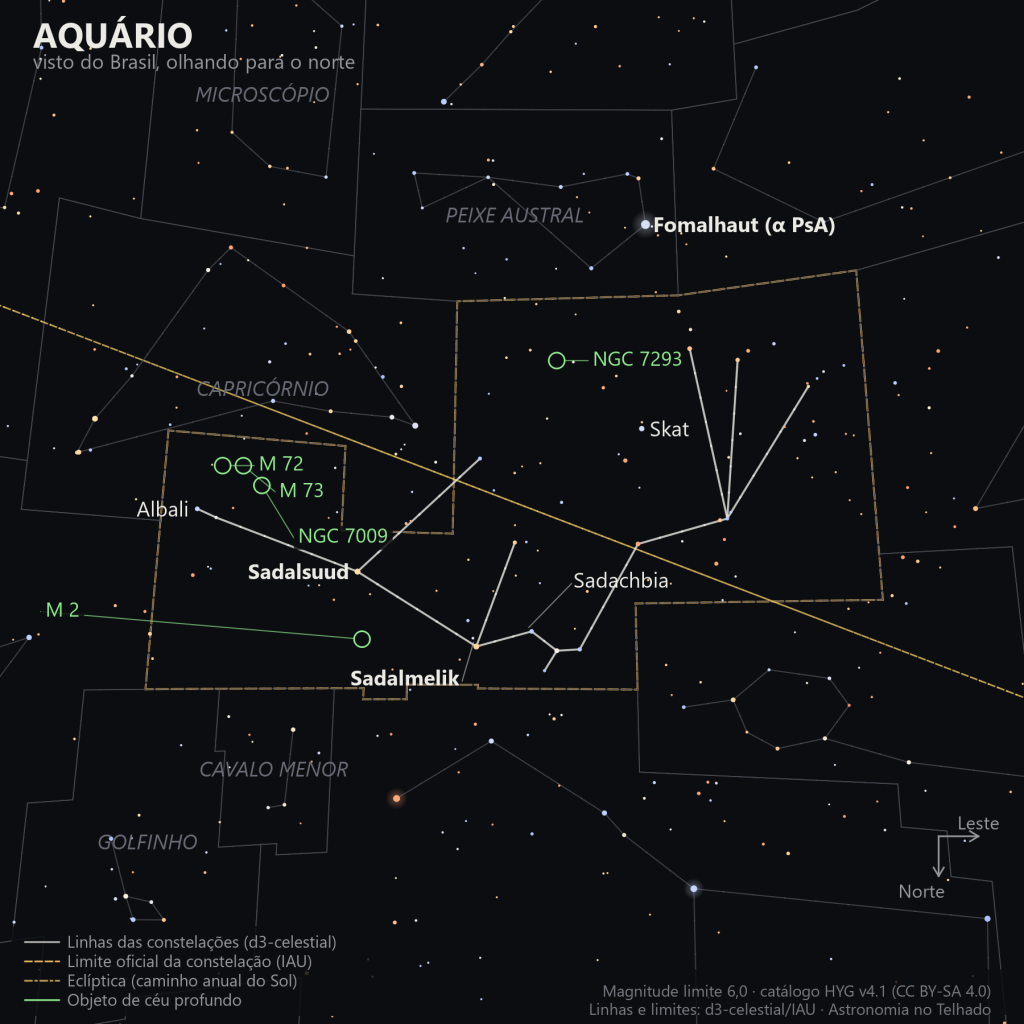
Aquarius is one of the largest constellations of the zodiac and, at the same time, one of the faintest: it has no truly bright star, and the picture of a young man pouring water from a jar takes some goodwill and a chart. In exchange, it holds first-rate treasures for observers in Brazil: the Helix Nebula, the planetary nebula closest to Earth, the Saturn Nebula, the globular clusters M 2 and M 72, and a famous little double star, Zeta Aquarii. It was also toward Aquarius that the astronomers in Berlin pointed their telescope in 1846 and found Neptune. In this guide you will learn how to find the jar, get to know the stars, visit each object, and understand why the Sun is inside the constellation's boundaries only between February and March.
Texto em revisão. This is a test article, written from reference sources; the sources are listed at the end.
A large, discreet constellation
Aquarius covers about 980 square degrees of sky, between right ascensions of 20h36 and 23h54 and declinations of +3° to -25° (Mourão, entry Aquarius). Ridpath ranks it tenth in size among the 88 constellations (Ridpath). The celestial equator cuts across the top, but almost the whole figure lies in the southern celestial hemisphere (Moore), which places it high and comfortable for anyone living in Brazil.
It is one of Ptolemy's original constellations (Moore), and what makes it recognizable is not a striking outline but two practical facts. The first is the long triangle that Alpha and Beta Aquarii, both of third magnitude, form with brilliant Fomalhaut, in the Southern Fish (Mourão). The second is the "jar", a small Y-shaped asterism made up of Gamma, Zeta, Eta and Pi Aquarii (Ridpath; Moore, who calls it the Water-Jar).
When and where to look
The center of the constellation sits around 22h of right ascension. This means it culminates, that is, reaches its highest point in the sky, at 9 p.m. local time in late October; September to November are the best months. In February and March the Sun is inside it, and so it vanishes in the daylight glare.
Because most of Aquarius lies north of the latitude of Rio de Janeiro, the constellation culminates north of the zenith: look north. The table below shows the maximum altitude (on the meridian) of Sadalmelik and Sadalsuud, which mark the range of the northern part of the figure, and of the Helix Nebula, the southernmost part.
| City | Sadalmelik to Sadalsuud | Helix Nebula |
|---|---|---|
| Boa Vista (RR) | 82° to 87° | 66° |
| Manaus (AM) | 87° to 88° | 72° |
| Recife (PE) | 82° to 88° | 77° |
| Brasília (DF) | 75° to 80° | 85° |
| Rio de Janeiro (RJ) | 67° to 73° | 88° |
| Porto Alegre (RS) | 60° to 66° | 81° |
| Chuí (RS) | 57° to 62° | 77° |
Altitudes calculated from the stars' declinations in SIMBAD and each city's latitude, ignoring refraction; values rounded.
Note the detail for Rio de Janeiro: the Helix passes about 2° from the zenith.
Step by step to find the jar
- Look for Fomalhaut, in the Southern Fish, very high in the sky (in Rio, it passes about 7° from the zenith, on the southern side). It is the only bright star in that region, and it stands alone (Vieira; Ridpath).
- From the zenith, turn to the north and look for two yellowish stars of similar brightness: Sadalsuud (Beta) and Sadalmelik (Alpha). Together with Fomalhaut they form the elongated triangle described by Mourão. Another route: the two western stars of the Great Square of Pegasus point south, cross Pisces and Aquarius, and reach Fomalhaut (Moore, night of September 29).
- From Sadalmelik, look for the jar on the eastern side (on the chart, to the right), with Gamma, Zeta, Eta and Pi.
- Almost halfway between Fomalhaut and Iota Aquarii lies the Helix (Moore).

The stars of the Water Bearer
Sadalmelik, the Alpha star, comes from Al Sa'd al Malik, "the lucky one of the king" (Moore, night of September 23).
| Star | Visual brightness (mag.) | Spectral type | Approximate distance |
|---|---|---|---|
| Sadalsuud (beta) | 2.89 | G0 Ib (yellow supergiant) | about 550 light-years |
| Sadalmelik (alpha) | 2.94 | G2 Ib (yellow supergiant) | about 660 light-years |
| Skat (delta) | 3.28 | A3 V | about 140 light-years |
| Albali (epsilon) | 3.77 | B9.5 V | about 245 light-years |
| Sadachbia (gamma) | 3.83 | A0 V | about 125 light-years |
| Lambda | 3.79 | M2.5 III (red giant) | about 365 light-years |
| Zeta (double) | 4.3 and 4.5 (the two components) | F2 | about 95 light-years |
| Pi | 4.64 | B1 III-IVe (Be star) | about 1,100 light-years |
Brightnesses, spectral types and parallaxes taken from SIMBAD (CDS, Strasbourg); distances calculated from parallaxes measured by the Hipparcos satellite, hence "about". Older books give quite different values: Moore lists 945 light-years for Sadalmelik and 980 for Sadalsuud, while Mourão and Vieira mention more than 1,100.
Sadalsuud and Sadalmelik are the two brightest and also the most interesting. They are yellow supergiants, stars much larger and more luminous than the Sun that have already left the main phase of their lives. Moore lists luminosities of more than 5,000 times that of the Sun; Mourão, from 6,000 to 12,000 (Moore, p. 259; Mourão, p. 699). With the shorter Hipparcos distances these numbers drop, but the result is still in the thousands of times the Sun's brightness, which still makes them respectable supergiants.
Sadachbia (Gamma) is a blue-white star, a spectroscopic binary with a 58-day period, with a faint companion 49 arcseconds away that is not physically related to it (Mourão, entry Sadalachbia). Skat (Delta) marks the spot near which lies the radiant of a meteor shower in July and August (Mourão). Lambda is the only red star among the main ones. Pi is a Be-type star, hot and distant.
Zeta Aquarii deserves a section of its own. In a small telescope it shows two nearly equal stars (4.3 and 4.5) separated by about 2 arcseconds; both are F-type subgiants, with an orbital period of 856 years. Herschel measured more than 4 arcseconds in 1781, and the separation is slowly shrinking, because we see the pair from an increasingly less favorable angle. It lies just 1 arcminute from the celestial equator, so it is seen equally well from both hemispheres (Moore, night of September 24). Ridpath cites it as a test for a 60 mm telescope.
Deep-sky objects
NGC 7293, the Helix Nebula (Caldwell 63)
The Helix is a planetary nebula, the shell of gas expelled by a Sun-like star in its last thousands of years. It is the closest and one of the brightest in the sky, but its light is spread over a large area: the apparent diameter is about 12 to 16 arcminutes, roughly half the size of the full Moon (Moore; Mobberley). The total magnitude, between 6 and 7.5 depending on the author, promises more than it delivers, because the surface brightness is low (Coe, p. 44-45). Coe notes that without binoculars you cannot see it.
The distance quoted by the books ranges from 400 to 520 light-years; the SIMBAD parallax points to about 650, a value that comes from Hipparcos and more recent studies. The central star has magnitude 13.5 and is a very hot white dwarf (Kambič cites more than 100,000 K), and the age of the shell is estimated at about 10,000 years (Mobberley). Hubble Space Telescope images show tadpole-shaped structures ejected by the dying star (Moore, p. 262).
How to observe. Use a wide field and low magnification: 7x to 15x binoculars with a large front lens, or a telescope at about 60x. O III or UHC filters help a lot; without a filter, look for the little doughnut under a dark sky (Mobberley, p. 134-135; Coe, p. 44-45). To find it, start from Fomalhaut, about 9° north and 6.5° west, or from Upsilon Aquarii, about 1° away (Mobberley). Under a very dark sky, some observers can even see it with the naked eye (Bakich, object no. 707). See the complete guide to the Helix Nebula.
NGC 7009, the Saturn Nebula (Caldwell 55)
A small, bright, blue-green planetary nebula, about 6° south and 6.9° west of Sadalsuud (Mobberley). The name comes from Lord Rosse, who noticed rays (the "ansae") extending from both sides of the disk and recalling the rings of Saturn; the discovery is due to William Herschel (Mourão, entry Saturno; Moore, night of September 28). The total magnitude is about 8, and the central star, of magnitude 12, is a blue dwarf (Mourão).
At low magnification it looks like a star; from 50x on it shows a greenish disk, and the "wings" only appear in large telescopes, of 25 to 50 cm (Mobberley, p. 120-121). The books differ widely on the distance (from 1,400 to 3,900 light-years); SIMBAD indicates something around 4,000. Use an O III or UHC filter. Guide: Saturn Nebula.
M 2, the globular cluster
M 2 is one of the richest and most compact globular clusters in the sky, with about 150,000 stars (Kambič) and a magnitude between 6.2 and 6.6. Discovered by Maraldi in 1746 during a comet hunt, it lies about 5° north of Sadalsuud, forming a triangle with that star and Sadalmelik (Moore, night of September 27; Allison; Bakich, object no. 672). In binoculars it appears as a fuzzy little ball; from 8 inches up it resolves the stars at the edge (Allison, p. 185-186). The distance ranges from 37,000 to 55,000 light-years depending on the source. Guide: M 2.
M 72 and M 73, an unequal pair
M 72, found by Pierre Méchain in 1780, is another globular cluster, much fainter (magnitude around 9), about 3° southeast of Epsilon Aquarii, at 55,000 to 62,000 light-years (Moore; Allison, p. 181). Next to it lies M 73, which disappoints: it is just four stars, an asterism and not a cluster, and Moore notes that it is in the catalog "out of respect for Messier's memory". The Data Book lists it as "not a cluster" (Moore and Rees, p. 342). Guides: M 72 and M 73.
Mythology and history
For the Greeks, Aquarius is Ganymede, the handsome young shepherd carried to Olympus by Zeus's eagle to be the cupbearer of the gods (Ridpath; Moore). Mourão records that he was also identified with Hebe, who served nectar to the gods, and, in another Greek tradition, with Deucalion, son of Prometheus. The Roman poet Manilius described the figure pouring out water without end, forming the river that flows from his feet (Moore).
Before the Greeks, Babylonian monuments already showed a man pouring water from a vessel over a small fish, the Southern Fish. Ridpath tells the same scene: the water of Aquarius runs down to the mouth of the fish, which is the star Fomalhaut, "the fish's mouth" in Arabic (Ridpath). Mourão records that, for the Egyptians, the stars Alpha and Omicron Aquarii announced the sowing season, after the flooding of the Nile. He adds that Fomalhaut was one of the four royal stars of the Persians.
The night Neptune was found. On September 23, 1846, Johann Galle and Heinrich d'Arrest used the 23 cm refractor in Berlin and, on the first night of the search, found an eighth-magnitude star that was not on the chart, at a right ascension of 22h53m. It was Neptune, predicted by calculation by Le Verrier, with an error of only 55 arcminutes (Moore and Rees, p. 235-236). Vieira records that the discovery took place in Aquarius.
The zodiac and the Sun in Aquarius
The ecliptic is the path the Sun follows in the sky over the year, as seen from Earth, and the band 8° on either side of it is the zodiac, a Greek name meaning "circle of animals", although not every constellation in the band is an animal, and Aquarius is a man (Mourão, entry zodíaco, p. 885). On the chart above, the dashed golden line crosses the northwest corner of the constellation, near Sadalsuud.
The Sun is inside the official boundaries of Aquarius, as defined by the International Astronomical Union, from about February 17 to March 12, roughly 24 days (approximate dates). Note that the "sign" of Aquarius in the astrological calendar is something else: Mourão associates it with those born between January 20 and February 18 (Mourão, entry Aquarius, p. 50). They are not the same thing. The sign is one of the 12 equal 30° sections of the zodiac, defined in Antiquity, when each sign coincided with the constellation of the same name. Since then, the precession of the equinoxes has made the constellations shift back about 30° relative to the signs: by Mourão's definition, the constellation of Aries is today in the sign of Taurus (Mourão, entry signo, p. 736). In addition, constellations have different sizes and boundaries set by the IAU, so the Sun spends little time in some and a lot in others. Here we treat the signs as part of culture and history, with no predictions whatsoever.
The same precession gives rise to the famous "Age of Aquarius". Mourão explains that the point where the Sun lies at the start of the northern-hemisphere spring changes constellation about every 2,200 years; we would be in the Age of Pisces, and would enter that of Aquarius around the year 2300 (Mourão, p. 50). Vieira, for his part, places the vernal point in Pisces from 60 BC to AD 2100 (Vieira, p. 52-53). The dates differ because the boundaries are conventions: there is no formal astronomical definition of an "age".
Meteors: the Eta and Delta Aquariids
Aquarius gives its name to two meteor showers. The Eta Aquariids are attributed to debris from Comet Halley and occur between April 24 and May 20, with a broad peak on May 4 and 5 and an hourly rate of up to 50 meteors at southern latitudes; they are fast (67 km/s), yellowish and leave persistent trails (Philip's, entry Eta Aquarids, p. 135; Moore, night of May 5, p. 135). Mourão gives a more modest version, from May 1 to 8 and 20 meteors per hour (Mourão, p. 288). They are favored in Brazil, because the radiant sits higher in the southern sky; the radiant rises only a few hours before dawn, so wake up early.
The Delta Aquariids run from July 15 to August 15, with a peak on July 27 and 28; the radiant is near Delta Aquarii (Skat) and the rate is 20 (northern branch) and 10 (southern branch) meteors per hour (Mourão, p. 227).
Observing plan
| Instrument | What to see |
|---|---|
| Naked eye | The triangle of Fomalhaut, Alpha and Beta Aquarii; the jar; the slightly yellowish color of Sadalsuud and Sadalmelik; M 2 under a very dark sky. |
| Binoculars (10×50) | M 2 as a fuzzy little ball, the Helix under a dark sky (only as a faint smudge), the M 73 group and the field of orange stars around Psi 1 (Moore). |
| Small telescope (70 to 100 mm) | Zeta Aquarii split into two nearly equal stars; M 2 with a grainy edge; the Saturn Nebula as a greenish star at high magnifications. |
| Larger telescope (150 mm or more) with O III/UHC filter | The doughnut of the Helix, the oval disk of the Saturn Nebula and, with plenty of aperture, the "wings"; partial resolution of M 2 and M 72. |
| DSLR camera | The Helix and the Saturn Nebula in long-exposure photos; meteor showers with a wide-angle lens. |
Field tips:
- Choose a moonless night and a sky with little light pollution: planetary nebulae of low surface brightness suffer greatly from the city.
- Observe the planetary nebulae when they are highest (near the meridian) and look north. In the Southeast, the Helix passes almost through the zenith.
- An O III or UHC filter is the best investment for these planetary nebulae.
References
- ALLISON, Michael. Star Clusters and How to Observe Them. London: Springer, 2006. M 72, p. 181; M 2, p. 185-186.
- BAKICH, Michael E. 1,001 Celestial Wonders to See Before You Die. New York: Springer, 2010. Objects no. 650 (M 72), 651 (M 73), 657 (NGC 7009), 672 (M 2) and 707 (NGC 7293).
- COE, Steven R. Nebulae and How to Observe Them. London: Springer, 2007. NGC 7009, p. 43-44; NGC 7293, p. 44-45.
- KAMBIČ, Bojan. Viewing the Constellations with Binoculars. New York: Springer, 2010. Helix, Saturn and M 2, p. 184-188.
- MOBBERLEY, Martin. The Caldwell Objects and How to Observe Them. New York: Springer, 2009. Caldwell 55 (NGC 7009), p. 120-121; Caldwell 63 (NGC 7293), p. 134-135.
- MOORE, Patrick (ed.). Philip's Astronomy Encyclopedia. London: Philip's, 2002. Entry "Eta Aquarids", p. 135.
- MOORE, Patrick. The Observer's Year: 366 Nights of the Universe. 2nd ed. London: Springer, 2005. Nights of September 23 (Aquarius, p. 258), 24 (Zeta Aquarii, p. 259), 27 (Messier objects, p. 261), 28 (Saturn and Helix, p. 262), 29 (Pisces and Pegasus, p. 262) and May 5 (Eta Aquariids, p. 135).
- MOORE, Patrick; REES, Robin. Patrick Moore's Data Book of Astronomy. Cambridge: Cambridge University Press, 2011. Discovery of Neptune, p. 235-236; list of Messier objects, p. 342.
- MOURÃO, Ronaldo Rogério de Freitas. Dicionário enciclopédico de astronomia e astronáutica. Rio de Janeiro: Nova Fronteira, 1987. Entries "Aquarius" (p. 49-50), "Delta Aquáridas" (p. 227), "Eta Aquáridas" (p. 288), "Sadalachbia", "Sadalmelek" and "Sadalsud" (p. 699), "Saturno" (sense 2, p. 712), "signo" (p. 736), "Skat" (p. 742) and "zodíaco" (p. 885).
- RIDPATH, Ian. Astronomia (Guia Ilustrado Zahar). 4th ed. Rio de Janeiro: Zahar. Aquarius, p. 187; Southern Fish, p. 206.
- VIEIRA, Fernando. Identificação do céu. Aquarius, Capricornus and Southern Fish, p. 100-101; precession, p. 52-53.
- SIMBAD Astronomical Database. Centre de Données astronomiques de Strasbourg (CDS). Query for brightnesses, spectral types and parallaxes, on Sept. 21, 2026.
- HYG Database (v4.1), David Nash / Astronexus, CC BY-SA 4.0 license, used for the star chart; IAU constellation boundaries and d3-celestial lines.