September 24, 2026
Scorpius: a guide to the constellation of Antares, the stinger and the tail that crosses the Milky Way
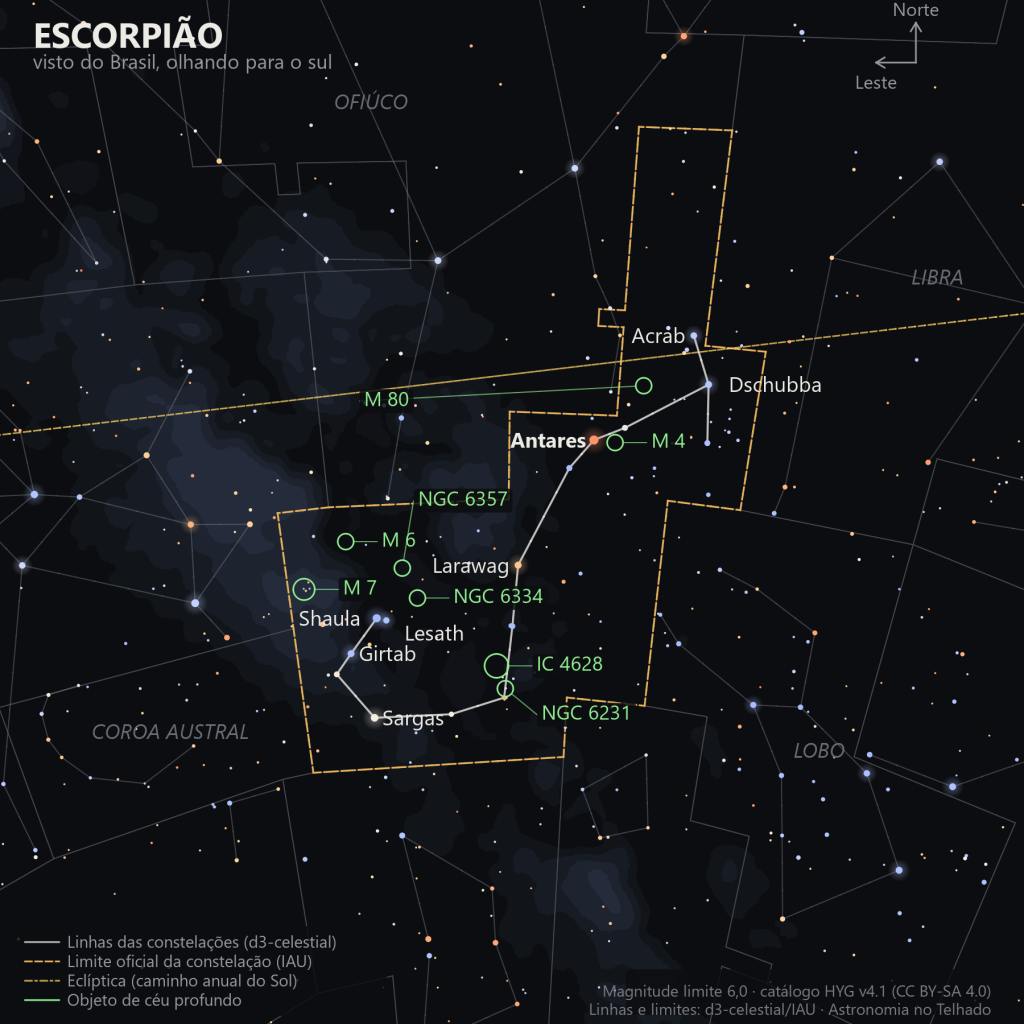
Few constellations make as much sense to anyone looking up as Scorpius: it really does look like a scorpion. It has the red heart of Antares, the elegant curve of the tail and a double stinger pointing toward the horizon. And if you live in southeastern or southern Brazil, it passes almost exactly over your head on winter nights, with the whole Milky Way behind it. In this guide you will learn how to find it, get to know its stars, the clusters around it and the story of the Scorpion that never appears in the sky at the same time as Orion the Hunter.
Texto em revisão. This is a test article, written from reference sources; the sources are listed at the end.
The scorpion Brazil sees overhead
Scorpius (abbreviation Sco) is the eighth constellation of the zodiac, between Libra and Sagittarius, and covers about 497 square degrees of sky (Mourão, entry Scorpius). Moore describes it as one of the few figures in the sky that truly resemble the thing they are named after, the mythological scorpion that killed Orion (Philip's, entry Scorpius). Moore notes that from the United Kingdom it never climbs properly, whereas from southern countries it sits almost at the zenith (Observer's Year, p. 172).
Among the twelve zodiacal constellations, Scorpius is the richest in stars: about 7.6 stars brighter than magnitude 5 per 100 square degrees, against 2 to 3 in its neighbors Virgo and Leo (Moore, Observer's Year, nights of May 2 and 3). Add the Milky Way running through the constellation, and it offers whole nights of observing.
When and how to find it
Best time. Scorpius culminates (reaches its highest point) at around 9 p.m. local time in mid-July, with the tail a little later. In practice, the good season runs from May to August: in May it rises early, in June and July it dominates the early evening, and in August it is already leaning toward the west.
Where to look. In Rio de Janeiro (latitude 23° south), Antares passes about 3.5° from the zenith, on the southern side, and the tail is very high. The chart below shows the sky looking south, with north up and east to the left.
| City | Antares | Shaula (stinger) | Sargas (end of the tail) |
|---|---|---|---|
| Boa Vista (RR) | 61° | 50° | 44° |
| Manaus (AM) | 67° | 56° | 50° |
| Recife (PE) | 72° | 61° | 55° |
| Brasília (DF) | 79° | 69° | 63° |
| Rio de Janeiro (RJ) | 86° | 76° | 70° |
| São Paulo (SP) | 87° | 77° | 71° |
| Porto Alegre (RS) | 86° | 83° | 77° |
Maximum altitude above the horizon, calculated by us from the SIMBAD declinations and each city's latitude; values rounded. Antares passes south of the zenith in the North and Southeast of Brazil, and north of it in Porto Alegre.

Step by step.
- Look for Antares, the bright red-orange star in the middle of the constellation. You cannot mistake it.
- On either side of Antares, at the same distance, there are two smaller stars: Sigma and Tau. Moore draws attention to this trio, a pattern that is repeated only with Altair, in Aquila (Observer's Year, p. 174).
- Toward the east (left on the chart), the curve of the tail descends through the stars Larawag and Girtab to the stinger, which is the pair Shaula and Lesath, and ends at Sargas.
- Toward the west (right), the head and claws: Acrab (or Graffias), Dschubba and the row of stars pointing toward Libra.
The stars of Scorpius
| Star | Position | Visual brightness (mag.) | Spectral type | Approximate distance |
|---|---|---|---|---|
| Antares (alpha) | heart | 0.9 to 1.2 (variable) | M1.5 Iab (red supergiant) + B2 V | about 550 to 600 light-years |
| Shaula (lambda) | stinger | 1.63 | B2 IV (multiple system) | about 570 light-years |
| Sargas (theta) | tip of the tail | 1.85 | F1 III | about 300 light-years |
| Dschubba (delta) | head | 2.3 (varied in 2000) | B0.3 IV | about 490 light-years |
| Larawag (epsilon) | curve of the tail | 2.29 | K1 III (orange giant) | about 64 light-years |
| Girtab (kappa) | tail | 2.39 | B1.5 III | about 480 light-years |
| Acrab (beta 1) | head | 2.62 (double with 4.9) | B1 V | about 400 light-years |
| Lesath (upsilon) | stinger | 2.65 | B2 IV | about 575 light-years |
Brightnesses, spectral types and parallaxes taken from SIMBAD (CDS, Strasbourg). Distances come from satellite parallaxes (Hipparcos and Gaia), calculated as 3,261.56 divided by the parallax in milliarcseconds; older books give very different values.
Antares is the heart of the scorpion and one of the most famous stars in the sky. Its name comes from a Greek expression meaning "like Mars" or "rival of Mars," because of its reddish color (Mourão, entry Antares, p. 42; Philip's, p. 19). It is a red supergiant more than 10,000 times as luminous as the Sun, varying in brightness between magnitude 0.9 and 1.2 (Philip's; Ridpath). Its size depends on who does the math: Mourão and Philip's speak of 300 to 400 times the Sun's diameter, and Vieira and Kambič of 900 to 980 million kilometers in diameter, a value that, in the Solar System, would reach nearly to the asteroid belt (Vieira, p. 87; Kambič, p. 429). Distances vary too: 500 to 600 light-years in books, and about 550 by the current parallax.
Antares has a bluish 5th-magnitude companion about 2.5 to 2.9 arcseconds away, which only telescopes of 75 mm or larger can show, because of the glare of the main star. By contrast with Antares's orange, it looks green (Philip's, p. 19; Kambič, p. 429; Bakich, object no. 431). The orbital period is around 880 to 900 years (Moore, Observer's Year, p. 173).
Shaula and Lesath, at the end of the tail, form the stinger. Shaula is the second-brightest star in the constellation (magnitude 1.63), a spectroscopic binary whose Arabic name means "the scorpion's tail" (Mourão, entry Shaula, p. 733). Lesath is about half a degree from it, and together the two give the scorpion a double "sting," easy to see even under moderate light pollution. The older books we consulted give Shaula as 270 to 275 light-years away and Lesath as more than 1,500; current parallax data place both at about 570 light-years, that is, side by side in space, not just in the sky.
Sargas, at the tip of the tail, is a yellowish-white star and the only one among Scorpius's main stars that is neither blue nor red. Larawag, the curve of the tail, is the closest: about 64 light-years. Dschubba, in the head, holds a surprise: until June 2000 it was steady at magnitude 2.3, and that year it began to vary, reaching close to 1.6, with the brightening attributed to an ejection of gas (Kambič, p. 430; Ridpath, p. 204).
Acrab, or Graffias, is an easy double: one star of 2.6 and another of 4.9, separated by about 13 arcseconds, which a small telescope splits, both bluish-white (Moore, Observer's Year, p. 175; Philip's, p. 358).
An eyesight test. Near the end of the tail, Zeta-1 and Zeta-2 form a pair that can be split with the naked eye, about 6.8 arcminutes apart, and Mu-1 and Mu-2 about 5.8 apart (Kambič, p. 430). Vieira suggests using Mu as a test of visual acuity (p. 87-88). The catch is that Zeta-1 and Zeta-2 are only a line-of-sight alignment: according to SIMBAD, Zeta-2 is about 135 light-years away and Zeta-1 more than 5,000, in the direction of the cluster NGC 6231.
Clusters and nebulae
M 4, the globular next to Antares
The globular cluster M 4 lies about 1.3 degrees west of Antares (to the right on the chart) and fits in the same binocular field. It has magnitude 5.6 to 5.8 and a diameter of more than 25 arcminutes. It was discovered by De Chéseaux in 1746, and Messier was the first to resolve it into stars, in 1764 (Bakich, object no. 424). In a 15 cm telescope it shows dozens of stars and a north-south row in the center (Bakich). The distance ranges from 5,900 light-years, by the current parallax, to 7,200 in books (Ridpath, p. 204; Kambič).
M 80, the globular that looks like a star
M 80 lies halfway between Antares and Acrab, in the same direction toward the north. It is small and dense, of magnitude 7.3, and in binoculars looks like an out-of-focus star (Kambič, p. 431; Bakich).
M 6, the Butterfly Cluster
The open cluster M 6 lies about 5 degrees north-northeast of Shaula. At magnitude 4.2, it is visible to the naked eye under dark skies and, in binoculars, shows 50 to 70 stars. The "butterfly wings" take some imagination (Moore, Observer's Year, p. 176; Kambič, p. 431-432; Bakich, object no. 496). An orange giant, BM Scorpii, stands out in one of the wings (Ridpath, p. 204). It is about 1,500 to 1,600 light-years away, roughly twice the distance of M 7.
M 7, Ptolemy's Cluster
M 7 is larger, brighter and closer: magnitude 3.3, about 80 arcminutes across (almost three times the diameter of the full Moon) and some 800 to 900 light-years away. It is visible to the naked eye as a small cloud in the Milky Way, about 5 degrees east-northeast of Shaula (to the left on the chart) (Kambič, p. 434; Bakich, object no. 505). It already appears in Ptolemy's text, around the year 130, as a "nebula" after the sting of Scorpius, and it is the southernmost object in the whole Messier catalog (Bakich). 10×50 binoculars show about 50 stars; use the lowest magnification, because it is larger than the field of many telescopes (Moore, Observer's Year, p. 176; Bakich).
NGC 6231, the false comet
NGC 6231 is a young cluster of magnitude 2.6 and about 14 arcminutes across, about 0.5 degree north of Zeta-2, near the end of the tail (Moore, Observer's Year, p. 176). It is about 7 million years old and lies 5,500 to 6,000 light-years away (Mobberley, p. 160). Together with the Trumpler 24 group (part of Sco OB1) it forms the "tail" of a naked-eye "false comet": Martin Mobberley himself tells how, in April 1986 in Tenerife, he mistook this cluster for Halley's Comet (Mobberley, p. 160-161). Bakich cites the chemist Ernst Hartung's comparison with diamonds on black velvet (object no. 451).
Cat's Paw, War and Peace and Prawn: the nebulae of the tail
Near the stinger, in the tail that plunges into the Milky Way, there are three large emission nebulae, all of them regions where stars are born. They are hard targets for the naked eye and excellent for photography and for telescopes with a filter.
- NGC 6334, the Cat's Paw Nebula (Cat's Paw). It was discovered by John Herschel on June 7, 1837, from the Cape of Good Hope. It is one of the largest star-forming regions in the Milky Way, made up of five patches; the brightest, in the southeast, is about 60′ across and holds a magnitude 9 star. It lies some 3° west-northwest of Shaula, larger than the full Moon: use a wide field or a nebula filter and observe the five areas separately (Bakich, object no. 474).
- NGC 6357, the War and Peace Nebula (War and Peace, also called the Lobster). Also a Herschel discovery, from 1837. The nickname comes from mid-infrared images from the MSX satellite: the bright part looked like a dove, the symbol of peace, and the filaments to the east like a skull, the symbol of war. It surrounds the cluster Pismis 24, with stars among the most massive known; Hubble found a pair there of about 100 solar masses. It lies some 3.3° north-northwest of Shaula and is larger than the full Moon, but only about a tenth of its extent shows in an amateur telescope: use a filter (Bakich, object no. 483).
- IC 4628, the Prawn Nebula (Prawn Nebula). A large, faint nebula next to the cluster NGC 6231. Coe reports that in a 100 mm refractor it shows only with averted vision and no filter; with a UHC filter it becomes easy to see. The OIII filter increases contrast but dims the stars. The dark cloud Barnard 48, to the south, stands out with the UHC (Coe, p. 119-120).
Mythology and history
Scorpius is one of the few constellations that still keep the animal form that gave them their name. According to Mourão, Greeks, Romans, Arabs and Persians all depicted it as a scorpion, since the remotest Antiquity. The autumnal equinox, around 3000 BC, lay within this constellation (Mourão, entry Scorpius, p. 722-723). In Persia, Antares was one of the four "royal stars," along with Regulus, Aldebaran and Fomalhaut, guardians of the sky that, for the Persians, marked key points of the year (Vieira, p. 24; Mourão, p. 723).
The Scorpion and the Hunter who never meet. In the Greek version that Mourão relates, the scorpion was sent by Artemis (Diana, in the text) to kill Orion, who interfered with the huntress's activities. And the myth has an "echo" in the sky: the stars of Orion set in the west just as Scorpius rises in the east, and the two never appear together (Mourão, p. 723). One constellation always flees from the other.
Scorpius is also linked to Libra. In other times, the stars of Libra were seen as the scorpion's claws; Zubenelgenubi, the name of Alpha Librae, means "the southern claw" (Bakich, object no. 386).
Scorpius and the zodiac
Over the year, the Sun crosses the twelve constellations of the zodiac band, following the ecliptic, the Sun's apparent path against the background of stars, which is the projection of Earth's orbit onto the celestial sphere (Moore, Observer's Year, p. 132-133). On the chart above, it is the dotted line passing across the top: notice that it cuts only the upper part of Scorpius, near Acrab and Dschubba, and passes about 4 to 5 degrees north of Antares. When Mars, the "rival," passes near Antares, there are two reddish points side by side.
A sign is not a constellation. A sign is each of the 12 equal 30-degree sections of the zodiac. Two thousand years ago, each sign coincided with the constellation of the same name; because of the precession of the equinoxes, the scenery has shifted by about 30 degrees. As a result, says Mourão, the constellation of Aries is today in the sign of Taurus, that of Taurus in Gemini, and so on (entry signo, p. 736). Philip's reinforces that the signs, of 30 degrees each, have been misaligned from the constellations by precession and by the redefinition of the boundaries (entry zodiac, p. 445). For astronomy, the patterns of the constellations are arbitrary and have no astrological meaning (Moore, Observer's Year, p. 133).
When the Sun is in Scorpius. By the official IAU boundaries, the Sun crosses Scorpius from about November 24 to 30, just about a week (approximate dates), and soon afterward it enters Ophiuchus, where it stays from about December 1 to 18, a constellation that is not part of the 12 traditional signs. Horoscopes give the "sign of Scorpio" the period from late October to mid-November, weeks before the Sun reaches the constellation; the difference comes from precession.
When the Sun is in Scorpius, the constellation is in the daytime sky and cannot be seen at night. That is why the good season is winter, with the Sun on the opposite side of the sky.
Observing plan
| Instrument | What to see |
|---|---|
| Naked eye | The shape of the whole scorpion, the color of Antares, the curve of the tail, the cloud of M 7 next to the stinger and the Zeta pair under dark skies. If the sky is very good, M 6 and NGC 6231 show up as patches. |
| Binoculars (10×50) | M 4 next to Antares, M 80 as a diffuse star, M 6 and M 7 resolved into dozens of stars, NGC 6231 and the star field of the Milky Way. |
| Small telescope (70 to 100 mm) | The blue-green companion of Antares (with patience and good conditions), the Acrab double, M 4 beginning to resolve into stars, NGC 6231 with more than 100 stars and the densest core of M 80. |
| DSLR or phone camera on a tripod | The whole constellation over the Milky Way with a wide-angle lens; the field of Antares and M 4 with the colors of the region. M 6 and M 7 with a 100 to 200 mm telephoto lens. |
Field tips:
- Choose a moonless night between May and August, under dark skies.
- Start at Antares and move west to M 4; then use the binoculars to sweep along the tail to M 6 and M 7.
- Past the stinger, follow the Milky Way to the east: it leads to Sagittarius, toward the center of the Galaxy, one of the richest stretches of the winter sky (Ridpath, p. 204).
References
- BAKICH, Michael E. 1,001 Celestial Wonders to See Before You Die. New York: Springer, 2010. Object no. 386 (Beta Librae), no. 424 (M 4), no. 474 (NGC 6334), no. 483 (NGC 6357), no. 431 (Antares), no. 451 (NGC 6231), no. 496 (M 6) and no. 505 (M 7).
- COE, Steven R. Nebulae and How to Observe Them. London: Springer, 2007. IC 4628, p. 119-120.
- KAMBIČ, Bojan. Viewing the Constellations with Binoculars. New York: Springer, 2010. Scorpius, p. 428-436.
- MOBBERLEY, Martin. The Caldwell Objects and How to Observe Them. New York: Springer, 2009. Caldwell 76 (NGC 6231), p. 160-161.
- MOORE, Patrick (ed.). Philip's Astronomy Encyclopedia. London: Philip's, 2002. Entries "Antares" (p. 19), "Scorpius" (p. 358) and "zodiac" (p. 445).
- MOORE, Patrick. The Observer's Year: 366 Nights of the Universe. 2nd ed. London: Springer, 2005. Nights of May 2 and 3 (zodiac, p. 132-133), June 18 to 22 (Scorpius, Antares, neighbors and head, p. 172-175) and June 24 (M 6 and M 7, p. 176).
- MOURÃO, Ronaldo Rogério de Freitas. Dicionário enciclopédico de astronomia e astronáutica. Rio de Janeiro: Nova Fronteira, 1987. Entries "Antares" (p. 42), "Scorpius" (p. 722-723), "Shaula" (p. 733) and "signo" (p. 736).
- RIDPATH, Ian. Astronomia (Guia Ilustrado Zahar). 4th ed. Rio de Janeiro: Zahar. Scorpius, p. 204.
- VIEIRA, Fernando. Identificação do céu. The four royal stars, p. 24; Scorpius, Libra and visual acuity tests, p. 87-88.
- SIMBAD Astronomical Database. Centre de Données astronomiques de Strasbourg (CDS). Query for brightnesses, spectral types, parallaxes and dimensions, on Sept. 21, 2026.
- HYG Database (v4.1), David Nash / Astronexus, CC BY-SA 4.0 license, used for the star chart; IAU constellation boundaries and d3-celestial lines.