September 24, 2026
Ophiuchus: The 13th Sign That Isn’t a Sign, the Fastest Star and Kepler’s Supernova
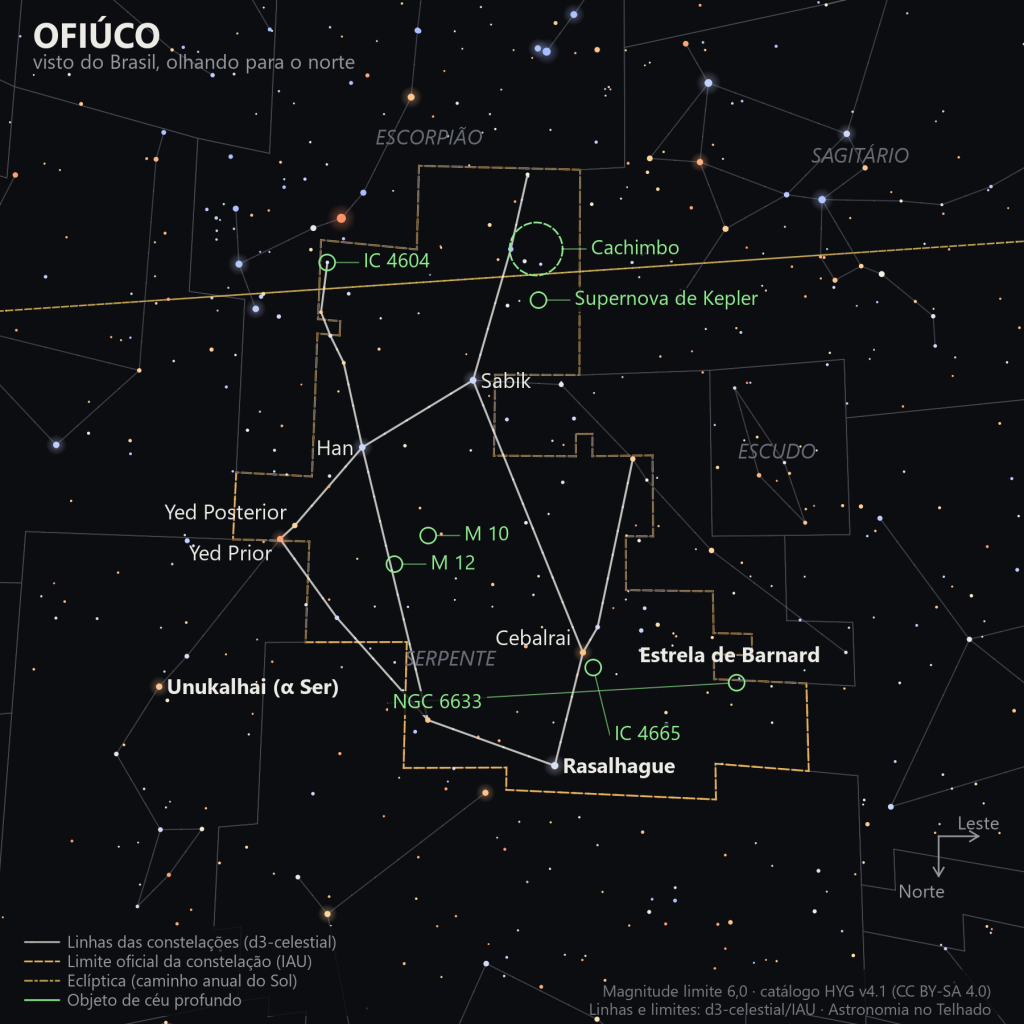
Every time someone asks, "What's my real sign?", Ophiuchus enters the conversation. It is the constellation that the ecliptic, the line of the Sun's yearly path, crosses even though traditional horoscopes leave it out of the twelve signs. But reducing it to that controversy would be selling it short: it holds the star with the largest proper motion we know of, it was the stage for the last supernova seen with the naked eye in our Galaxy, and in Brazil's winter it passes almost directly overhead. In this guide you will learn how to find it, understand what makes it a "13th sign" (no predictions, just astronomy and history) and discover what to point at it with binoculars and a telescope.
Text under review. This is a test article, written from reference sources; the sources are listed at the end.
A huge, ill-defined constellation
Ophiuchus (Greek for "serpent bearer", also known as the Serpent Bearer) covers about 950 square degrees (Mourão gives 948) and spans both sides of the celestial equator, between Scorpius and Sagittarius (Mourão, entry Ophiuchus; Moore, The Observer's Year). Philip's Encyclopedia describes it as "large but ill-defined", and that is true: there is no obvious pattern. A good image is a big "house" lying on its side, with Rasalhague as the only truly bright star (Philip's, entry Ophiuchus; Moore). It is one of Ptolemy's 48 constellations and, ranging from +14° to -30° in declination, it is visible from 59° north latitude to 75° south latitude (Ridpath). For us, it is a high and comfortable constellation.
How to find Ophiuchus
The best season in Brazil is winter: Ophiuchus crosses the meridian (its highest point) at 9 p.m. around the end of July and beginning of August, and it is well placed from May to September. Since its central declination is about -6° and Rio de Janeiro is at -23°, it culminates north of the zenith: to see it, you look north, very high up. That is why the chart below was made facing north, with north at the bottom and east on the right.

A step-by-step way to find the figure:
- Start with Antares, the red star of Scorpius, easy to recognize. Ophiuchus lies on its north side (on the chart, below Antares), and the Rho Ophiuchi cloud sits very close to the star.
- Look for Rasalhague, the brightest star in the constellation. It sits at the northern tip of the figure, near Rasalgethi, in the constellation Hercules (Moore). In Rio, it culminates about 55° above the horizon.
- Draw the "house": from Rasalhague, the line runs to Cebalrai (Beta), climbs through Sabik (Eta) and Han (Zeta) and reaches the pair of Yed stars, Delta and Epsilon, which mark the western side of the figure.
- Find the Serpent: the two halves of Serpens, the Head and the Tail, lie one on each side of Ophiuchus. On the chart, the Head is the region with Unukalhai, on the left.
When it is high in the sky
Because Ophiuchus stretches from north to south, its height changes depending on the spot and the city. We calculated the maximum altitude (at meridian passage) of Rasalhague, at the northern tip, and of Theta Ophiuchi, at the southern tip:
| City | Rasalhague | Theta Ophiuchi |
|---|---|---|
| Boa Vista (RR) | 80° | 62° |
| Manaus (AM) | 74° | 68° |
| Recife (PE) | 69° | 73° |
| Brasília (DF) | 62° | 81° |
| Rio de Janeiro (RJ) | 55° | 88° |
| Porto Alegre (RS) | 47° | 85° |
| Chuí (RS) | 44° | 81° |
Maximum altitudes calculated from each star's declination (SIMBAD) and each city's latitude, rounded.
Note that in Rio de Janeiro, Theta Ophiuchi passes just 2° from the zenith, the point exactly overhead. The farther south you are, the more you have to look north to see the constellation; in the north of the country it passes almost directly overhead.
The stars of Ophiuchus
| Star | Visual brightness (mag.) | Spectral type | Approximate distance |
|---|---|---|---|
| Rasalhague (alpha) | 2.07 | A5 IV | about 49 light-years |
| Sabik (eta) | 2.42 | A2 IV-V | about 88 light-years |
| Han (zeta) | 2.56 | O9.2 IV | about 440 light-years |
| Yed Prior (delta) | 2.75 | M0.5 III (red giant) | about 160 light-years |
| Cebalrai (beta) | 2.75 | K2 III | about 83 light-years |
| Yed Posterior (epsilon) | 3.23 | G9.5 IIIb | about 107 light-years |
| Theta | 3.26 | OB (Beta Cephei-type variable) | about 436 light-years |
| 70 Ophiuchi | 4.03 (combined) | K0 V | about 17 light-years |
| Barnard's Star | 9.51 | M4 V (red dwarf) | about 6 light-years |
Brightnesses, spectral types and parallaxes consulted in SIMBAD (CDS, Strasbourg). Distance is 3,261.56 divided by the parallax in milliarcseconds. Older books give different values (for example, 47 to 62 light-years for Rasalhague and 105 to 140 for Yed Prior).
Rasalhague comes from the Arabic ra's al-hawwa', "the head of the serpent charmer" (Philip's, entry Rasalhague). It is a white star, much hotter than the Sun, about 49 light-years from us. Vieira notes that it is a double star, with an invisible companion (p. 90).
Yed Prior and Yed Posterior, Delta and Epsilon, form a pair with contrasting colors: Delta is orange-red and Epsilon is yellowish. The name, of Arabic origin, means "the hands of the Serpent Bearer" (Mourão, entry Yed Prior). Moore suggests viewing the pair with binoculars because of the color contrast.
Sabik, Han and Theta complete the figure. Han, a very hot blue star, is the most luminous of the group, even though it is much farther away. Theta is a hot, distant star lying just south of the ecliptic, a detail that will matter in the section on the zodiac.
70 Ophiuchi is an easily split double star: the components have magnitudes 4.2 and 6.0, with yellow and orange colors, and they orbit each other in 88 years. The two are just 16.5 light-years from Earth, which makes them one of the Sun's neighbors (Philip's; Moore). Near it used to lie Poniatowski's Bull, a constellation created in 1777 by Abbot Poczobut in honor of the king of Poland and now defunct (Moore, night of July 9, p. 191-192).
The star that moves the most: Barnard's Star
Here is Ophiuchus's hook for record lovers. Barnard's Star is a red dwarf of magnitude 9.5, too faint for the naked eye, about 6 light-years from us. Only the Alpha Centauri system is closer (Moore, night of July 11, p. 193-194; Philip's, entry Barnard's Star, p. 48).
What makes it special is its proper motion: the apparent shift of the star against the background sky. Most stars move less than 0.1 arcsecond per year, and only about 300 exceed 1 (Philip's, entry proper motion, p. 321). Barnard's Star moves about 10.3 arcseconds per year, the largest known value; in less than two centuries it covers on the sky a distance equal to the apparent diameter of the full Moon (Moore; Philip's). The books by Moore and Vieira give about 180 years.
It was identified in 1916 by the American astronomer Edward Emerson Barnard, who noticed it while compiling a star catalog and realized its motion was out of the ordinary (Mourão, entry Velox Barnardi, p. 834; Philip's). This motion is not the same thing as "speed": Barnard's Star is very fast across the sky mainly because it is close to us. Vieira cites 259 km/s, a value that does not match current measurements: Philip's calculates a transverse velocity of about 89 km/s (entry proper motion, p. 321).
A famous story goes with the star. In the 1960s and 1970s, the astronomer Peter van de Kamp announced a small wobble in the star's motion, which he attributed to planets the size of Jupiter and Saturn. The measurement was not confirmed and the "wobble" seems to have come from instrumental error (Philip's, entry Barnard's Star, p. 48). Today, recent studies propose very small planets around Barnard's Star, but the Van de Kamp case became a classic warning about the limits of astrometry.
How to find it: it lies between Cebalrai and 70 Ophiuchi, about 3° east of Cebalrai, in a region with nothing special. You need a telescope and a detailed chart; Moore warns that it is not easy to identify (Moore, p. 194).
Kepler's supernova, 1604
Ophiuchus also holds one of the great stories of astronomy. On October 9, 1604, a "new star" appeared near the foot of the Serpent Bearer and, within a few days, became brighter than any star in the sky. At that moment, Jupiter and Mars were in conjunction a few degrees from it, which helped to locate it (Mourão, entry Estrela de Kepler, p. 285). It was first seen by Italian astronomers, and Johannes Kepler observed it on October 17, after several days of cloudy skies. At maximum, around magnitude -2.25, it outshone Jupiter for several weeks and remained visible to the naked eye for about 18 months, until March 1606 (Mourão).
Kepler wrote a book about it, De Stella Nova in Pede Serpentarii ("On the New Star in the Foot of the Serpent Bearer"), published in Prague in 1606, and that is why the object bears his name (Mourão). It was a supernova, the explosive end of a star, 32 years after Tycho Brahe's star of 1572 (Philip's, entry Kepler's Star, p. 217). Since 1604, no other supernova in our Galaxy has been seen with certainty (Philip's; Mourão). Mourão estimates the distance at about 20,000 light-years, but acknowledges that it is not well determined. Today what remains is a very faint remnant, which from Rio de Janeiro passes at about 88° altitude, almost at the zenith: a target for large telescopes and photography, not for binoculars.
The globular clusters: M 10 and M 12
Ophiuchus is rich in globular clusters: there are seven in Messier's catalog (M 9, 10, 12, 14, 19, 62 and 107), all within reach of a small telescope (Moore, p. 194). The best are two that appear in the same binocular field.
- M 10 — globular cluster (NGC 6254): magnitude 6.6, about 20' across and roughly 14,000 to 16,500 light-years away (sources disagree). It is detectable with binoculars; in an 8-inch telescope at 48x it is easy to find and quite bright (Allison, p. 157; Kambič).
- M 12 — globular cluster (NGC 6218): magnitude 6.7, about 16' across and some 16,000 light-years away. It lies about 3° from M 10, to the northwest (from SIMBAD coordinates), and, according to Allison, it is much brighter than M 10 in the telescope (Allison, p. 157; Ridpath, p. 181).
They are so close that they fit in the same binocular field. Kambič imagines that, from a planet in one of the two, the other would be an object about 2° across and magnitude 2.
Open clusters and nebulae
- IC 4665 — open cluster: magnitude 4.2, about 1° across and some 1,400 light-years away. A binocular target: on an excellent night, about 75 stars stand out (Kambič, p. 359-361).
- NGC 6633 — open cluster: magnitude 4.6, about half a degree across and some 1,040 light-years away; in binoculars, 60 to 110 stars show up (Kambič). It and IC 4665 are the two great open clusters of Ophiuchus for binoculars (Philip's, entry Ophiuchus).
- Pipe — dark nebula (Barnard 59 and neighbors): a dark cloud visible to the naked eye under a dark sky, looking like a "pipe silhouette" north of the great star cloud of Sagittarius. For observers in the Northern Hemisphere, the bowl is on the left and the stem on the right, toward Scorpius; it calls for a wide field (Coe, p. 112-113). The guide star is Theta Ophiuchi, and the dark area, practically starless, lies east and south of it (Kambič, p. 361-362). In Brazil, it sits high in the sky.
- Rho Ophiuchi Cloud (IC 4604): a complex nebulosity, full of color in long-exposure photographs, that extends toward Antares (Ridpath, p. 181).
Mythology: Asclepius, the physician with the serpent
Ophiuchus is identified with Asclepius, called Aesculapius by the Romans. In Greek mythology, he was the son of Apollo and became so skilled in medicine that he could even raise the dead. To keep the world of the dead from emptying, Zeus (Jupiter, for the Romans) struck him down with a thunderbolt, at the request of Hades, but, in compensation, raised him to the heavens (Moore, night of July 8, p. 191; Ridpath, p. 181). Serpents symbolized rebirth, because they shed their skin (Ridpath). Mourão records the serpent as a symbol of prudence and wisdom, and of the power to discover medicinal herbs (Ridpath; Mourão, entry Ophiuchus, p. 589). That is why the serpent coiled around a staff became the emblem of medicine, a use we know well today.
The serpent, in the sky, is the constellation Serpens, the only one divided into two parts: the Head (Caput) on one side and the Tail (Cauda) on the other, with Ophiuchus between them (Ridpath, p. 180; Moore, night of July 12, p. 194). Moore comments that the figure suggests a fight in which the serpent loses, split in half. The brightest star of Serpens, Unukalhai, is in the Head (Moore).
The zodiac: the Sun, the ecliptic and the "13th sign"
Now we come to the part that motivated the title. Let's go step by step.
What the zodiac is. It is the band of sky, about 8° on each side of the ecliptic, through which the Sun, the Moon and the planets (except Pluto) appear to travel. The name comes from the Greek and means "circle of animals", because almost all the constellations there have animal names (Mourão, entry zodíaco, p. 885; Philip's, entry zodiac, p. 445). The ecliptic is the line the Sun follows over the year, and it is drawn on the chart above.
What a sign is. In astrology, the zodiac is divided into 12 equal parts of 30° each, the signs. Because of precession (the slow wobble of Earth's axis) and the redefinition of constellation boundaries, these 12 parts no longer coincide with the constellations of the same name (Philip's, entry zodiac). A sign and a constellation are different things: one is a calendar convention, inherited from ancient traditions; the other is a region of the sky with official boundaries.
Where Ophiuchus comes in. The ecliptic does pass through Ophiuchus, a little north of Theta, between Scorpius and Sagittarius (Moore, night of July 10, p. 193). That is why Mourão lists thirteen constellations crossed by the ecliptic and calls Ophiuchus the "thirteenth zodiacal constellation" (Mourão, entries Ophiuchus, p. 589, and zodíaco, p. 885). By the official boundaries of the International Astronomical Union (IAU), the Sun is inside Ophiuchus from about December 1 to 18 (approximate dates, with small differences among sources: Mourão gives November 28 to December 17 and Ridpath speaks of the first half of December).
Does this change your sign? No. Nobody "discovered" a new sign: it has always been known that the ecliptic passes through there. The subject made the news in January 1995, after a misleading British TV program that said "astronomers had found a new sign" (Moore, night of July 10, p. 193). Astrological signs are a division of the circle into equal parts, and they do not depend on which constellations lie behind the Sun. For astronomy, what matters is what can be observed: Ophiuchus is a constellation like the others, and the Sun passes through it in December. The rest is culture and history, which are also worth knowing, without our having to draw predictions about anyone's life from it.
Observing plan
| Instrument | What to see |
|---|---|
| Naked eye | The Ophiuchus "house", with Rasalhague and the Yed pair; the Pipe as a dark smudge in a very dark sky, north of Sagittarius. |
| Binoculars (10×50) | The clusters M 10 and M 12 in the same field, IC 4665 and NGC 6633, the companions of Rho, the color contrast of Yed Prior and Yed Posterior, the Pipe in a wide field. |
| Small telescope (70 to 100 mm) | Resolving the edges of M 10 and M 12, the double 70 Ophiuchi (mags. 4.2 and 6.0), the double 36 Ophiuchi, Barnard's Star with a detailed chart. |
| DSLR camera | The Rho Ophiuchi cloud and Antares in a single shot with a lens of about 100 mm; the Pipe with a wide-angle lens; the field of Kepler's supernova with a larger telescope. |
Field tips:
- Choose a winter night without the Moon, and look north, very high up.
- For the Pipe and the Rho cloud, a dark sky is essential; in the city they disappear.
References
- ALLISON, Michael. Star Clusters and How to Observe Them. London: Springer, 2006. M 10 and M 12, p. 157.
- COE, Steven R. Nebulae and How to Observe Them. London: Springer, 2007. Pipe Nebula (B 59), p. 112-113.
- KAMBIČ, Bojan. Viewing the Constellations with Binoculars. New York: Springer, 2010. Ophiuchus: M 10 and M 12, p. 353-358; IC 4665 and NGC 6633, p. 359-361; Pipe Nebula, p. 361-362.
- MOORE, Patrick (ed.). Philip's Astronomy Encyclopedia. London: Philip's, 2002. Entries "Barnard's Star" (p. 48), "Kepler's Star" (p. 217), "Ophiuchus" (p. 293), "proper motion" (p. 321), "Rasalhague" (p. 334) and "zodiac" (p. 445).
- MOORE, Patrick. The Observer's Year: 366 Nights of the Universe. 2nd ed. London: Springer, 2005. Nights of July 8 (Ophiuchus, p. 191), July 9 (Poniatowski's Bull, p. 191-192), July 10 (Ophiuchus in the zodiac, p. 193), July 11 (Barnard's Star, p. 193-194) and July 12 (Serpens, p. 194).
- MOURÃO, Ronaldo Rogério de Freitas. Dicionário enciclopédico de astronomia e astronáutica. Rio de Janeiro: Nova Fronteira, 1987. Entries "Estrela de Kepler" (p. 285), "Ophiuchus" (p. 589), "Velox Barnardi" (p. 834), "Yed Prior" (p. 879) and "zodíaco" (p. 885).
- RIDPATH, Ian. Astronomia (Guia Ilustrado Zahar). 4th ed. Rio de Janeiro: Zahar. Serpens and Ophiuchus, p. 180-181.
- VIEIRA, Fernando. Identificação do céu. Ophiuchus, Serpens and Barnard's Star, p. 90.
- SIMBAD Astronomical Database. Centre de Données astronomiques de Strasbourg (CDS). Queried for brightnesses, spectral types and parallaxes, on Sept. 21, 2026.
- HYG Database (v4.1), David Nash / Astronexus, CC BY-SA 4.0 license, used for the star chart; IAU constellation boundaries and d3-celestial lines.