September 24, 2026
Cancer: a guide to the faintest constellation of the zodiac and the Beehive that saves it
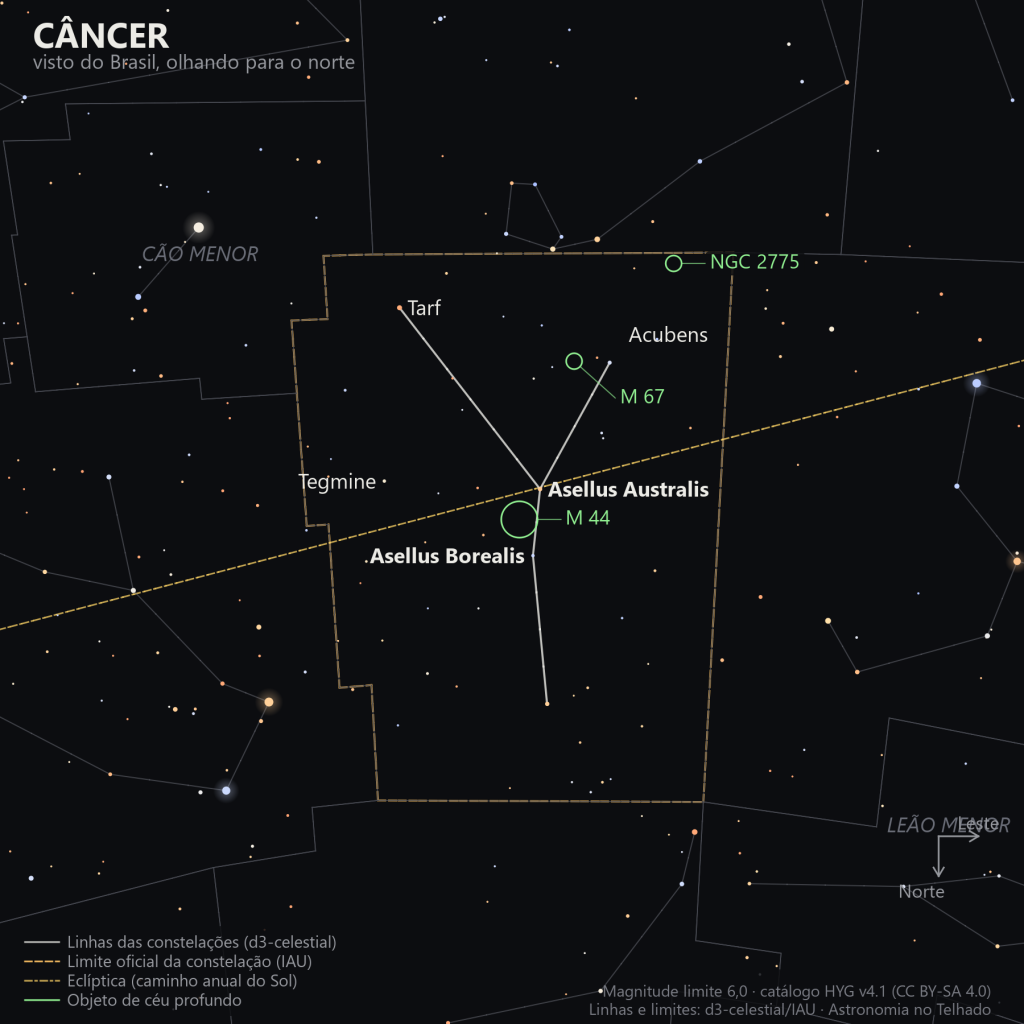
Cancer is the constellation almost nobody can point to in the sky, even among people who know their own sign. It is the Crab of the zodiac: a figure so faint that it is little more than a pretext for a smudge of light in its middle. That smudge is the Beehive (M 44), one of the most beautiful star clusters in the sky, known since antiquity and visible to the naked eye. And it was by looking at it that Galileo discovered that this "cloud" was, in fact, a crowd of stars. In this guide you will learn to find Cancer between Gemini and Leo, get to know the stars of the figure, the Beehive and its far older neighbor, M 67, and understand what the zodiac has (and has not) to do with astronomy.
Under review. This is a test article, written from reference sources; the sources are listed at the end.
The faintest of the zodiac
Cancer (Cancer, abbreviation Cnc) lies between Gemini and Leo and is the faintest of the twelve zodiacal constellations (Ridpath, p. 175; Philip's Astronomy Encyclopedia, entry Cancer). It covers about 506 square degrees, between 6.8° and 33.3° of northern declination (Mourão, entry Cancer, p. 143). The brightest star, Beta Cancri (Tarf, or Altarf), has a magnitude of only 3.5 (Moore, The Observer's Year, p. 72), and the others are fainter still.
What saves the constellation is the Beehive: on clear, moonless nights far from city lights, it appears as a pale mist among the stars (Mourão, p. 143). Moore says the constellation is "redeemed" by the Beehive and by M 67 (The Observer's Year, p. 72). From Brazil, the constellation can be seen from one end of the country to the other, because it lies in the equatorial sky: according to Ridpath, it is visible from 90° north latitude to 57° south (p. 175).
How to find Cancer
The secret is not to look for the figure, but for its neighbors. Cancer is squeezed between two easy constellations: Gemini, with the stars Castor and Pollux, and Leo, with Regulus. Then look for the triangle formed by Procyon (Canis Minor), Pollux and Regulus. The Beehive sits almost in the middle of this triangle, and it is recognizable because it is flanked by two stars, Delta and Gamma Cancri (Moore, The Observer's Year, night of March 5, p. 75). Cancer culminates north of the zenith: you observe it facing north, and the chart below is oriented that way (north down, east to the right).

Step by step:
- Wait until the constellation is high (late March, early in the evening) and look north.
- Find Pollux and Castor (Gemini), then Regulus (Leo) and Procyon (Canis Minor).
- In the middle of the triangle these stars form, look for a small "Y" of faint stars. The crossing of the Y is close to Asellus Australis (Delta), and the Beehive appears right beside it, between Delta and Gamma.
- If you cannot see the smudge, use binoculars. If it has vanished altogether, it may be haze or a city sky: Cancer is the first to disappear.
When to observe. The center of the constellation is at about 8h40 of right ascension, which makes it culminate at 9 p.m. local time around the end of March. From February to April it is high at dusk; in May it is already sinking toward the west; and from late July to mid-August it is in the daytime sky, together with the Sun.
The farther north you are, the higher it climbs: the maximum altitude of the Beehive in the sky is 90° minus the difference between your latitude and the declination (about +19.7°). We calculated it for a few cities:
| City | Maximum altitude of the Beehive |
|---|---|
| Boa Vista (RR) | about 73° |
| Manaus (AM) | about 67° |
| Recife (PE) | about 62° |
| Brasília (DF) | about 55° |
| Rio de Janeiro (RJ) | about 47° |
| Porto Alegre (RS) | about 40° |
| Chuí (RS) | about 37° |
Altitudes calculated from the declination of the Beehive (SIMBAD) and the latitude of each city; values rounded.
The stars of Cancer
| Star | Position | Visual brightness (mag.) | Spectral type | Approximate distance |
|---|---|---|---|---|
| Tarf or Altarf (beta) | southern tip, brightest | 3.52 | K4 III (orange giant) | about 320 light-years |
| Asellus Australis (delta) | crossing of the Y, south of the Beehive | 3.94 | K0 III (orange giant) | about 137 light-years |
| Iota (iota) | northern tip | 4.02 | G8 III (yellow giant) | about 350 light-years |
| Acubens (alpha) | eastern tip | 4.25 | A7 (peculiar star, with a companion) | about 180 light-years |
| Asellus Borealis (gamma) | north of the Beehive | 4.65 | A1 V | about 175 light-years |
| Tegmine (zeta) | western tip | 4.67 (multiple system) | F8 V + G0 V | about 80 light-years |
Brightnesses, spectral types and parallaxes taken from SIMBAD (CDS, Strasbourg). The distances come from parallaxes of the Hipparcos satellite; older books give other values (for example, 290 light-years for Tarf and 158 for Asellus Borealis in Philip's, or 218 for Asellus Australis in Mourão).
The Aselli (the "donkeys"). Asellus means "little donkey" in Latin: Asellus Borealis (Gamma) is the northern donkey and Asellus Australis (Delta) is the southern one (Mourão, entries Asellus, p. 62; Philip's, entry Aselli, p. 30). The Beehive (in Latin, Praesepe) is the manger, and the two donkeys feed from it, one on each side. You can see them with the naked eye under a good sky: they are the two 4th-magnitude stars flanking the smudge (Vieira, p. 75; Moore, p. 75). Delta is orange and Gamma is white; the contrast is subtle.
Acubens comes from Arabic and means "the claws of the crab" (Mourão, entry Acubens, p. 7). It is a wide double star, about 11 arcseconds apart, but hard to observe because of the difference in brightness between the components: one of magnitude 4.3 and the other of 11 (Mourão). It lies near M 67 and serves as a starting point for finding it.
Iota Cancri is an easy double: a yellow giant of magnitude 4 and a blue-white companion of magnitude 6.6 to 7, which 10×50 binoculars can already separate (Ridpath, p. 175; Philip's, p. 69). Zeta Cancri is a multiple system, with a pair of magnitudes 5.0 and 6.2 and an orbital period of more than a thousand years (Philip's, entry Cancer, p. 69; Ridpath, p. 175): worth a look in a small telescope.
The Beehive (M 44), the loveliest cluster most people have never seen
M 44 — the Beehive (in Portuguese, Presépio, the "manger"), also cataloged as NGC 2632, is an open cluster of magnitude 3.1 and one of the jewels of the autumn sky in the Southern Hemisphere. Under a dark sky it is easy to see with the naked eye, as a mist; under a city sky it is difficult without binoculars (Ridpath, p. 175). It spans more than a degree of sky (sources give from 1.2° to 1.5°, that is, between two and three full Moons), so it works best in binoculars or a wide-field telescope. A high-magnification telescope spoils the effect (Kambič, p. 214; Allison, p. 147). Complete guide: M 44 — Presépio.
SIMBAD and the books disagree on the distance: the numbers range from 525 to 607 light-years, with intermediate values (577 in Kambič). It is one of the nearest open clusters, and in excellent conditions you can count about 120 stars with binoculars (Kambič, p. 214). It has more than a thousand stars in all, about 68% of them red dwarfs, and some white dwarfs (Moore and Rees, p. 346). Its age, according to Philip's, is about 700 million years (p. 318); the Data Book says it is similar to that of the Hyades (p. 346). If the Sun were at the distance of the Beehive, it would shine at magnitude 11 (Kambič, p. 214).
Galileo and the star that was a cluster
Here is the hook of the constellation: until 1610, the Beehive was treated as a single star, "Epsilon Cancri." Galileo pointed his telescope at it and resolved it into more than 30 stars (Mourão, entry Praesepe, p. 643). Kambič tells that the astronomer was astonished to see the "little cloud" break up into individual stars, and that Hipparchus (2nd century BC) already called it a "little cloud" and Bayer, around 1600, recorded it as Nubilum (p. 214).
The Beehive as a weather forecast
Since the smudge can only be seen under a clear sky, it served as a weather forecast. According to Moore, around 280 BC the Greeks Aratus and Theophrastus wrote that if the Beehive looked faint or invisible in an apparently clear sky, rain was on its way (The Observer's Year, night of March 5, p. 75). Pliny, in the 1st century, describes Mediterranean sailors doing the same: high clouds arrive before bad weather and blot out the cluster (Philip's, entry Praesepe, p. 318).
M 67, the cluster that does not grow old
M 67 — open cluster, NGC 2682, lies in the southern part of the constellation, about 1.8° west of Acubens, and fits in the same binocular field as the star (Kambič, p. 215; complete guide: M 67). It has magnitude 6.9 and, in binoculars, is a faint smudge about 15 arcminutes across; a 20 cm telescope already reveals nearly 300 stars (Kambič, p. 215). Allison describes it, in an 8-inch telescope, as a ragged "2," with about 45 resolved stars (p. 148).
The appeal is in its age. It is at least 4 billion years old and is one of the oldest open clusters known: clusters such as the Pleiades are incomparably younger (Moore, The Observer's Year, night of March 28, p. 94; Moore and Rees, p. 346). The explanation is its location: most open clusters break up within a few hundred million years because of encounters with other stars, but M 67 lies about 1,500 light-years above the plane of the Galaxy, where few stars pass by to disturb it (Kambič, p. 215). It is between 2,700 and 2,900 light-years from us (sources vary) and was discovered by Köhler between 1772 and 1779 (Moore and Rees, p. 346). In one and the same constellation, then, you have a young cluster and an old one, side by side.
NGC 2775 (Caldwell 48), a discreet galaxy
NGC 2775 — Caldwell 48, in southern Cancer, is a spiral galaxy of magnitude near 10 with arms so tight they look like rings, about 55 million light-years away. Visually you only see the nucleus and a faint halo (15 cm telescope or larger); in photos the arms appear (Mobberley, p. 108-109). It is a target for astrophotography, and the site's guide has more information: NGC 2775. M 67 lies about 5° from it (Mobberley, p. 108).
The crab of myth and history
In Greek mythology, the crab appears in Hercules' fight with the Hydra: while the hero faced the monster, the crab (sent by Hera, or Juno, according to Mourão and Vieira) bit his feet and ended up crushed, and Hera placed it in the sky as a tribute (Mourão, entry Cancer, p. 143; Vieira, p. 23-24; Philip's, p. 69).
But the origin of the figure predates the Greeks and, according to Mourão, is uncertain: some authors link it to the Sun's motion at the summer solstice of the Northern Hemisphere, which would recall the crab's sideways walk, and the Chaldeans already knew it (p. 143). Vieira adds that the name would come from the fact that the Sun reaches its maximum distance from the equator and then "walks backward," like a crab (p. 23-24 and 75). Mourão records that the Egyptians represented it in the Dendera zodiac as a round crab (p. 143).
The zodiac: the Sun, the ecliptic and the misunderstanding of the signs
The dashed golden line on the chart is the ecliptic, the Sun's apparent path through the year against the background of the stars. Because the planets and the Moon always travel near this line, the constellations it crosses make up the zodiac. Cancer is one of them, and on the chart the ecliptic passes very close to the Beehive: planets and the Moon visit the cluster from time to time (Moore, The Observer's Year, p. 72).
Within the official boundaries of the constellation, defined by the International Astronomical Union (IAU), the Sun is roughly between July 22 and August 11. These dates are approximate and vary by a day depending on the year. At that time the constellation is in the daytime sky, and so it cannot be seen at night.
A sign is not a constellation. Mourão gives the definition: a sign is each of the 12 equal 30° sections of the zodiac, which in antiquity coincided with the constellations of the same name. In the roughly two thousand years since then, the precession of the equinoxes has shifted the reference points, and the signs have fallen out of step: for example, the constellation of Aries is today in the sign of Taurus (Dicionário, entry signo, p. 736). The same dictionary lists the fourth sign of the zodiac, Cancer, for "those born between June 21 and July 22" (p. 143). By today's official boundaries, however, during almost the whole period of that sign the Sun is still in the constellation of Gemini, and only enters Cancer around July 22. A sign is a system for dividing the year, inherited from tradition; a constellation is a region of the sky. Here we treat the zodiac as culture and as the history of how humans have looked at the sky, without any predictions.
The name "Tropic of Cancer" is a legacy of that era: the Sun was in Cancer at the June solstice, and today, because of precession, that point is already in Gemini (general knowledge, to be checked).
Observing plan
| Instrument | What to see |
|---|---|
| Naked eye | The Beehive as a mist, under a dark sky; Asellus Borealis and Australis on either side; the Y of faint stars; the orange color of Tarf and Asellus Australis. |
| Binoculars (10×50) | The Beehive resolved into dozens of stars (about 120 in good conditions); the companion of Iota Cancri; M 67 in the same field as Acubens. |
| Small telescope (70 to 100 mm) | Zeta Cancri as a double, M 67 with dozens of stars, the pairs in the Beehive (lower the magnification to see the whole cluster). |
| Medium telescope (15 cm or larger) | M 67 almost "grainy" (up to about 300 stars with 20 cm) and the galaxy NGC 2775, only nucleus and halo. |
| DSLR camera | The Beehive with a 100 to 200 mm lens; M 44 and M 67 together with a telephoto lens; the galaxy with a telescope. |
Field tips:
- Choose a moonless night far from the city: Cancer is one of the first to vanish in urban glow.
- Start with the triangle of Procyon, Pollux and Regulus; then look for the "Y" in the middle of it.
References
- ALLISON, Michael. Star Clusters and How to Observe Them. London: Springer, 2006. M 44 and M 67, p. 147-148.
- KAMBIČ, Bojan. Viewing the Constellations with Binoculars. New York: Springer, 2010. M 44 and M 67, p. 214-215.
- MOBBERLEY, Martin. The Caldwell Objects and How to Observe Them. New York: Springer, 2009. Caldwell 48 (NGC 2775), p. 108-109.
- MOORE, Patrick (ed.). Philip's Astronomy Encyclopedia. London: Philip's, 2002. Entries "Aselli" (p. 30), "Cancer" (p. 69) and "Praesepe" (p. 318).
- MOORE, Patrick. The Observer's Year: 366 Nights of the Universe. 2nd ed. London: Springer, 2005. Nights of March 5 (Beehive, p. 75) and March 28 (M 67, p. 94); introduction to Cancer, p. 72.
- MOORE, Patrick; REES, Robin. Patrick Moore's Data Book of Astronomy. Cambridge: Cambridge University Press, 2011. Beehive and M 67, p. 346.
- MOURÃO, Ronaldo Rogério de Freitas. Dicionário enciclopédico de astronomia e astronáutica. Rio de Janeiro: Nova Fronteira, 1987. Entries "Acubens" (p. 7), "Asellus Australis" and "Asellus Borealis" (p. 62), "Cancer" (p. 143), "Colmeia" (p. 182), "Praesepe" (p. 643) and "signo" (p. 736).
- RIDPATH, Ian. Astronomia (Guia Ilustrado Zahar). 4th ed. Rio de Janeiro: Zahar. The Crab and the Beehive, p. 175.
- VIEIRA, Fernando. Identificação do céu. Cancer and the Beehive, p. 75; myth of the crab, p. 23-24.
- SIMBAD Astronomical Database. Centre de Données astronomiques de Strasbourg (CDS). Query for brightnesses, spectral types and parallaxes, on Sep. 21, 2026.
- HYG Database (v4.1), David Nash / Astronexus, CC BY-SA 4.0 license, used for the star chart; IAU constellation boundaries and d3-celestial lines.