September 24, 2026
Virgo: Spica, the Vanishing Twin and the Galaxy Field Hidden in the Y
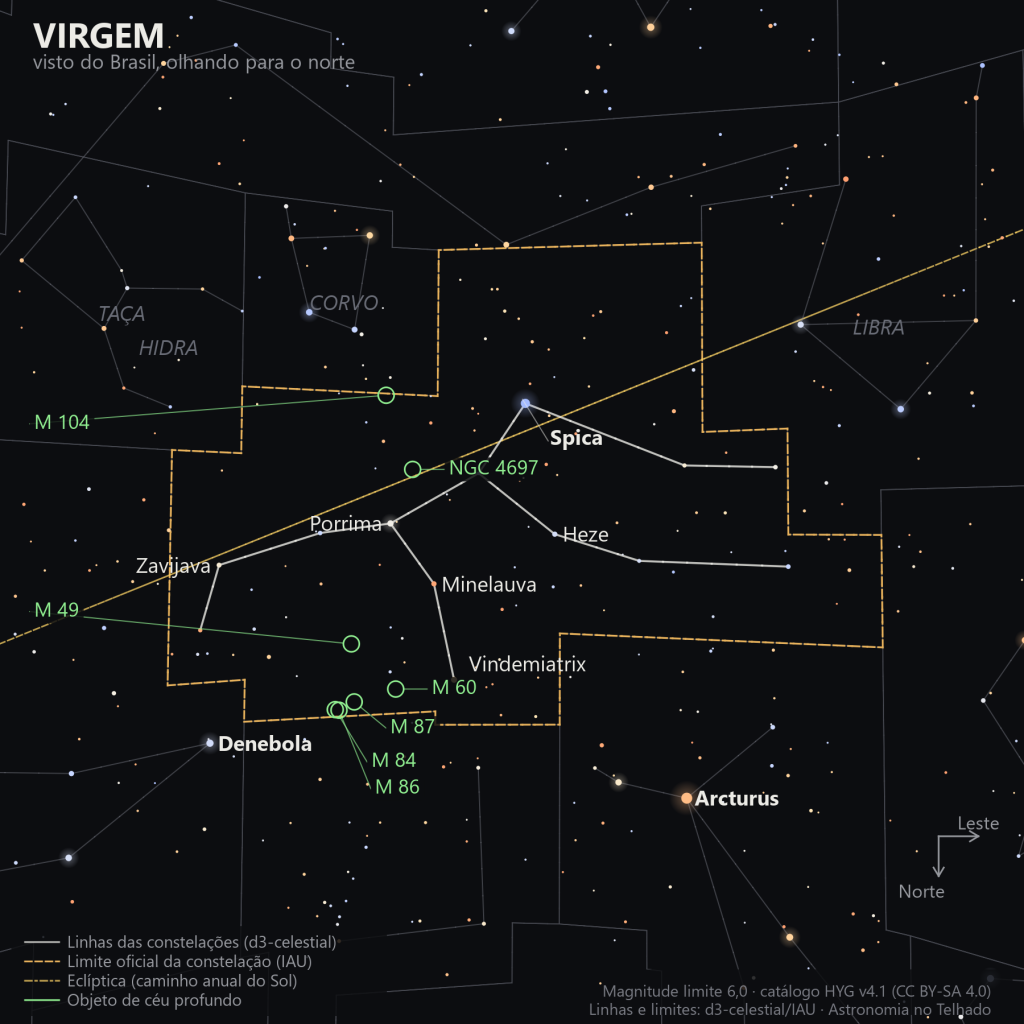
Virgo is the second-largest constellation in the sky, surpassed only by Hydra, and it has one of the easiest shapes to recognize on an early autumn evening: a big Y with a bright, bluish star at its base. It is a zodiacal constellation, it straddles the celestial equator, it holds the September equinox point, and in the "bowl" of the Y it hides thousands of galaxies. It also has a classic puzzle: the double star Porrima, two twin stars that drew so close to each other that for a few years they looked like one, and are now drifting apart again. Here you will learn how to find it, get to know its main stars, see what to look for in the Virgo Cluster, and understand what the constellation has to do with the zodiac.
Texto em revisão. This is a test article, written from reference sources; the sources are listed at the end.
The Second-Largest in the Sky
Virgo (Virgo, abbreviated Vir) covers 1,294 square degrees, a little more than Ursa Major (1,280) and less than Hydra (1,303) (Moore, The Observer's Year, night of May 8; Mourão, entry Virgo). It has only one first-magnitude star, Spica, but several other clearly visible ones, and the Y shape makes it easy to identify. The base of the Y is Spica; the two arms open upward, and the space between them, called the "bowl," is the region of the galaxies (Moore).
From Brazil, Virgo appears in the northern part of the sky. Because the constellation crosses the celestial equator, it can be seen from practically anywhere on Earth, from 67° north latitude to 75° south latitude (Ridpath).
How to Find Virgo
Look north on an autumn night and search for Spica. Three routes can help.
- Via the Southern Cross. Vieira teaches an autumn alignment: the line that runs from Acrux, the star at the foot of the Cross, to Gacrux, the one at the top, extended to the north, points toward Spica (Vieira, p. 82). We measured it with the coordinates: the line passes about 12 degrees from the star, so use it as a general hint and confirm by brightness. Spica is the brightest star in the region.
- Via Boötes. Arcturus, the bright orange star of Boötes, is about 33 degrees from Spica, to the northeast. In the Northern Hemisphere, the classic recipe is to follow the arc of the Ursa Major's tail to Arcturus and keep following the curve to Spica (Moore); from Brazil, Ursa Major sits low in the north, and it is easier to start from Arcturus or from the Cross.
- Via the triangle. Mourão describes an almost equilateral triangle, about 35 degrees on each side, formed by Spica, Arcturus and Denebola (Beta Leonis). We checked: the three sides measure between 33 and 35 degrees. Denebola, the star in the Lion's tail, sits at the western vertex.

Mind the orientation: when you look north, the zenith is at the top of your field of view and the celestial north is at the bottom. That is why, on the chart, Spica sits above the other points of the Y and Leo sits at the lower left. This is the orientation in which Virgo actually appears to observers in Brazil.
Best time. The constellation crosses the highest point of the sky (culminates) at 9 p.m. local time around the end of May and early June. In April it culminates in the small hours; in July and August, only the early evening remains. From Rio de Janeiro, Spica reaches 78 degrees in altitude, very high in the sky.
The Stars of the Y
| Star | Position in the Y | Visual brightness (mag.) | Spectral type | Approximate distance |
|---|---|---|---|---|
| Spica (alpha) | base | 0.97 | B1 V (spectroscopic binary) | about 250 light-years |
| Porrima (gamma) | center of the Y | 2.74 (combined) | F1-F2 V + F1-F2 V (two twins) | about 39 light-years |
| Vindemiatrix (epsilon) | northern tip | 2.79 | G8 III (yellow giant) | about 108 light-years |
| Minelauva (delta) | edge of the bowl | 3.38 | M3 III (red giant) | about 190 light-years |
| Heze (zeta) | near Spica | 3.38 | A2 V (white) | about 75 light-years |
| Zavijava (beta) | western tip | 3.60 | F9 V | about 36 light-years |
Brightnesses and spectral types from SIMBAD (CDS, Strasbourg). Distances come from Hipparcos parallaxes; older books give different values (Spica, 220 to 262 light-years; Porrima, 35 to 36; Minelauva, 147).
Spica is the base of the Y and one of the stars closest to the plane of the ecliptic: for that reason, from time to time the Moon passes in front of it and occults it (Moore). The name is Latin for "ear of grain" (Moore, Philip's Astronomy Encyclopedia, entry Spica; Mourão), and several ancient cultures called it that: in Turkey and Syria, for example, with names that translate as "ear of wheat" (Moore). In a telescope it is a single blue-white star, but in 1889 it was discovered to be a spectroscopic binary: two stars orbiting each other in a little over 4 days, so close together that no ordinary telescope can separate them. The main one has about 11 times the Sun's mass; the companion, about 4 (Moore). The slight variation in brightness comes from the two stars being distorted by their mutual gravity, not from eclipses (Moore, Philip's Astronomy Encyclopedia, entry Spica).
Vindemiatrix is the northernmost of Virgo's main stars, a G8-type giant with a yellowish hue. Minelauva is a red giant, 120 times more luminous than the Sun (Moore), and Heze, a white point, is much more modest in energy (about 17 times the Sun) and closer. Looking at the two alternately with binoculars, the color difference leaps out. It might seem that the red one is the younger, but it is the opposite: red giants are stars that have already burned through much of their fuel and swelled up, so Minelauva is further along in life than the white Heze (Moore, night of May 15, p. 143). Nu Virginis (ν Vir), of magnitude 4.0, between Zavijava and Denebola, is another red giant.
Zavijava marks the western tip of the Y. Heze, almost right on the celestial equator (declination minus 0.6 degree), is a reminder that Virgo is cut by it: both Heze and Porrima lie less than 2 degrees from the equator line (Moore, p. 137).
Porrima, the Vanishing Twin
Gamma Virginis, in the center of the Y, is the great curiosity of the constellation and also the one that sparks the most conversation at a gathering of observers. To the naked eye, it is a magnitude 2.7 star. In a telescope, it is a binary of two identical, yellowish-white stars, both of type F, each much more luminous than the Sun. They lie somewhere around 36 to 39 light-years from us (sources vary). Porrima and Postvarta are the names of two ancient Roman goddesses of prophecy; Arich is another name, and the Chinese called it Shang Shang, the High Minister of State (Moore, nights of May 10 and 11, p. 138-139; Mourão, entry Porrima, p. 642).
The interesting part is the orbit: the two stars complete a revolution in about 168 to 172 years, depending on the source, but the path is very elongated, so they spend years very close together and decades far apart. In the early 20th century it was one of the widest and easiest pairs of identical stars in the sky. The separation kept shrinking and fell below half an arcsecond around 2005, when only large telescopes could split them; after that, it began to widen again (Moore; Borgia, p. 222-223; Mollise, p. 131; Monks, p. 112). Observe the pair with a telescope and repeat the visit in a few years: the change in distance and angle between the stars is visible (Moore, p. 139). In the tightest years, the authors cite telescopes of about 250 mm (Monks).
The Virgo Cluster
The bowl of the Y, marked by the stars epsilon, delta, gamma, eta and beta Virginis and by Denebola, in Leo, is the gateway to one of the richest galaxy fields in the sky: the Virgo Cluster, with at least 2,000 galaxies, at a distance of 50 to 65 million light-years, depending on the source. It is the nearest large cluster to us; the Milky Way belongs to the Local Group, which is small next to it (Moore; Ridpath; Kambič, p. 487-493; Mollise, p. 124-133). A dozen Messier galaxies lie there. Do not confuse it with the open cluster in Coma Berenices, which is close in the sky but inside our own Galaxy (Moore, p. 141).
We chose seven galaxies for the chart.
M 87 — giant galaxy (guide) is the star of the cluster: a giant elliptical, with a mass of at least 300 billion Suns, about 120,000 light-years across and a jet of matter shooting out of its nucleus. The motions of the stars at the center point to a giant black hole, and the galaxy is a powerful source of radio waves (Virgo A) (Moore, night of May 14, p. 142). The number of globular clusters around it varies widely: "at least 800" in Moore, "more than 10,000" in Kambič.
M 49 — elliptical galaxy (guide) is one of the largest ellipticals, at about 160,000 light-years. It is the brightest in the cluster, at magnitude 8.4 (Kambič, p. 490-491).
M 60 — elliptical galaxy (guide) is another giant elliptical, of magnitude 8.8 and about 120,000 light-years across (Kambič).
M 84 and M 86 — Markarian's Chain (M 84, M 86). This pair of ellipticals is the heart of a row of galaxies almost 2 degrees long called Markarian's Chain. It lies almost exactly halfway between Beta Leonis (Denebola) and Epsilon Virginis (Tonkin, p. 243). Both require averted vision in binoculars, and the problem in the chain is not finding the galaxies but telling them apart (Kambič; Tonkin). Nearby, NGC 4438 and NGC 4435 form "The Eyes" (Kier, p. 122).
M 104 — Sombrero Galaxy (guide) lies on the southern edge of the bowl and in fact does not belong to the cluster: it is about two thirds of the way to it (Ridpath). It is a spiral seen almost edge-on, with a dark dust lane crossing the nucleus that recalls the brim of a hat (hence the name; Moore compares the lane to a South American hat, and the galaxy was once nicknamed the "Saturn Nebula," for its resemblance to the planet's rings; p. 141). It was discovered by Pierre Méchain in 1781; it has a magnitude near 8 and a true diameter of more than 130,000 light-years (Moore, entry Sombrero Galaxy, p. 376). To find it from Spica, a good route passes through the stars 49 Virginis and Psi (Kambič, p. 491-492). In large binoculars, it is an elongated smudge with a nucleus; the dust lane is only a suspicion (Tonkin, p. 244).
NGC 4697 — Caldwell 52 (guide) is the "southern target": a massive elliptical (or lenticular) galaxy 75 million light-years away, with a central black hole of 50 to 100 million solar masses. It lies about 5 degrees west of Theta Virginis, and in a 20 cm telescope it looks like an elongated, fuzzy nut (Mobberley, p. 114-115).
Mythology and History
Virgo is one of the oldest constellations. In the Euphrates valley, it symbolized the goddess Ishtar, daughter of heaven and queen of the stars, with an ear of grain in her hand, a symbol of fertility. In Greek mythology, it was associated with Demeter, goddess of wheat, and also with Astraea, goddess of justice, daughter of Zeus (Jupiter) and Themis (Mourão, entry Virgo, p. 845; Moore, p. 137). Vieira lists other readings: Erigone, Ceres and Proserpina, and the Egyptian Isis, who supposedly created the Milky Way by scattering grains of wheat across the sky; the rising of Spica alongside the Sun was tied to the harvest (Vieira, p. 24). This is a Northern Hemisphere setting; here, the Sun reaches Virgo at the beginning of spring.
Virgo and the Zodiac
The zodiac is a band of the sky about 8 degrees to each side of the ecliptic, the Sun's apparent path through the year. The name comes from Greek and means "circle of animals" (Mourão, entry zodíaco, p. 885). The ecliptic is tilted about 23.5 degrees relative to the celestial equator, and the two cross at two points, the March and September equinoxes (Ridpath, p. 132; Vieira, p. 50-52).
Virgo is the sixth zodiacal constellation. By the official boundaries of the International Astronomical Union (IAU), the Sun is inside it from around September 18 to October 31, about 44 days (approximate dates, calculated from the IAU boundaries). During that period Virgo is lost in the Sun's glare, and it is one of the longest stays of the Sun in a constellation, since Virgo is the largest in the zodiac (Ridpath, p. 178). The best time to see the constellation is autumn, seven to eight months later.
The September equinox happens with the Sun inside Virgo (Ridpath, p. 178). The exact point where the Sun crosses the celestial equator, heading into the southern celestial hemisphere, lies a few degrees from the star Zavijava (Beta Virginis), a position we calculated from the coordinates and which can be checked in planetarium software. Because the Earth has a slow "wobble" (precession, which completes one cycle in about 26,000 years), this point changes constellation roughly every 2,000 years (Vieira, p. 52-53).
That same precession explains the difference between a sign and a constellation. A sign is each of the 12 equal sections, of 30 degrees, into which the zodiac was divided in antiquity; two thousand years ago, each sign coincided with the constellation of the same name. Precession has shifted the reference point by about 30 degrees since then (Mourão, entry signo, p. 736; Moore, Philip's Astronomy Encyclopedia, entry zodiac, p. 445). In addition, the official constellation boundaries have unequal sizes, and the ecliptic crosses a 13th constellation, Ophiuchus (Mourão, p. 885). As a result, traditional astrological calendars associate the sign of Virgo with about August 23 to September 22, while the Sun is actually inside the constellation of Virgo during a different period, almost all of it after that. Signs are culture and history; astronomy observes where the Sun really is.
Observing Guide
Maximum altitudes (culmination) calculated for a few cities, from the declinations of Spica (minus 11 degrees) and Vindemiatrix (plus 11 degrees):
| City | Spica | Vindemiatrix |
|---|---|---|
| Manaus (AM) | 82° (south of the zenith) | 76° |
| Recife (PE) | 87° (south of the zenith) | 71° |
| Brasília (DF) | 85° | 63° |
| Rio de Janeiro (RJ) | 78° | 56° |
| Porto Alegre (RS) | 71° | 49° |
Altitudes calculated from the star coordinates in SIMBAD and each city's latitude; rounded values. Spica culminates south of the zenith in Manaus and Recife and north of it in the others; Vindemiatrix always culminates to the north.
| Instrument | What to see |
|---|---|
| Naked eye | The Y, the blue of Spica and the yellow of Vindemiatrix, the red of Minelauva next to the white of Heze. |
| Binoculars (10×50) | The color comparison between Minelauva and Heze, Nu Virginis, and the brightest galaxies of the bowl (M 87, M 49, M 60) under a dark sky. |
| Small telescope (70 to 100 mm) | Porrima (with the current separation checked in an ephemeris), M 104 with its nucleus, M 84 and M 86 as two smudges side by side. |
| Telescope of 150 mm or more | Markarian's Chain, NGC 4697 and dozens of other galaxies, with a detailed chart. |
Field tips:
- Choose a moonless night far from city lights: the galaxies of Virgo are faint, and the hard part is identifying each one.
- Use a detailed chart and short hops between known stars; Mollise suggests starting at Rho Virginis and moving from galaxy to galaxy at medium magnification (about 125x) (Mollise, p. 126-131).
- Let your eyes adapt and use averted vision; in binoculars, gently shaking the instrument helps you notice the smudge (Kambič).
- Start with the stars of the Y and with Spica before going to the galaxies: they are the reference points for the hops.
References
- BORGIA, Michael P. Human Vision and the Night Sky: How to Improve Your Observing Skills. New York: Springer. Difficult doubles (Porrima), p. 222-223.
- KAMBIČ, Bojan. Viewing the Constellations with Binoculars. New York: Springer, 2010. Virgo Cluster, M 87, M 60, M 49, M 84, M 86 and M 104, p. 487-493.
- KIER, Ron. The 100 Best Targets for Astrophotography. New York: Springer. Virgo Cluster and Markarian's Chain, p. 122.
- MOBBERLEY, Martin. The Caldwell Objects and How to Observe Them. New York: Springer, 2009. Caldwell 52 (NGC 4697), p. 114-115.
- MOLLISE, Rod. The Urban Astronomer's Guide. London: Springer. Virgo and the cluster, p. 124-133 (Porrima, p. 131).
- MONKS, Neil. Go-To Telescopes Under Suburban Skies. London: Springer. Doubles to test your telescope (Porrima), p. 112.
- MOORE, Patrick (ed.). Philip's Astronomy Encyclopedia. London: Philip's, 2002. Entries "Sombrero Galaxy" (p. 376), "Spica" (p. 383) and "zodiac" (p. 445).
- MOORE, Patrick. The Observer's Year: 366 Nights of the Universe. 2nd ed. London: Springer, 2005. Nights of May 8 (Virgo, p. 137), May 9 (Spica, p. 138), May 10 and 11 (Porrima/Arich and star names, p. 138-139), May 13 (the Virgo Bowl and the Sombrero, p. 141), May 14 (M 87, p. 142) and May 15 (Minelauva, p. 143).
- MOURÃO, Ronaldo Rogério de Freitas. Dicionário enciclopédico de astronomia e astronáutica. Rio de Janeiro: Nova Fronteira, 1987. Entries "Virgo" (p. 844-845), "Spica" (p. 753), "Porrima" (p. 642), "signo" (p. 736) and "zodíaco" (p. 885).
- RIDPATH, Ian. Astronomia (Guia Ilustrado Zahar). 4th ed. Rio de Janeiro: Zahar. Virgo, p. 178; ecliptic and coordinates, p. 132.
- TONKIN, Stephen. Binocular Astronomy. London: Springer, 2007. Markarian's Chain and M 104, p. 243-244.
- VIEIRA, Fernando. Identificação do céu. Autumn alignment (Cross, Spica and Arcturus), p. 82; zodiac myths, p. 24; ecliptic and precession, p. 50-53.
- SIMBAD Astronomical Database. Centre de Données astronomiques de Strasbourg (CDS). Query of brightnesses, spectral types and parallaxes, on Sept. 21, 2026.
- HYG Database (v4.1), David Nash / Astronexus, CC BY-SA 4.0 license, used for the star chart; IAU constellation boundaries and d3-celestial lines.