September 24, 2026
Taurus, the Constellation of Aldebaran, the Hyades and the Pleiades
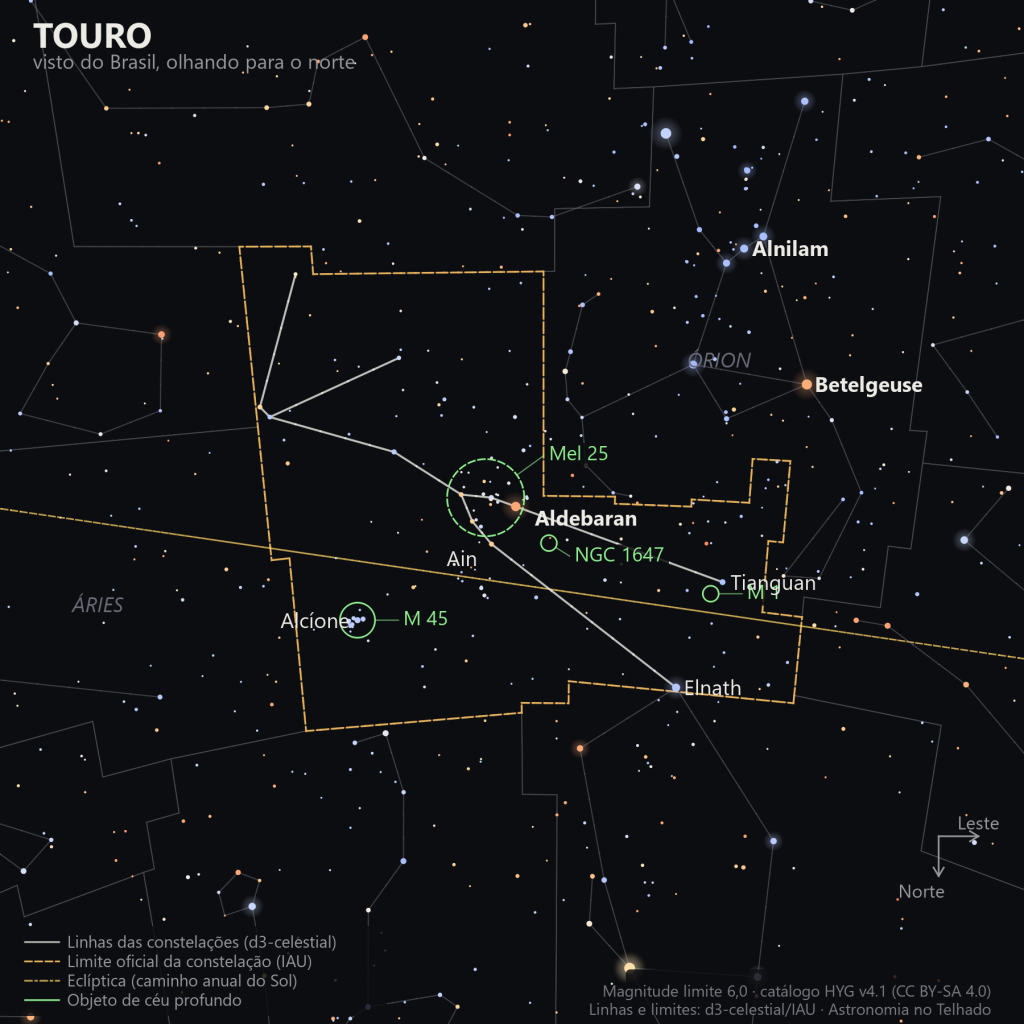
Few constellations pack so much into so small an area. Taurus holds one of the brightest stars in the sky, a V-shaped cluster visible to the naked eye, the most-counted group of stars in history, and the remains of an explosion recorded in China in 1054. Add to that a myth of abduction, two meteor showers, and the Sun crossing the constellation from mid-May to mid-June.
Text under review. This is a test article, written from reference sources; the sources are listed at the end.
Taurus in the Brazilian sky
Taurus is the second zodiacal constellation (counting from Aries) and covers about 797 square degrees, between right ascensions 3h20 and 5h58 and declinations from 0° to about +31° (Mourão, entry Taurus). According to Ridpath, it is visible from 88° N to 58° S, which covers all of Brazil.
Because it lies north of the celestial equator, Taurus culminates north of the zenith: look north. In Rio de Janeiro, Aldebaran reaches an altitude of about 51°, the Pleiades 43° and Elnath about 38° (values calculated for this article).
| City | Aldebaran | Pleiades | Elnath |
|---|---|---|---|
| Boa Vista (RR) | 76° | 69° | 64° |
| Manaus (AM) | 70° | 63° | 58° |
| Brasília (DF) | 58° | 50° | 46° |
| Rio de Janeiro (RJ) | 51° | 43° | 38° |
| Porto Alegre (RS) | 43° | 36° | 31° |
Maximum altitudes calculated from the star coordinates in SIMBAD and each city's latitude (90° minus the difference between latitude and declination); rounded values.
When to look. Taurus culminates at 9 p.m. local time around the end of January (constellation center at RA 4h36). From December to February it is high in the sky at dusk, and the Pleiades already show up in the east in November.
How to find Taurus
The most reliable path goes through Orion. The three stars of Orion's Belt (known in Brazil as the Three Marys) form a straight line; extend it away from Sirius, that is, to the left and downward when you face north, and the first orange glint you meet will be Aldebaran, the eye of the Bull (Moore, The Observer's Year, night of December 10; Vieira). A little farther along the same direction, you reach the Pleiades.
- Find the Belt of Orion and follow its line to the left and downward.
- Spot Aldebaran, a bright orange star with a V of fainter stars just behind it: these are the Hyades, the Bull's snout.
- Keep going to a small "bunch" of blue stars: these are the Pleiades, which look like a tiny dipper.
- Find the horns. From Aldebaran, two lines open out to the right (east) toward Elnath (the northern horn) and Tianguan (the other horn).

The stars of Taurus
| Star | Position in the figure | Visual magnitude | Spectral type | Approximate distance |
|---|---|---|---|---|
| Aldebaran (alpha) | eye | 0.86 (slightly variable) | K5 III (orange giant) | about 67 light-years |
| Elnath (beta) | tip of the northern horn | 1.65 | B7 III (blue-white giant) | about 134 light-years |
| Alcyone (eta) | center of the Pleiades | 2.87 | B7 III | about 400 light-years |
| Tianguan (zeta) | tip of the southern horn | 3.03 | B1 IVe (star with a gas envelope) | about 445 light-years |
| Ain (epsilon) | right eye of the V, in the Hyades | 3.53 | G9.5 III | about 146 light-years |
| Prima Hyadum (gamma) | tip of the V, in the Hyades | 3.65 | G9.5 III | about 150 light-years |
| Lambda | near the border with Orion | 3.4 (variable, 3.3 to 3.8) | B4 IV (eclipsing binary) | about 405 light-years |
Magnitudes, spectral types and parallaxes taken from SIMBAD (CDS, Strasbourg), which carries measurements from the Hipparcos satellite. Distances come from 3,261.56 divided by the parallax in milliarcseconds and carry some uncertainty; older books give different values (for example, 490 light-years for Zeta and 330 for Lambda in Moore, 2005).
Aldebaran: the star that is not in the Hyades
The name comes from Arabic and means "the follower," because the star seems to follow the Pleiades in the daily motion of the sky (Vieira, p. 68; Mourão, entry Aldebaran, p. 18). It is an orange giant about 40 times the diameter of the Sun (sources give 36 to 40) and 90 to 150 times its luminosity (Mobberley, p. 94; Moore, night of December 10, p. 335), with a slight variation in brightness of about 0.2 magnitude (Kambič, p. 455).
The most curious fact: although it looks like the brightest point of the Hyades, Aldebaran is not part of the cluster. It lies about 65 light-years away, less than half the cluster's distance (Ridpath, p. 173; Moore and Rees, p. 346). It is a coincidence of perspective, and Moore notes that its brightness even gets in the way of observing the cluster (night of December 11, p. 336).
Aldebaran also has a scientific story. According to Kambič (p. 455-456), an occultation of the star by the Moon seen from Athens in AD 509 led Edmond Halley to realize that the star must have changed position for the account to make sense. By comparing Aldebaran, Sirius and Arcturus with ancient records, he discovered the proper motion of stars. Today Aldebaran is estimated to have shifted about 7 arcminutes in 2,000 years.
Elnath, the horn
Elnath has magnitude 1.65 and its Arabic name is translated as "the one that butts" (Philip's Astronomy Encyclopedia, entry Alnath, p. 10). It was once counted as gamma Aurigae, until it was moved to Taurus (Vieira, p. 70; Moore, night of December 10, p. 336).
Lambda, the star that "blinks"
Lambda is the brightest Algol-type eclipsing binary after Algol itself: every 3.95 days it drops from magnitude 3.3 to 3.8 and recovers (Moore, night of December 15, p. 338-339). The drop is small, but you can notice it by comparing with gamma (3.6), xi (3.7), nu (3.9) and mu (4.3), stars that Moore suggests as comparisons. It sits at declination +12.5°, a comfortable spot for us.
The Hyades: the V of rain
The Hyades form the V that represents the bull's face, with Aldebaran as the eye (Vieira, p. 22-23). It is the open cluster closest to the Sun, at about 150 light-years (Moore and Rees, p. 346), and spans about 6°, ten times the width of the full Moon (Ridpath, p. 173). More than a dozen members are visible to the naked eye; Kambič (p. 456-457) speaks of about 28, more than 160 stars in binoculars down to magnitude 9, and more than 400 with a limit of 11.
The site's catalog lists it as Mel 25, the Hyades (also Caldwell 41), of magnitude 0.5 and about 5° across (Mobberley, p. 94-95). The ages cited range from 600 to 800 million years. There is color in the group: epsilon (3.5) and gamma (3.6) are orange, and theta is a naked-eye double, with a white star of magnitude 3.4 and an orangish one of 3.8, a contrast that binoculars show very well (Moore, night of December 11, p. 336). Binoculars are the best instrument here, because the cluster is too large for a telescope's field of view. Object guide: Mel 25, the Hyades.
Near the Hyades: about 3° northeast of Aldebaran lies NGC 1647, an open cluster, of magnitude around 6, great to see right after you approach the V (Mobberley, p. 94; Tonkin, p. 150). Object guide: NGC 1647.
The Pleiades: how many can you count?
M 45, the Pleiades, is the most famous cluster in the sky. Ridpath (p. 173) says it covers an area three times larger than the full Moon. The distance varies by study: about 440 light-years in Moore and Rees (p. 343), 450 in Allison (p. 121-122) and 370 in Kambič (p. 457); the Data Book considers the smaller Hipparcos value wrong, which is why we do not fix a single number.
The classic question is how many stars you can see. Kambič (p. 459) says the average person sees six or seven. Maestlin saw 14 and drew 11 before the telescope; Eduard Heis reached 19, a record cited by Moore (night of December 12, p. 337); and Slovenian observers in Arizona counted 23 in 2001, under an exceptional sky (Kambič, p. 459).
Vieira (p. 22) gives a map with the name of each star, and Moore (p. 338) lists nine: Alcyone (2.9, the brightest), Atlas, Electra, Maia, Merope, Taygeta, Pleione, Celaeno and Asterope. A long-exposure photo shows a bluish haze, which is not the cocoon where the stars were born, but a cloud the cluster happens to be passing through (Moore and Rees, p. 343; Kambič, p. 457). Object guide: M 45, the Pleiades.
The Crab Nebula (M 1)
Next to the tip of the southern horn is M 1, the Crab Nebula, the first object in Messier's catalog and the remnant of an exploded star. Chinese astronomers recorded, on July 4, 1054, a star as bright as Venus, visible in broad daylight (Philip's Astronomy Encyclopedia, p. 104; Moore, night of December 16, p. 338-339), which stayed in view for more than a year.
What remains is a nebula of magnitude around 8, about 6 by 4 arcminutes (Kambič, p. 461; Kier, p. 25), a little over 1° northwest of Tianguan. John Bevis found it in 1731 and Messier included it in his catalog in 1758. The name "Crab" comes from Lord Rosse, in 1844 (Ridpath, p. 173; Kambič, p. 462; Moore says 1846), for the filaments that resembled crab legs in his 72-inch reflector.
Inside it lies a pulsar, a neutron star that spins about 30 times per second and emits from radio waves to gamma rays (Philip's Astronomy Encyclopedia, p. 105; Kambič, p. 464-465). The distance is 6,000 to 6,500 light-years depending on the source (Moore, p. 339; Philip's, p. 104), and the edges expand at about 0.2 arcseconds per year, something like 960 km/s (Kambič, p. 463). Moore's honest warning: visually it disappoints those who expect a lot, and only a telescope and photography reveal its complexity; strong binoculars show a faint smudge. Object guide: M 1, the Crab Nebula.
Mythology and history
Taurus is one of the oldest constellations. Mourão (p. 774) considers it perhaps the first zodiacal constellation delimited by the Babylonians, who used it to mark the beginning of the year, because the spring equinox (in the Northern Hemisphere) occurred in it around 4000 BC; Vieira (p. 21) gives the interval 4380 to 2220 BC (p. 52-53). For the Egyptians, the bull symbolized the return to life, linked to Osiris and Apis; for the Persians, it was the aleph, the first letter of the alphabet (Vieira, p. 21-22).
Europa. Zeus (Jupiter) fell in love with Princess Europa, daughter of Agenor, and turned himself into a gentle white bull. She climbed onto the animal's back, and it plunged into the sea and swam to Crete (Mourão, p. 774; Vieira, p. 22; Ridpath, p. 172).
The Hyades. They were the daughters of Atlas and Aethra. After their brother Hyas was killed by a lioness, the gods turned them into stars. The heliacal rising of the cluster coincided with the rainy season, and the name means "to rain" (Vieira, p. 22-23; Mourão, p. 774).
The Pleiades. They were seven maidens, daughters of Atlas and Pleione, pursued by the hunter Orion until Jupiter turned them into stars (Vieira, p. 23; Moore, p. 337). They appear in the Odyssey and in the Bible (Job 38:31; Moore, p. 337). The Greek name comes from plein, "to sail," since they marked the opening and closing of the sailing season (Vieira, p. 23), and their reappearance in November was greeted as the festival of the dead (Mourão, p. 774).
The zodiac: the Sun, the ecliptic and Taurus
The ecliptic is the path the Sun seems to follow among the stars over the year, and Taurus is one of the constellations it passes through. The zodiac is the band of sky about 8° on each side of the ecliptic, where the Moon and planets also travel (Philip's Astronomy Encyclopedia, entry zodiac, p. 445; Mourão, entry zodíaco, p. 885). It is the dashed golden line on our chart.
By the International Astronomical Union's official boundaries, the Sun is inside the constellation Taurus from about May 15 to June 21 (approximate dates, about 38 days). This means that, in the late autumn, Taurus is in the daytime sky, alongside the Sun, and cannot be seen: that is why it only appears at night many months later.
A sign is not a constellation. Astrological signs divide the zodiac into 12 equal parts of 30°, counted from the vernal point; constellations have unequal sizes and boundaries defined by the IAU. The precession of the equinoxes, the wobble of Earth's axis over about 26,000 years, shifts the vernal point from constellation to constellation about every 2,000 years, and the signs no longer coincide with the constellations of the same name (Philip's Astronomy Encyclopedia, p. 445; Vieira, p. 52-53). Today the equinox is in Pisces. The period that astrological calendars call "Taurus," from about April 21 to May 20, falls before the Sun reaches the constellation's official boundaries (general knowledge). None of this predicts anything: Taurus gives us history, culture and a good reason to look up.
Taurids: meteors from Comet Encke
Taurus is the radiant of two meteor showers (Mourão, p. 774). The Taurids of June 4 to July 4 have about 30 meteors per hour, at 31 km/s, and are linked to Comet Encke. Those of October 20 to November 30, peaking on November 8 and 9, have a double radiant: the northern ones (about 5 per hour) and the southern ones (about 15 per hour, apparently also linked to Encke). Ridpath (p. 172) places them in early November. From Brazil, the southern ones, with a radiant at declination +14°, are the most promising.
Observing guide
| Instrument | What to see |
|---|---|
| Naked eye | The orange color of Aldebaran, the V of the Hyades, the Pleiades (count the stars), the double theta and the "blinking" of lambda over 3.95 days. |
| Binoculars (10×50) | The whole Hyades group in the field, the double theta with its colors, the dozens of stars of the Pleiades, NGC 1647 and M 1 as a very faint smudge near Tianguan. |
| Small telescope (70 to 100 mm) | The doubles of the V, more Pleiades stars (at low magnification), the oval shape of M 1 and the nebulosity of the Pleiades. |
| Camera and telephoto lens | The Pleiades with the blue reflection nebula, the Hyades with Aldebaran and, with a telescope, the Crab with an H-alpha filter. |
Field tips:
- For the Pleiades and the Hyades, use a wide field: binoculars or a telescope at low magnification (Mobberley, p. 94; Kambič, p. 456).
- Compare Aldebaran with Betelgeuse: Aldebaran is nearly constant and Betelgeuse varies; do the comparison with both high in the sky, because of atmospheric absorption (Moore, night of December 10, p. 336).
- For M 1, wait for Taurus to be high and for a dark sky.
References
- ALLISON, Michael. Star Clusters and How to Observe Them. London: Springer, 2006. Pleiades and Hyades, p. 121-122 and 125.
- KAMBIČ, Bojan. Viewing the Constellations with Binoculars: 250+ Wonderful Sky Objects to See and Explore. New York: Springer, 2010. Taurus, Hyades, Pleiades and M 1, p. 455-467.
- KIER, Ronald. The 100 Best Targets for Astrophotography. New York: Springer, 2009. M 1, p. 25.
- MOBBERLEY, Martin. The Caldwell Objects and How to Observe Them. New York: Springer, 2009. Caldwell 41 (Hyades), p. 94-95.
- MOORE, Patrick (ed.). Philip's Astronomy Encyclopedia. London: Philip's, 2002. Entries "Aldebaran" (p. 7), "Alnath" (p. 10), "Crab Nebula" and "Crab Pulsar" (p. 104-105), "Hyades" (p. 190), "zodiac" (p. 445).
- MOORE, Patrick; REES, Robert. Patrick Moore's Data Book of Astronomy. Cambridge: Cambridge University Press, 2011. Pleiades, Hyades and other open clusters, p. 342-347.
- MOORE, Patrick. The Observer's Year: 366 Nights of the Universe. 2nd ed. London: Springer, 2005. Nights of December 10 ("Taurus", p. 335-336), December 11 ("The Hyades", p. 336), December 12 ("The Seven Sisters", p. 336-337), December 14 ("The Stars of the Pleiades", p. 338), December 15 ("Lambda Tauri", p. 338-339) and December 16 ("The Crab Nebula", p. 339).
- MOURÃO, Ronaldo Rogério de Freitas. Dicionário enciclopédico de astronomia e astronáutica. Rio de Janeiro: Nova Fronteira, 1987. Entries "Aldebaran" (p. 18), "El Nath" (p. 262), "Taurídeos" and "Taurus" (p. 774), "zodíaco" (p. 885).
- RIDPATH, Ian. Astronomia (Guia Ilustrado Zahar). 4th ed. Rio de Janeiro: Zahar. Taurus, Pleiades and Hyades, p. 172-173.
- TONKIN, Stephen. Binocular Astronomy. London: Springer, 2007. Pleiades and Hyades in binoculars, p. 149-150.
- VIEIRA, Fernando. Identificação do céu. Taurus, myths and names, p. 21-23; precession of the equinoxes, p. 52-53; Taurus, Aldebaran, Hyades, Pleiades, El Nath and M 1, p. 68-70.
- SIMBAD Astronomical Database. Centre de Données astronomiques de Strasbourg (CDS). Query of magnitudes, spectral types and parallaxes of the stars cited, on Sept. 21, 2026.
- HYG Database (v4.1), David Nash / Astronexus, CC BY-SA 4.0 license, used for the star chart; IAU constellation boundaries and d3-celestial lines.