September 24, 2026
Sagittarius: the Teapot and the road to the center of the Milky Way
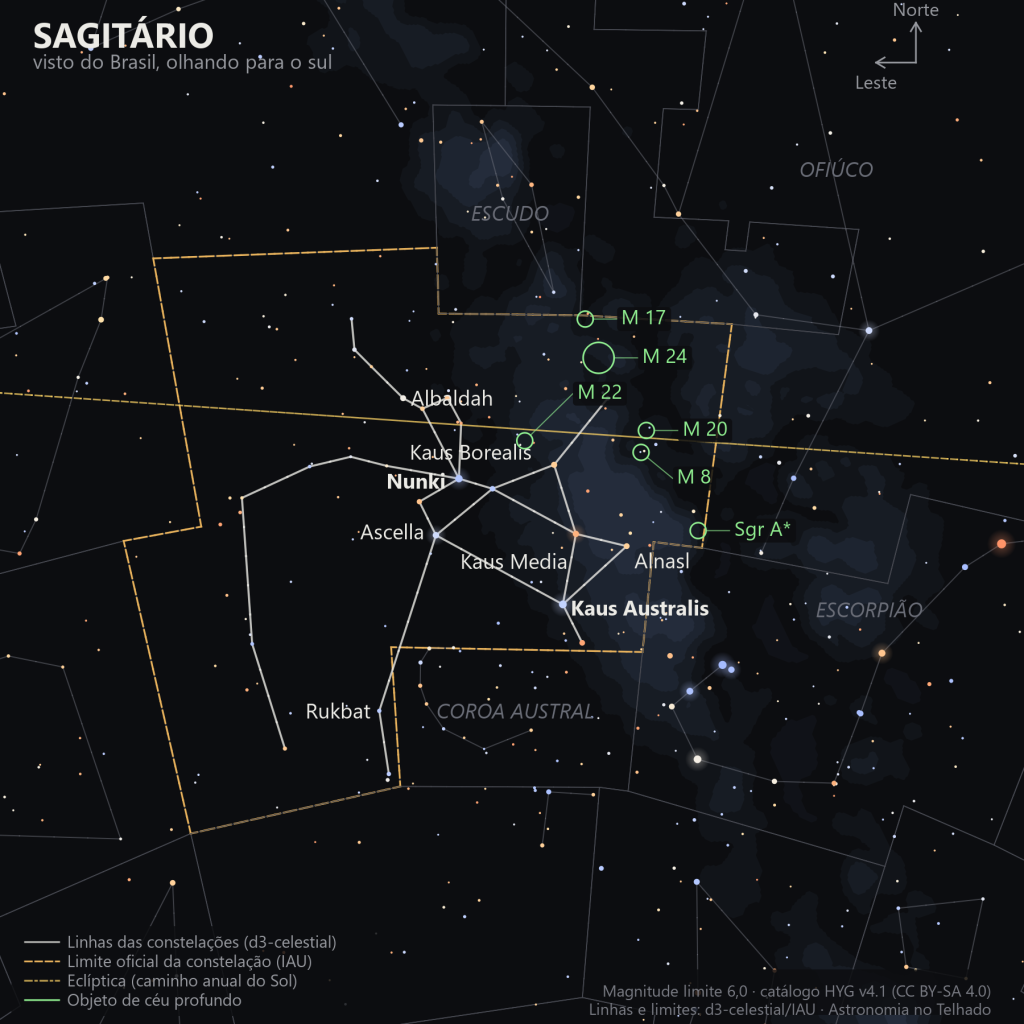
If you live in Brazil and have a reasonably clear horizon, there is one direction in the sky worth more than any other to anyone who likes looking up: Sagittarius. It is the southernmost zodiacal constellation, it passes almost directly overhead on winter nights, and it points toward the center of our galaxy. In this guide you will learn how to find the Teapot, get to know the stars that make it up, and go fishing for nebulae, clusters and star clouds with binoculars or a telescope.
Texto em revisão. This is a test article, written from reference sources; the sources are listed at the end.
The archer pointing at the center of the Galaxy
Sagittarius (Sagittarius, abbreviation Sgr) is a large constellation: it covers 867 square degrees, one of the biggest in the sky, and is recognizable by its intense density of stars (Mourão, entry Sagittarius). Ridpath ranks it 15th in size and says it can be seen from anywhere between 44° N and the south pole. It lies between Ophiuchus and Capricornus, next to Scorpius, and Philip's describes it as a centaur aiming his arrow at the heart of the Scorpion, that is, at Antares (Philip's, entry Sagittarius).
The reason for all that brightness is geographic. When we look at Sagittarius, we are looking into the Milky Way. Vieira sums it up this way: looking at Orion is seeing the outskirts of the Galaxy; looking at Sagittarius is seeing the core. That is why the constellation is one of the richest in nebulae and clusters and, according to Moore, has more Messier catalog objects than any other.
And here is a fact that makes for good conversation: the center of the Galaxy is right there, but you cannot see it. The dust and gas between us and the core dim visible light by a factor of about a trillion (Kambič). What we know about the heart of the Milky Way comes from infrared, radio, X-ray and gamma-ray observations. To the naked eye, what shows up is the brightest, "thickest" band of the Milky Way, a view of the neighborhood of the center, not of the center itself.
How to find the Teapot
Sagittarius has no archer figure that is easy to imagine. Moore notes that there is no truly distinctive shape, only the nickname "Teapot." That asterism is what you are looking for: eight stars forming a teapot with a lid, spout and handle (Philip's, entry Sagittarius).
Here are the steps, adapted for someone in Brazil looking south:
- Pick the time. At 9 p.m., from July to September, the Teapot is very high in the sky. In May and June it appears in the early morning hours.
- Find Scorpius. Locate Antares, the bright orange-tinted star in the heart of Scorpius. The Teapot sits just east of it (to the left, for someone looking south).
- Look for the lid and the base. The lid is Kaus Borealis; the base, Kaus Australis. Two bluish stars, Nunki and Ascella, mark the handle, and orange Alnasl is the tip of the spout, pointing toward Scorpius.
- Confirm with the Milky Way. Under a dark sky, the brightest band of the Galaxy passes "inside" the teapot and comes out through the spout. Many observers call that patch steam coming out of the spout.
One detail that can be misleading: the Greek letters of Sagittarius are out of order. Alpha and Beta are faint, "extras," and the brightest stars are Epsilon, Sigma and Zeta (Moore).

How high the Teapot climbs in your sky
Because Sagittarius is so far south, it passes near the zenith across much of Brazil. The maximum altitude above the horizon is 90° minus the difference between the place's latitude and the object's declination. We calculated it for the center of the Galaxy (Sgr A*, declination about -29°) and for Kaus Australis (about -34°):
| City | Center of the Galaxy (Sgr A*) | Kaus Australis |
|---|---|---|
| Boa Vista (RR) | 58° | 53° |
| Manaus (AM) | 64° | 59° |
| Recife (PE) | 69° | 64° |
| Brasília (DF) | 77° | 71° |
| Rio de Janeiro (RJ) | 84° | 78° |
| Porto Alegre (RS) | 89° | 86° |
| Chuí (RS) | 85° | 89° |
Altitudes calculated from SIMBAD coordinates and each city's latitude; values rounded, at the time the object crosses the meridian.
In Rio de Janeiro, then, the center of the Galaxy reaches about 84° in altitude: practically overhead, with the least possible atmosphere in the way. Moore points out the contrast: in Britain, part of the constellation never rises and the rest stays low on the southern horizon, while in Australia and New Zealand it passes near the zenith. In other words: what Brazil sees right above its houses, Europe barely sees at all.
The stars of the Teapot
| Star | Position in the teapot | Visual brightness (mag.) | Spectral type | Approximate distance |
|---|---|---|---|---|
| Kaus Australis (epsilon) | base | 1.81 | B9 IV | about 143 light-years |
| Nunki (sigma) | handle | 2.07 | B2.5 V | about 230 light-years |
| Ascella (zeta) | handle | 2.59 (combined) | A2.5 V (double system) | about 90 light-years |
| Kaus Media (delta) | spout side | 2.67 | K2.5 III (orange giant) | 300 to 420 light-years |
| Kaus Borealis (lambda) | lid | 2.81 | K1 III (orange giant) | about 76 light-years |
| Alnasl (gamma-2) | tip of the spout | 2.99 | K0 III (orange giant) | about 100 light-years |
| Rukbat (alpha) | outside the teapot, to the south | 3.94 | B8 V | about 180 light-years |
Brightnesses, spectral types and parallaxes taken from SIMBAD (CDS, Strasbourg). The distances come from parallaxes measured by the Hipparcos satellite; older books give different values (for example, Moore gives about 85 light-years for Kaus Australis, Mourão 136 and Philip's 145), and the distance to Kaus Media varies a lot from source to source.
Kaus Australis is the brightest star in the constellation, at the southern end of the bow. The prefix Kaus designates the Archer's bow, and the three Kaus stars (Australis, Media and Borealis) define the southern, middle and northern positions of the bow (Mourão, entry Kaus). The color contrast between it (bluish-white) and the orange giants Kaus Media and Kaus Borealis shows up well in binoculars.
Nunki (sigma) is the second brightest. Mourão says the name comes from its position near the Archer's chest. On the chart, it appears a few degrees south of the ecliptic, the line of the Sun's yearly path.
Ascella (zeta) has a name that means the archer's "armpit," and Mourão describes it as a binary system with components of magnitudes close to 3.2 and 3.4, orbiting in about 21 years, and hard to observe.
The deep sky: six must-see stops
The chart marks six targets. None of them requires observatory equipment: almost all show up in binoculars, and several to the naked eye under a dark sky.
M 8 — Lagoon Nebula
The Lagoon Nebula is an emission nebula visible to the naked eye as a faint patch, with an apparent size of about three times the full Moon (Ridpath; Bakich, object no. 513). It lies a little over 5 degrees west-northwest of Kaus Borealis (Kambič; Tonkin), so it is in the same binocular field, which shows the stars of the open cluster NGC 6530 immersed in the nebulosity. In excellent conditions, you can count 30 to 50 stars (Kambič). The 6th-magnitude star 9 Sagittarii is the likely source of the light that makes the gas glow. The distance varies quite a bit among sources, from about 4,500 to 6,500 light-years. It sits in the Sagittarius Arm, the next spiral arm toward the center after the Orion Arm, at about 5,000 light-years at its nearest point (Philip's, entry Sagittarius Arm). Moore and Rees's Data Book records the discovery as John Flamsteed's, around 1680.
M 20 — Trifid Nebula
The Trifid Nebula lies about 1.5 degrees north-northwest of the Lagoon, and the two fit together in binoculars (Kambič). It is fainter and calls for a completely dark sky. In photographs, dust lanes divide it into parts; that is where the name comes from. The southern side is emission (reddish in images) and the northern side is reflection (bluish). The distance is around 5,000 to 5,200 light-years, and the diameter is about 30 light-years (Moore; Kambič). Kambič points out that the Lagoon and the Trifid are probably part of the same vast cloud of gas and dust, since they are at the same distance.
M 17 — Omega Nebula
The Omega Nebula lies at the border with Scutum (the Shield), about 3 degrees north of the M 24 Star Cloud. It has several names because of its shape: Omega, Swan, Horseshoe, Lobster (Kambič; Mourão, entry Ômega). In binoculars it appears as a bright, elongated bar; in a telescope, the outline gains detail, and a filter makes a difference (Coe). The distance is about 5,000 light-years and the brightest region measures about 12 light-years (Kambič).
M 22 — the globular cluster
Among globulars, M 22 is the star of the show: at magnitude about 5.1, it is the third brightest globular cluster in the sky, behind only Omega Centauri and 47 Tucanae (Kambič; Philip's; Bakich, object no. 549). It lies about 2 degrees northeast of Kaus Borealis, and so is easy to find in binoculars, as a bright patch with a denser center. The distance is about 10,000 light-years (sources give 9,600 to 10,400) and it is so close that it resolves well into stars. Moore calls it the easiest to resolve of all the globulars.
The story is a good one: it was the first globular cluster ever recorded, by Abraham Ihle, in 1665 (Moore; Moore and Rees). Ihle is an obscure figure, and Bakich himself cites Admiral Smyth to note that Hevelius had already noticed it earlier. Kambič adds a useful detail: M 22 lies less than 1 degree from the ecliptic, and sometimes the Moon or a planet passes nearby.
M 24 — the Sagittarius Star Cloud
M 24 is the "oddity" on the list: it is neither a cluster nor a nebula, but a star cloud of the Milky Way, visible to the naked eye as a stretch of the band denser and brighter than its surroundings, 1 to 2 degrees across (Kambič; Bakich, object no. 533). It lies about 3 degrees north of Mu Sagittarii. In binoculars the view is breathtaking: the density of stars turns the background into a mist (Kambič). Two dark nebulae, B 92 and B 93, sit half a degree above the center and show the contrast well.
The curious detail is historical. Moore explains that M 24 is not a nebular object and, logically, should have no place in Messier's list, but it is there; the small open cluster NGC 6603, at the northwest end, is just one part of the cloud. Bakich calls it the Small Sagittarius Star Cloud. The Great Sagittarius Star Cloud is another region, just north of Alnasl (Philip's, entry Sagittarius).
Sgr A* — the center of the Galaxy
The exact point of the center of the Galaxy coincides with a radio source, Sagittarius A* (Sgr A*), near the point where Sagittarius, Ophiuchus and Scorpius meet (Ridpath). You cannot see it, but you can point to it: on the chart, the green circle at the right edge marks the spot. Moore notes that the real center lies behind the star clouds and the material that obscures it, and Harlow Shapley, in 1917, deduced that we are far from the center after noticing that globular clusters are concentrated in Sagittarius (Moore).
What we know about the object comes from observations outside the visible range. Kambič describes a source of about 45 astronomical units, with a mass of about 3.7 million Suns, and nearby stars orbiting at up to 1,000 km/s: only a black hole gathers that much mass in so small a space. More recent estimates speak of about 4 million solar masses. The books used here predate two developments: the direct image of the black hole's shadow, made by the Event Horizon Telescope, was released in 2022, and the 2020 Nobel Prize in Physics honored part of the work that measured the orbits of the stars around it.
The distance to the center is about 26,000 to 27,000 light-years, and older books say up to 30,000 (Ridpath; Moore; Kambič). The Sun is far from the center, "in the suburbs," as Vieira puts it, and takes somewhere between 200 and 250 million years to complete one lap: the so-called cosmic year (Vieira; Moore).
Mythology and history
Since antiquity, the constellation has been drawn as a being half man, half horse, with a bow in hand. Mourão records that inscriptions from Babylon and Persian monuments show this asterism as the archer god of war, Nergal; in Egypt it was represented as a winged centaur, galloping west with the bow drawn. In the Greek tradition, it was associated with the centaur Chiron, who stood out from the other centaurs, brutish and uncultured, for his wisdom, and whose pupils were the Argonauts. Wounded, immortal and suffering atrocious pain, Chiron offered his immortality to Prometheus and was placed among the stars by Jupiter (Mourão). Ridpath cites yet another version: Crotus, son of Pan, inventor of the bow and arrow.
In other words, the sources used here show a long tradition of an archer pointing at the Scorpion. The modern "discovery" of what the constellation hides is much more recent: 1917, the year Shapley showed where the center of the Galaxy lies (Moore).
The zodiac: the Sun in Sagittarius
Sagittarius is the ninth constellation of the zodiac, the band of about 8° on each side of the ecliptic through which the Sun, the Moon and the planets appear to pass (Philip's, entry zodiac). The ecliptic is the projection of Earth's orbit onto the sky: it is the Sun's yearly path. On the chart, it is the dashed line crossing the top of the frame, passing very close to M 22.
By the official IAU boundaries, the Sun is inside Sagittarius from about December 19 to January 20, some 34 days (approximate dates, from the official boundaries). During this period the constellation is in the daytime sky, invisible, and the Sun passes a few degrees north of the direction of the center of the Galaxy around December 18. Six months later, in late June and in July, the Sun is on the opposite side of the sky and Sagittarius is visible all night.
And the sign of Sagittarius? Mourão says the sign is the ninth of the zodiac, for those born between November 22 and December 21. Note that this period begins almost a month before the Sun reaches the constellation's boundaries. The reason lies in the definition: a sign is one of twelve equal 30° sections of the zodiac, not a constellation. In antiquity, each sign did in fact contain the constellation of the same name, but because of the precession of the equinoxes, the signs shifted back about 30° in two thousand years and the constellations fell out of step with them (Mourão, entry signo). Philip's adds that constellation borders were redefined and that the ecliptic today also crosses Ophiuchus (entry zodiac). This is not a prediction of anything: they are simply two counts that drifted apart over the centuries, one cultural, the other astronomical. Here, we treat the signs as part of cultural history, and the constellations as what you see in the sky.
Observing plan
| Instrument | What to see |
|---|---|
| Naked eye | The Teapot, the colors of the Kaus stars, the brightest band of the Milky Way, the Lagoon and M 24 as patches, M 22 as a blurry star, under a dark sky. |
| Binoculars (10×50) | The Lagoon with the NGC 6530 cluster and the Trifid in the same field; M 24 and the dark nebulae; M 22 as a ball of light; M 17 as a bright bar; M 21, M 23 and M 25 (open clusters) scattered across the region. |
| Small telescope (70 to 100 mm) | M 22 resolved into stars; the Trifid's clover design under a very dark sky; the Lagoon's "hourglass"; the curved stroke of M 17. |
| DSLR camera | The Lagoon and the Trifid with a 200 to 300 mm telephoto lens; the Teapot and the Milky Way with a wide-angle lens, on a fixed tripod. |
Field tips:
- Go to a dark sky: the Trifid and the Omega demand darkness, and in the city almost all of this disappears.
- Use averted vision: look a little to the side of the nebula and it "grows" (Tonkin).
- Wait for the Moon to leave. Sagittarius is less affected on new Moon nights.
- Best season: July to September, with the Teapot high at 9 p.m.; in May and June, look in the early morning. Kambič suggests April and May mornings for M 22.
References
- BAKICH, Michael E. 1,001 Celestial Wonders to See Before You Die. New York: Springer, 2010. Objects no. 509 (M 20), 513 (M 8), 533 (M 24), 538 (M 17) and 549 (M 22).
- COE, Steven R. Nebulae and How to Observe Them. London: Springer, 2007. M 8, M 20 and M 17, p. 113-116.
- KAMBIČ, Bojan. Viewing the Constellations with Binoculars: 250+ Wonderful Sky Objects to See and Explore. New York: Springer, 2010. Galactic center and Sgr A*, p. 130-133; Sagittarius with binoculars (M 8, M 17, M 20, M 21, M 22, M 23, M 24, M 25), p. 413-421; Great Rift and center of the Milky Way, p. 427.
- MOORE, Patrick (ed.). Philip's Astronomy Encyclopedia. London: Philip's, 2002. Entries "Sagittarius" (p. 351-352), "Sagittarius A" (p. 351) and "Sagittarius Arm" (p. 351-352) and "zodiac" (p. 445).
- MOORE, Patrick. The Observer's Year: 366 Nights of the Universe. 2nd ed. London: Springer, 2005. Nights of July 17 (Sagittarius, p. 197), July 18 (declinations, p. 198), July 19 and 20 (star clouds and galactic center, p. 199), July 21 (Lagoon, Trifid and Omega, p. 200) and July 22 and 23 (M 22 and M 24, p. 201).
- MOORE, Patrick; REES, Robin. Patrick Moore's Data Book of Astronomy. Cambridge: Cambridge University Press, 2011. Table of deep-sky object discoveries (M 22, Ihle, 1665; M 8, Flamsteed, 1680), p. 339.
- MOURÃO, Ronaldo Rogério de Freitas. Dicionário enciclopédico de astronomia e astronáutica. Rio de Janeiro: Nova Fronteira, 1987. Entries "Sagittarius" and "Sagitário" (p. 700), "signo" (p. 736), "Ascella" (p. 61), "Kaus" (p. 430), "Nunki" (p. 575), "Lagoa" (p. 451) and "Ômega" (p. 587).
- RIDPATH, Ian. Astronomia (Guia Ilustrado Zahar). 4th ed. Rio de Janeiro: Zahar. Sagittarius and the Teapot, p. 200-203; Lagoon, Trifid, Omega and M 24, p. 201.
- TONKIN, Stephen. Binocular Astronomy. London: Springer, 2007. Lagoon, Trifid and Sagittarius Star Cloud in binoculars, p. 142-143.
- VIEIRA, Fernando. Identificação do céu. Sagittarius and the center of the Milky Way, p. 88-90.
- SIMBAD Astronomical Database. Centre de Données astronomiques de Strasbourg (CDS). Query of brightnesses, spectral types, parallaxes and coordinates, on Sept. 21, 2026.
- HYG Database (v4.1), David Nash / Astronexus, CC BY-SA 4.0 license, used in the star chart; IAU constellation boundaries and d3-celestial lines.