September 24, 2026
Pisces: the constellation where the Sun crosses the equator in March
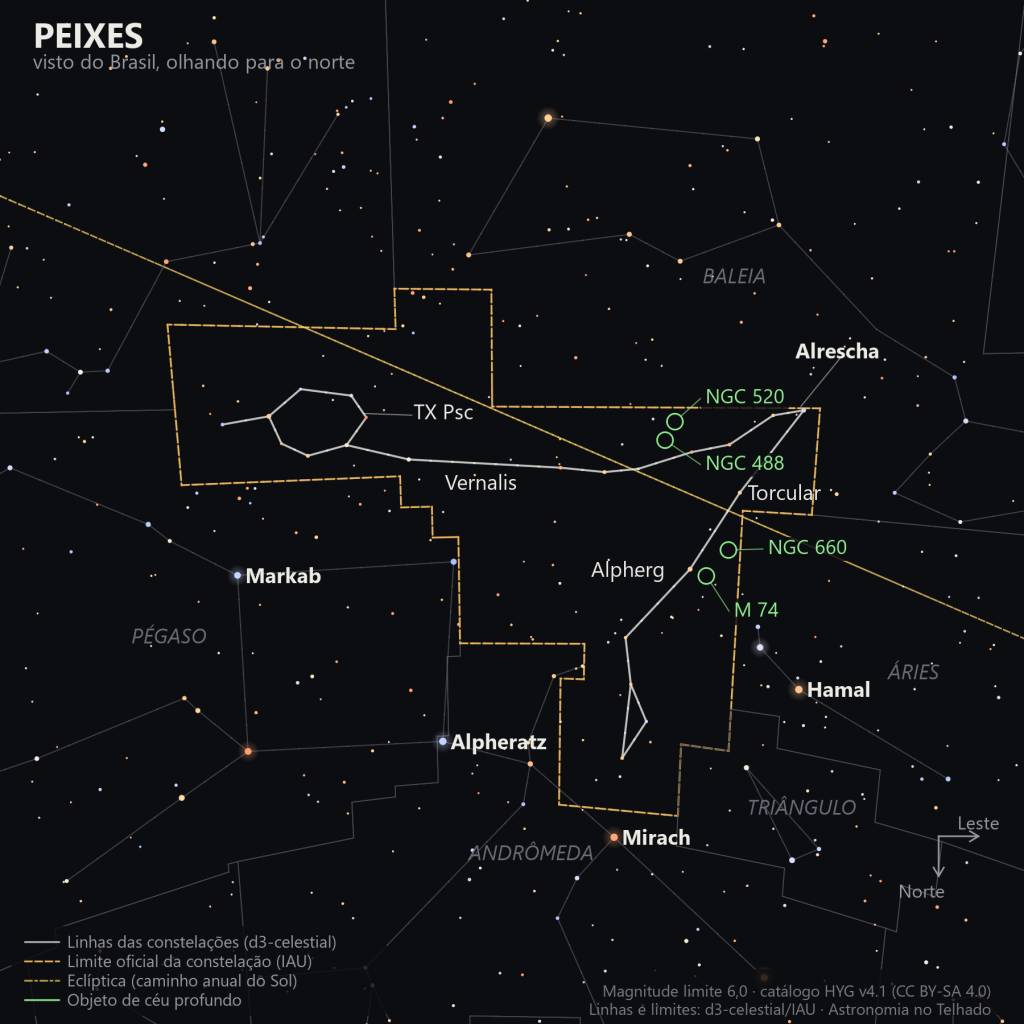
Every March an event takes place that marks the start of autumn in Brazil and of spring in the Northern Hemisphere: the Sun crosses the celestial equator, moving from the southern half of the sky to the northern half. The exact spot where this happens, the vernal point, is the origin of all the right ascensions in star catalogs. Few people know that today it lies inside Pisces, one of the faintest constellations of the zodiac, and not in Aries, as the old name "First Point of Aries" suggests. In this guide you will find Pisces on a dark spring night, get to know the Circlet, Alrescha, a face-on spiral galaxy and a white dwarf that is our neighbor, and understand why the vernal point changed constellations.
Text under review. This is a test article, written from reference sources; the sources are listed at the end.
A large but discreet constellation
Pisces (Pisces, abbreviated Psc) is the 14th largest constellation in the sky, visible from 83° north to 56° south (Ridpath, p. 188), and therefore from all of Brazil. Mourão describes it as the 12th and last zodiacal constellation, between Aquarius and Aries, covering about 899 square degrees (Mourão, entry Pisces, p. 629; the official IAU value is a little smaller). Despite its size and historical importance, it is "not very remarkable in the sky, since its stars are of faint magnitude" (Mourão, p. 629). The brightest, Eta, has magnitude 3.6 (Philip's, entry Pisces, p. 309); Kambič reminds us that the constellation can only be seen on a moonless night, far from light pollution (p. 391).
The figure is two fish joined at the tails by a ribbon, and the point where the cords meet is Alrescha, Alpha Piscium (Philip's, p. 309).
How to find Pisces
When: the nights from October to December are the best. By "best time" we mean 9 p.m. local time, when the constellation culminates: its center is at a right ascension of about 0h30m, which gives early November, and Alrescha (2h02m) culminates in December. Vieira includes it in the "spring sky" (p. 95-101), which has no bright groups high overhead and therefore uses the Great Square of Pegasus as a starting point.
Where to look: for anyone in Brazil, Pisces lies north of the zenith (the central declination is about +11°). Face north. In Rio de Janeiro, the highest part, at the height of Alrescha, passes at about 64° altitude (calculated; the table below gives other cities).
- Find the Great Square of Pegasus. It is the starting point suggested by Vieira (p. 95): four stars of medium brightness, at about 45° altitude, which at this time of year are high in the northern sky.
- Find the Circlet. Just southeast of the Square (on the chart, above and to the right of Markab, since south is up), there is a ring of 4th-magnitude stars: Gamma, Kappa (κ), Lambda, Iota and Theta. It represents the head of the western fish (Kambič, p. 392). Philip's calls it the Circlet and describes a ring of seven stars of 4th and 5th magnitude (p. 309).
- Follow the ribbon. From the Circlet, a line of faint stars runs east to Alrescha, the knot. This is the body of the western fish, which Mourão says lies "beneath the Square of Pegasus" (p. 629).
- Climb to the northern fish. From Alrescha, another line rises toward Beta Andromedae (Mirach), where the other fish lies (Mourão, p. 629; Kambič, p. 391). Eta, the brightest star in Pisces, sits along this line.

| City | Maximum altitude of Alrescha | Maximum altitude of M 74 |
|---|---|---|
| Boa Vista (RR) | about 90° (almost at the zenith) | 77° |
| Manaus (AM) | 84° | 71° |
| Recife (PE) | 79° | 66° |
| Brasília (DF) | 71° | 58° |
| Rio de Janeiro (RJ) | 64° | 51° |
| Porto Alegre (RS) | 57° | 44° |
| Chuí (RS) | 54° | 41° |
Altitudes calculated from the objects' coordinates (SIMBAD) and each city's latitude, at the moment they cross the meridian, to the north; values rounded.
The stars of Pisces
| Star | Visual brightness (mag.) | Spectral type | Approximate distance |
|---|---|---|---|
| Alrescha (alpha) | 3.8 (combined) | two white stars, type A | 140 to 150 light-years |
| Alpherg (eta) | 3.6 | G7 III (yellow giant) | 290 to 370 light-years |
| Gamma | 3.7 | G9 III (yellow giant) | about 135 light-years |
| Vernalis (omega) | 4.0 | F4 V | about 105 to 110 light-years |
| Iota | 4.1 | F7 V | about 45 light-years |
| TX Piscium (19 Psc) | 4.8 to 5.2 (variable) | C-N6 (carbon star) | 400 to 800 light-years |
Brightnesses and spectral types from SIMBAD (CDS, Strasbourg); distances calculated from SIMBAD parallaxes and compared with Moore and Rees (p. 470). Values in older books differ: for Eta, for example, the Data Book gives 294 light-years, while the current parallax points to about 370.
Alrescha is a lovely test for small telescopes. To the naked eye it is a single star, of magnitude 3.8 (Philip's, p. 309). With an aperture of about 100 mm, it splits into two white stars of magnitudes close to 4.2 and 5.1, less than 2 arcseconds apart (Ridpath, p. 188; Moore, p. 263). It is a real, slow binary: the books cite periods between 700 and 930 years (Vieira, p. 101; Mourão, p. 26; Moore, p. 263; Kambič, p. 391). Kambič points out that the separation will shrink to a minimum of 1.1 arcseconds around 2060 (p. 392), so anyone with a telescope should take advantage of this decade to see it. The name comes from Arabic and, according to Mourão, may mean "the cord" that joins the two fish (p. 26).
Vernalis is the name of Omega, and the reason for it is the subject of the zodiac section. Eta, also called Alpherg, is the brightest star in the constellation (Philip's, p. 309). Iota, the nearest on the list, is only about 45 light-years away, a discreet neighbor of the Sun.
TX Piscium is one of the reddest stars in the sky, and lies in the same region as the Circlet, between Iota and Lambda (Kambič, p. 392). It has a magnitude between 4.8 and 5.2, varying irregularly, and is a carbon star: a giant so cool that its atmosphere is full of carbon, which makes it look like "a piece of glowing ember" against a dark sky (Kambič, p. 392). The variation is small (0.4 magnitude) and hard to follow, but the color jumps out in binoculars (Moore and Rees, p. 471). Moore gives a surface temperature of about 2,500 °C (p. 263-264).
Deep-sky objects
M 74, a face-on spiral galaxy
The galaxy M 74 (NGC 628) is the constellation's main deep-sky object, and the only one from the Messier list (Moore, p. 264). According to Ridpath, it is a beautiful spiral seen face-on, which in a small telescope appears as a round glow and shows its arms only in larger apertures or in photographs (p. 188). Kambič also describes it as "face-on" and a little too faint for binoculars; in long-exposure images it shows wide-open arms around a small nucleus (p. 392). Vieira gives its distance as 30 million light-years and about 30 billion stars (p. 100-101). It has a magnitude close to 9.4 (Kambič, p. 392; V 9.5 in SIMBAD), but its light is spread over a large area, which makes it hard to see under city skies. Machholz lists it among the difficult targets of the Messier marathon, still in twilight (p. 105). To find it, use Eta as a starting point (Moore, p. 264; Kambič, p. 392). See the M 74 guide.
NGC 488, NGC 660 and NGC 520
Vieira also mentions the galaxy NGC 488 among the targets in Pisces (p. 100-101): it is a spiral galaxy of magnitude close to 10, about 5 arcminutes across, between the Circlet and Alrescha. Farther east, near Alrescha and the ecliptic, are NGC 660 and NGC 520, two galaxies of about 4 arcminutes and magnitudes 11.3 and 11.5 in the site's catalog. They are targets for telescopes of 150 mm or larger. See the guides: NGC 488, NGC 660 and NGC 520.
Van Maanen's white dwarf
Van Maanen's star (also Wolf 28) is the nearest solitary white dwarf to the Sun known, at about 14 light-years (Moore and Rees, p. 471). It has a magnitude of 12.4 and a diameter of only 0.01 that of the Sun, about the size of Earth, which makes it incredibly dense: about a million times the density of water, according to Moore (p. 264). It lies near Delta Piscium, at a right ascension of 0h49m and a declination of +5°23'. It is not a target for binoculars: at magnitude 12.4 you need a medium-sized telescope and a detailed chart. The discovery was made by Adriaan van Maanen, in 1917 (Moore and Rees, p. 471).
The name holds a story of science. Van Maanen was a Dutch astronomer who worked at Mount Wilson (Philip's, p. 426) and had a famous dispute with Edwin Hubble: he argued that the "spiral nebulae" were local objects and claimed to have measured changes in the arms of galaxies in photographs, something that would only make sense if they were close to the Milky Way. Hubble saw no changes, and the argument was only settled when he measured distances using Cepheid stars, in 1923. Moore concludes that van Maanen made "an honest mistake" (Moore, night of March 31, p. 96).
The zodiac: sign and constellation
Pisces is the last of the twelve constellations of the zodiac, the band of sky through which the Sun, the Moon and the planets pass. The center of this band is the ecliptic, the line of the Sun's apparent path through the year, which appears dashed on the chart. It crosses the constellation, and planets and the Moon often pass near stars such as Zeta, which lies almost on it (Kambič, p. 392). According to Moore, the ecliptic runs through Sagittarius, Capricornus, Aquarius and Pisces (p. 249).
By the official IAU boundaries, the Sun is inside Pisces from around March 13 to April 19 (approximate dates, calculated for the constellation). In the tradition of the signs, however, "Pisces" corresponds to those born between February 19 and March 20 (Mourão, entry Peixes, p. 612). The difference comes from the fact that a sign is a 30° sector of the zodiac, defined by convention, while a constellation is a region of the sky of unequal size, with an outline set by the IAU. About two thousand years ago the two coincided; with precession, the signs fell behind by around 30° and, in Mourão's example, the constellation of Aries is now in the sign of Taurus, and that of Taurus in the sign of Gemini (Mourão, entry signo, p. 736). This is the history and culture of the sky, not a prediction of anything: anyone who wants to know where the Sun was at the time of their birth should look at the real boundaries of the constellations.
The vernal point and precession
The vernal point is the crossing of the ecliptic with the celestial equator, where the Sun passes from the southern to the northern hemisphere (Mourão, entry ponto vernal, p. 641). It is the origin of right ascensions: in a catalog, right ascension 0 means "the meridian of the vernal point." It was called the "First Point of Aries" because, when Hipparchus discovered precession, around 150 BC, the point was in that constellation (Philip's, p. 318; Vieira, p. 53). Precession explains why it left.
The Earth spins like a tilted top. The gravity of the Sun and the Moon, acting on the equatorial bulge, makes the axis trace a cone, and the celestial pole completes a circle in about 25,800 years (Philip's, p. 318; Ridpath, p. 133). Because the celestial equator tilts along with the axis, the point where it cuts the ecliptic slides westward along it, about one seventh of an arcsecond per day (Philip's, p. 143). Doing the math, that gives 1° every 72 years and a 30° sector every 2,150 years or so (calculation from the 25,800-year cycle).
The result: Mourão records that the spring equinox has been in Pisces "since the first century of our era" (p. 629). Vieira gives Pisces from 60 BC to AD 2100 (p. 53). Moore and Rees explain that the vernal point is now a little south of Omega Piscium, "hence the name Vernalis," and moves slowly beneath the western fish toward Aquarius (p. 471). We confirm this with the coordinates: Omega has a declination of about +7°, and the vernal point, +0°. Ridpath says the entry into Aquarius will happen around the year 2600 (p. 188). The dates vary depending on the outline used for the constellation, so it is best to treat them as approximate.
For Brazil there is a change of perspective: in March, when the Sun reaches the vernal point, autumn begins here. The same point is "spring" only in the Northern Hemisphere. The opposite point, the September equinox, is today near Zaniah, in Virgo (Moore and Rees, p. 502).
Mythology and history
The best-known Greek legend says that Aphrodite and her son, Eros, were surprised by the monster Typhon on the banks of the Euphrates and escaped by diving into the river, transformed into fish (Ridpath, p. 188; Philip's, p. 309). In the Roman versions they are Venus and Cupid, and Minerva is said to have placed them in the sky, joined by a cord; hence the popular name "Venus and Cupid" (Vieira, p. 26; Mourão, p. 629). The ribbon that joins the fish is precisely the line of stars that ends at Alrescha.
Mourão notes that for the Egyptians this sign announced the arrival of spring (in the Northern Hemisphere) and the fishing season, and that the Dendera zodiac, now in the Louvre, shows two large fish joined by a band inside a rectangle, a symbol of water. Babylonians, Assyrians and Persians also saw two fish in this group of stars (p. 629).
Observing plan
| Instrument | What to see |
|---|---|
| Naked eye | In a dark, moonless sky: the Circlet, the line of the western fish as far as Alrescha, Eta, and the orange tint of stars such as Gamma and Eta. |
| Binoculars (10×50) | TX Piscium, the carbon star, between Iota and Lambda; wide pairs such as Psi 1 (5.3 and 5.4, at 30.3") and Zeta (5.2 and 6.1, at 23.3") (Kambič, p. 392). M 74 is too faint for binoculars under ordinary skies. |
| Small telescope (70 to 100 mm) | Alrescha split into two white stars; M 74 as a faint, round glow. |
| Medium telescope (150 mm or larger) | The arms of M 74 under excellent skies; NGC 488, NGC 660, NGC 520; the faint van Maanen's star with a chart. |
| DSLR camera | With a telephoto lens and several long exposures, M 74 shows the face-on spiral, with wide-open arms (Kambič, p. 392). |
Field tips:
- Choose a moonless night and a clear northern horizon; Pisces demands a dark sky (Kambič, p. 391).
- Use the Great Square of Pegasus as a starting point and a chart like the one in this article so you don't get lost.
- To see the ecliptic passing through here, note that Zeta lies almost on it, so planets and the Moon often pass nearby (Kambič, p. 392).
References
- KAMBIČ, Bojan. Viewing the Constellations with Binoculars: 250+ Wonderful Sky Objects to See and Explore. New York: Springer, 2010. "Pisces", p. 391-392.
- MACHHOLZ, Don. The Observing Guide to the Messier Marathon: A Handbook and Atlas. Springer (year to be completed). M 74, p. 105.
- MOORE, Patrick (ed.). Philip's Astronomy Encyclopedia. London: Philip's, 2002. Entries "Pisces" (p. 309), "First Point of Aries" (p. 143), "Precession" (p. 318) and "Van Maanen" (p. 426).
- MOORE, Patrick. The Observer's Year: 366 Nights of the Universe. 2nd ed. London: Springer, 2005. Nights of September 29 (p. 249), September 30 (Alrescha, TX Piscium, M 74, p. 263-264) and March 31 (van Maanen, p. 96).
- MOORE, Patrick; REES, Robin. Patrick Moore's Data Book of Astronomy. Cambridge: Cambridge University Press, 2011. "Pisces", p. 470-471; September equinox, p. 502.
- MOURÃO, Ronaldo Rogério de Freitas. Dicionário enciclopédico de astronomia e astronáutica. Rio de Janeiro: Nova Fronteira, 1987. Entries "Alrisha" (p. 26), "Estrela de van Maanen" (p. 285), "Peixes" (p. 612), "Pisces" (p. 629), "ponto vernal" (p. 641) and "signo" (p. 736).
- RIDPATH, Ian. Astronomia (Guia Ilustrado Zahar). 4th ed. Rio de Janeiro: Zahar. Pisces, p. 188; precession, p. 133.
- VIEIRA, Fernando. Identificação do céu. The zodiac and the myth of Pisces, p. 26; precession of the equinoxes, p. 53; the spring sky and Pisces, p. 95-101.
- SIMBAD Astronomical Database. Centre de Données astronomiques de Strasbourg (CDS). Query of brightnesses, spectral types, parallaxes and coordinates, on Sep. 21, 2026.
- HYG Database (v4.1), David Nash / Astronexus, CC BY-SA 4.0 license, used for the star chart; IAU constellation boundaries and d3-celestial lines.