September 24, 2026
Libra, the Scales: a guide to the zodiac constellation that used to be the Scorpion’s claws
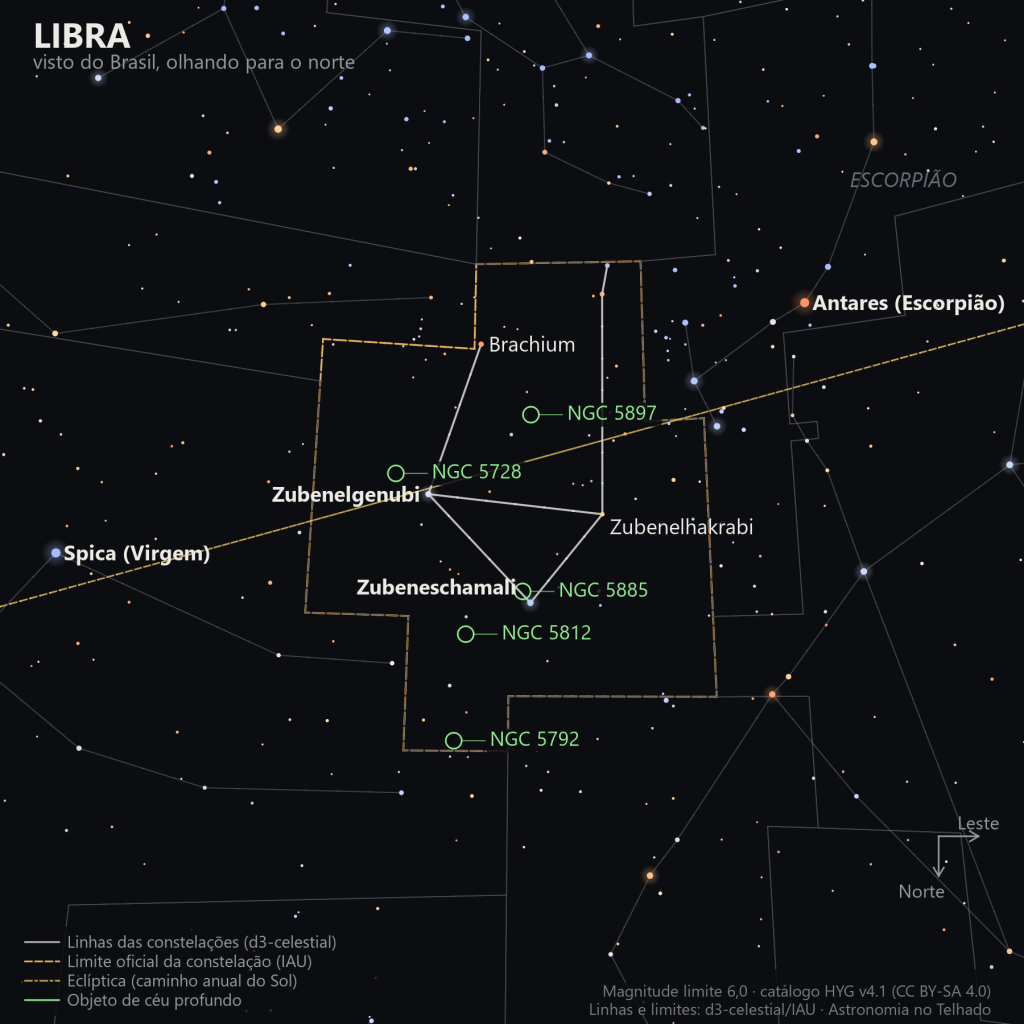
Libra is the zodiac constellation almost nobody can point out in the sky. It has no hero, no monster, no grand myth, and its stars are modest. But it is the Scales, an object among creatures, and before that it was simply the Scorpion's claws. Hidden there are a double star you can split with the naked eye, an eclipsing star you can follow with binoculars, a star some swear is green, a globular cluster, and the neighborhood of Gliese 581, a red dwarf that was once at the center of a famous announcement of a habitable planet. In this guide you will learn how to find it, where the exotic star names come from, and why the September equinox, which began in Libra, now happens in another constellation.
Text under review. This is a test article, written from reference sources; the sources are listed at the end.
How to find Libra
Libra covers about 538 square degrees and lies between Virgo and Scorpius, just south of the celestial equator (Mourão, entry Libra). The easiest way to reach it is to use its two famous neighbors: Spica, the brightest star in Virgo, and Antares, the red heart of the Scorpion. Libra is the patch of sky between them, and Mourão describes it as a quadrilateral of four main stars lying along a line from Spica to Antares.
Step by step, in the early evening in June or July:
- Look north. From Brazil, Libra climbs high and culminates near the zenith over much of the country (see the table below).
- Find Spica, bluish and bright, and Antares, reddish, farther east (to the right, for someone facing north).
- Between them, look for a triangle of 2nd- and 3rd-magnitude stars: Zubenelgenubi, the westernmost (closest to Spica); Zubeneschamali, the brightest, which lies toward the celestial equator (at the bottom of the chart); and Zubenelhakrabi, a little fainter, to the east. Moore notes that Alpha, Beta and Gamma Librae form a triangle (Moore, night of June 26, p. 177).
- Raise your gaze toward the south celestial pole (up on the chart): Brachium, more orange, and the faint stars of Epsilon and Tau complete the constellation's outline.

When and how high
Libra reaches its highest point at 9 p.m. local time around the end of June and the beginning of July (an estimate based on the central right ascension, about 15 h). In October and November it lies on the Sun's side of the sky and cannot be seen at night.
Because the constellation spans declinations from about 0 to 30° south (Mourão), it crosses the sky near the zenith over much of Brazil. We calculated the maximum altitude of the northernmost and southernmost stars of the figure from SIMBAD coordinates:
| City | Zubeneschamali (beta) | Zubenelgenubi (alpha) | Brachium (sigma) |
|---|---|---|---|
| Boa Vista (RR) | 78° to the north | 71° to the north | 62° to the south |
| Manaus (AM) | 84° to the north | 77° to the north | 68° to the south |
| Recife (PE) | 89° to the north | 82° to the north | 73° to the south |
| Brasília (DF) | 84° to the north | 90° (zenith) | 81° to the south |
| Rio de Janeiro (RJ) | 77° to the north | 83° to the north | 88° to the south |
| Porto Alegre (RS) | 69° to the north | 76° to the north | 85° to the south |
| Chuí (RS) | 66° to the north | 72° to the north | 82° to the south |
Altitudes calculated from the stars' coordinates in SIMBAD and each city's latitude; values rounded. Because Libra lies in the zodiac band, it never comes near the celestial pole and sets everywhere in Brazil.
A nice detail: in Brasília, Zubenelgenubi passes practically right over your head. Ridpath notes that Libra can be seen from 60° north to 90° south (Ridpath, p. 179), that is, from almost the entire planet.
A Ptolemaic constellation, without a myth
Libra is one of Ptolemy's 48 constellations, but "no myth seems to be associated with it," apart from a vague link to Mochis, the inventor of weights and measures (Moore, night of June 26, p. 177; Moore and Rees, entry Libra, p. 445). What exists is history: the Greeks grouped these stars as Chelae, the Scorpion's claws, and the Scales proper entered the figure through the Romans, in the 1st century BC, when the autumn equinox took place within it and day and night were of equal length, that is, "in balance" (Philip's, entry Libra, p. 226). The names of the two brightest stars preserve the memory of the claws: they mean "southern claw" and "northern claw" (Ridpath, p. 179; Mourão, entry Kiffa Australis, p. 434).
Mourão gives other versions: Virgil said that ancient farmers saw in it a sign for sowing time; the Romans associated it with the spirit of justice of Julius Caesar; and some authors say the scales were born in Egypt, where, on the Dendera planisphere, they would be a nilometer, the instrument priests used to measure the floods of the Nile (Mourão, entry Libra, p. 469). Vieira sums up the link with the Sun's balance, which brings equal days and nights at the September equinox (Vieira, p. 24-25).
In short, Libra is the only zodiac constellation that represents an object rather than a living being (Philip's, entry Libra, p. 226).
The stars of Libra
| Star | Name | Brightness (V mag.) | Spectral type | Approximate distance |
|---|---|---|---|---|
| Beta (β) | Zubeneschamali | 2.62 | B8 (blue-white) | 120 to 185 light-years, depending on the source |
| Alpha² (α²) | Zubenelgenubi | 2.75 | A (white) | about 76 light-years |
| Sigma (σ) | Brachium | 3.21 (variable) | M2.5 (red giant) | 165 to 290 light-years, depending on the source |
| Gamma (γ) | Zubenelhakrabi | 3.91 | G8.5 (yellow-orange giant) | about 160 light-years (Moore's book gives 75) |
| Delta (δ) | (no proper name) | 4.9 to 5.9 | A0 | about 350 light-years |
Brightnesses, spectral types and parallaxes taken from SIMBAD (CDS, Strasbourg); distances calculated as 3,261.56 divided by the parallax in milliarcseconds. The books give quite different values for several of them, hence the ranges. Star names vary in spelling among sources (for example, Zubeneschamali, Zubeneschemali and Zubenelchemale).
Zubeneschamali (beta) is the brightest star in the constellation, with magnitude 2.6 (Philip's, entry Libra, p. 226). The name comes from Arabic and means "the northern claw" (Mourão, entry Kiffa Borealis, p. 434). Mourão also records an invisible companion, revealed by its spectrum, that orbits it in about 80 years.
Zubenelgenubi (alpha) is the "southern claw" and the easiest target in the constellation: a wide pair of stars of magnitudes 2.8 and 5.2, separated by 231 arcseconds, which makes it a naked-eye pair if the night is dark (Moore, night of June 26, p. 177). The primary is white; the companion is slightly yellowish (Moore), which matches the A and F3 types in SIMBAD. Moore says the two share the same motion through space but are very far apart; Mourão speaks of an optical double, where the stars only appear to be close. The SIMBAD parallaxes (43.0 and 41.8 milliarcseconds) are nearly equal, which supports the idea that they are in the same region of space.
Brachium (sigma; Moore calls it Zubenalgubi) once belonged to Scorpius: the Data Book says that Sigma, Tau and Upsilon Librae were originally in that constellation, and that Sigma was Gamma Scorpii (Moore and Rees, p. 445; Moore, night of June 26, p. 177). Today it is a red giant, the southernmost star of Libra's main figure.
Delta Librae is an Algol-type eclipsing binary: one star passes in front of the other every 2.33 days, and the brightness drops from 4.9 to 5.9, enough to be followed with binoculars (Moore, night of June 26, p. 177). Kambič gives the period as 2.3273543 days, a dip lasting about 6 hours and a distance of about 7 million kilometers between the stars, and suggests comparing Delta with neighboring stars of constant brightness to estimate the drop (Kambič, p. 331).
The star that may be green
Zubeneschamali carries a controversy. No star is truly green to most people, because the mix of light reaching the eyes results in white, blue, orange or red. The exception would be Beta Librae, the only solitary star seen as green by some (Kambič, p. 330; Monks, p. 111-112).
The Reverend T. W. Webb spoke of a "beautiful pale green tint," and T. W. Olcott called it "distinctly green." Moore, an experienced observer, says he has never been able to see any color and suggests: "look for yourself and decide" (Moore, night of June 27, p. 178). Monks reminds us that observers should take care not to "see" what they expect to see, and that there is no good explanation for the supposed green (Monks, p. 111-112).
Kambič relates another ancient puzzle: Eratosthenes described Beta as the brightest star in the region of Scorpius and Libra, and centuries later Ptolemy wrote that it and Antares had the same brightness. Today Antares is much brighter. Either one of the two has changed, or the ancients were wrong (Kambič, p. 330). Moore adds that the evidence that Beta has faded is "very flimsy" (Moore, night of June 27, p. 178). The invitation is this: on a dark night, look at Zubeneschamali without instruments and then with binoculars, and note what you see.
The neighbor Gliese 581
About 1.8° north-northeast of Zubeneschamali (toward the celestial equator, that is, below it on the chart), lies a little star of magnitude 10.6, an M3-type red dwarf cataloged by Wilhelm Gliese as number 581 and about 20 light-years from us (Moore and Rees, Data Book, p. 313; SIMBAD). It has at most a third of the Sun's mass and is so faint that Moore and Rees compare it to a firefly, with the Sun as a flashlight.
Its fame comes from its planets. In September 2010, a team led by Steven Vogt announced the discovery of Gliese 581g, a planet of about 1.9 Earth masses in the habitable zone, based on 122 measurements from the Keck telescope and 119 from the HARPS instrument in Chile. In October, Francesco Pepe, of the Geneva Observatory, reanalyzed the HARPS data and found no trace of either that planet or of another announced one, Gliese 581f; the Data Book concludes that their existence should be "considered questionable" (Moore and Rees, p. 313). The book dates from 2011 and the system has been revised since then; treat the case as an example of how an announcement gets checked.
Deep-sky objects
Libra is not rich in deep-sky objects. The brightest is the 9th-magnitude globular cluster NGC 5897, according to Philip's encyclopedia (entry Libra, p. 226).
NGC 5897 — globular cluster
The cluster has magnitude 8.5 and measures about 11 arcminutes, at some 40,400 light-years, according to Allison, who rates it "difficult" to observe (Allison, p. 154). It is a large, loose globular. In a 200 mm (8-inch) telescope it appears as a faint, diffuse haze, unresolved; from 250 to 300 mm some stars begin to separate, and larger telescopes show its full extent (Allison).
To find it, start from Sigma Librae and go about 5° northeast, almost halfway between Sigma and Gamma (Allison). On the chart, it is the green circle above the Iota region, with north pointing down.
The galaxies of Libra
The galaxies of Libra are faint and call for telescopes of 200 mm or more. Bakich suggests four, all marked on the chart:
- NGC 5728 — Seyfert galaxy. Magnitude 11.5, with an exceptionally bright core; it lies 2.4° west-southwest of Zubenelgenubi (Bakich, object no. 366).
- NGC 5792 — barred spiral galaxy. Seen edge-on, very elongated and considered by some to be the best galaxy in Libra; magnitude 11.2 (Bakich, object no. 371).
- NGC 5812 — elliptical galaxy. Round, 1° north of Delta Librae; it looks like a planetary nebula (Bakich, object no. 373).
- NGC 5885 — barred spiral galaxy. Magnitude 11.8, less than 1° from Zubeneschamali; in a 250 mm telescope it is a faint, nearly uniform haze (Bakich, object no. 381).
The zodiac, the Sun and the ecliptic
Libra is part of the zodiac, the band of sky extending about 8° on either side of the ecliptic, through which the Sun, the Moon and the main planets (except Pluto) appear to pass (Philip's, entry zodiac, p. 445; Mourão, entry zodíaco, p. 885). The ecliptic is the Sun's apparent yearly path; on the chart above it is the dashed golden line, which cuts across Libra diagonally.
The name "zodiac" comes from Greek and means "circle of animals," because almost all the constellations in the band are named after animals (Mourão, p. 885). Libra is the exception. Mourão's entry also lists thirteen constellations crossed by the ecliptic, including Serpentarius (Ophiuchus), which the astrological calendar ignores.
The Sun's dates. By the official boundaries of the International Astronomical Union (IAU), the Sun crosses Libra from about November 1 to 23 (approximate dates, some 23 days). Note that this is only a few days, because the ecliptic crosses just one part of the constellation. At that time the Scales lie on the same side of the sky as the Sun and cannot be seen at night.
A sign is not a constellation. In astrology, the zodiac is divided into twelve equal signs of 30°, and Libra is assigned to those born between September 23 and October 22 (Mourão, entry Balança, p. 469). But signs and constellations have drifted apart. Because of precession, the slow wobble of Earth's axis, which completes one cycle in about 25,800 years, and because of redefinitions of the boundaries, the signs no longer coincide with the constellations (Philip's, p. 445). Mourão gives an example: two thousand years ago, at the autumn equinox, the Sun was in Libra (Mourão, p. 469), and today the constellation of Aries is in the sign of Taurus and Taurus in that of Gemini (Mourão, entry signo, p. 736). This is astronomy and history, with no predictions.
The September equinox. At the equinoxes the Sun crosses the celestial equator. The "First Point of Libra" is the point where the Sun crosses the equator from north to south, around September 23; it got that name when it lay in Libra, but precession has pushed it far away. Today it is in Virgo, between Beta and Eta Virginis (Moore, night of June 28, p. 178; Philip's, entry First Point of Libra, p. 143). For us in the Southern Hemisphere, it is the spring equinox, which begins on September 23 (Mourão, entry on the equinox, p. 269).
Observing plan
| Instrument | What to see |
|---|---|
| Naked eye | The triangle of Zubeneschamali, Zubenelgenubi and Zubenelhakrabi between Spica and Antares; the double Zubenelgenubi split into two stars, under a dark sky; the color of Brachium; the "green star" test. |
| Binoculars (10×50) | The double Zubenelgenubi well split and colored; Iota Librae, a double of magnitudes 5 and 6 (Ridpath, p. 179); the variation of Delta Librae over a few hours. |
| Small telescope (70 to 100 mm) | The 9th-magnitude companion of Iota Librae (Ridpath, p. 179); other doubles in the constellation. |
| Medium telescope (200 mm or more) | NGC 5897 as a faint haze and the galaxies NGC 5728, 5792, 5812 and 5885 as diffuse smudges (Allison; Bakich); the dot of Gliese 581 with the chart in hand. |
Field tips:
- Choose a moonless night in June or July and look for Libra right after dusk, when it is high in the north.
- Since the constellation climbs so high, a reclining lawn chair helps.
- For Delta Librae, note the time and the comparison with the neighboring stars Mu and Xi² Librae every 30 to 60 minutes; a drop of 1 magnitude within a few hours is a sign you have hit the target (Kambič, p. 331).
- Faint galaxies and globular clusters demand a dark sky and dark-adapted eyes.
References
- ALLISON, Mark. Star Clusters and How to Observe Them. London: Springer, 2006. NGC 5897, p. 154.
- BAKICH, Michael E. 1,001 Celestial Wonders to See Before You Die. New York: Springer, 2010. Objects no. 366 (NGC 5728), 371 (NGC 5792), 373 (NGC 5812) and 381 (NGC 5885).
- KAMBIČ, Bojan. Viewing the Constellations with Binoculars: 250+ Wonderful Sky Objects to See and Explore. New York: Springer, 2010. Chapter "Libra", Beta Librae, p. 330; Delta Librae, p. 331.
- MONKS, Neale. Go-To Telescopes Under Suburban Skies. Springer (publisher and year to be completed). Beta Librae, p. 111-112.
- MOORE, Patrick (ed.). Philip's Astronomy Encyclopedia. London: Philip's, 2002. Entries "First Point of Libra" (p. 143), "Libra" (p. 226) and "zodiac" (p. 445).
- MOORE, Patrick. The Observer's Year: 366 Nights of the Universe. 2nd ed. London: Springer, 2005. Nights of June 26 ("Libra", p. 177), June 27 ("Beta Libræ: a Green Star?", p. 178) and June 28 ("The First Point of Libra", p. 178).
- MOORE, Patrick; REES, Robin. Patrick Moore's Data Book of Astronomy. Cambridge: Cambridge University Press, 2011. Entry Libra, p. 445; habitable zone and Gliese 581, p. 313.
- MOURÃO, Ronaldo Rogério de Freitas. Dicionário enciclopédico de astronomia e astronáutica. Rio de Janeiro: Nova Fronteira, 1987. Entries "Kiffa Australis" and "Kiffa Borealis" (p. 434), "Libra" and "Balança" (p. 469), "equinócio" (p. 269), "signo" (p. 736) and "zodíaco" (p. 885).
- RIDPATH, Ian. Astronomia (Guia Ilustrado Zahar). 4th ed. Rio de Janeiro: Zahar. Balança, p. 179.
- VIEIRA, Fernando. Identificação do céu. Balança and the September equinox, p. 24-25; origin of the symbols, p. 31.
- SIMBAD Astronomical Database. Centre de Données astronomiques de Strasbourg (CDS). Query of brightnesses, spectral types, parallaxes and coordinates, on Sept. 21, 2026.
- HYG Database (v4.1), David Nash / Astronexus, CC BY-SA 4.0 license, used for the star chart; IAU constellation boundaries and d3-celestial lines.