September 24, 2026
Capricornus: a guide to the sea goat, its naked-eye double star, and the planet found next door
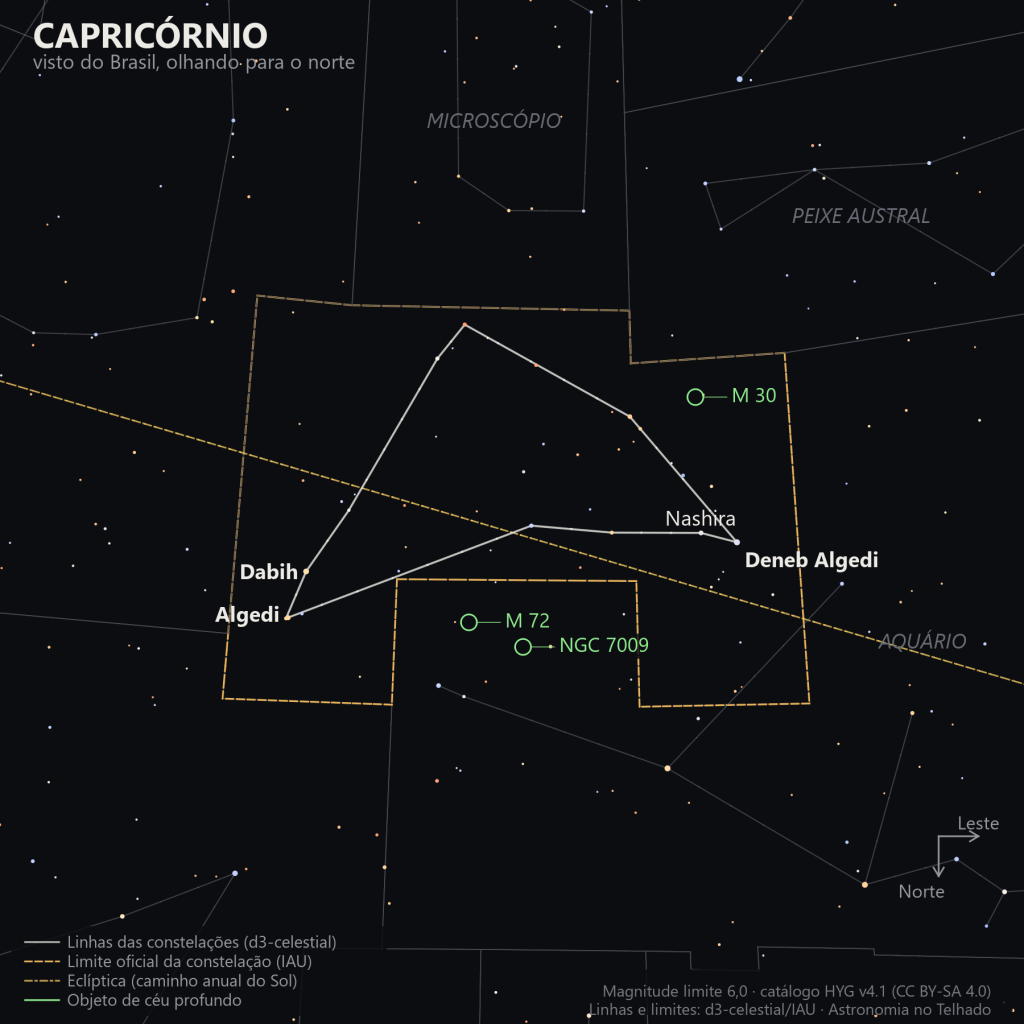
Capricornus is one of those constellations that everyone knows by name and almost nobody can point out in the sky. It is the smallest in the zodiac, it has no truly bright star, and on top of that it carries an impossible creature: half goat, half fish. It is still worth the hunt. It holds a pair of stars you can split with the naked eye, a curious globular cluster, and a direct link to one of the most beautiful stories in astronomy, the discovery of Neptune, which was found just a few degrees from here. It also gives its name to the tropic that crosses Brazil. In this guide you will learn how to find it, get to know its stars, hear the myth of Pan and understand, without any astrology, why the "sign of Capricorn" and the constellation of Capricornus are not the same thing.
Text under review. This is a test article, written from reference sources; the sources are listed at the end.
The smallest creature in the zodiac
Capricornus (abbreviation Cap) covers about 414 square degrees of sky in the southern region, between Sagittarius and Aquarius (Mourão, entry Capricornus; Moore and Rees, table of constellations). Philip's describes it as the smallest constellation of the zodiac (entry Capricornus). Its figure is among the least evocative in the sky: Moore points out that there is no distinct pattern and that the brightest star, Delta, is only magnitude 2.9 (The Observer's Year, night of 12 September). Mollise jokes that the sea goat looks even less like its name than the other figures do.
What helps is the overall shape. Mourão describes it as a triangle: Alpha and Beta to the north and Omega to the south, with the longest side parallel to the celestial equator. Mollise speaks of a "kite" or triangle, with Zeta on the eastern side. From the Northern Hemisphere people usually see a smile or a boat, with the curve at the bottom; from Brazil, looking north, the figure appears upside down and resembles a triangle with its base closer to the horizon and its apex (Omega) pointing up, as the chart below shows.
When and where to look
It is well placed in late winter and in spring. With the center of the constellation at a right ascension of about 21 hours, it crosses the meridian at 9 pm local time between late September and early October. In practice, it is easy to see in the early evening from August to November. After that, it sinks lower in the west until it vanishes in the twilight of the January Sun.
For anyone living in Brazil, Capricornus passes very close to the zenith. Since the declination of the main stars lies between about -12° and -17°, in Brasília the constellation sits practically at the highest point of the sky. In cities to the south it passes north of the zenith (look north); in cities to the north it passes south of the zenith. We did the calculation with the declinations of Dabih and Deneb Algedi:
| City | Maximum altitude of Dabih to Deneb Algedi | Culminates |
|---|---|---|
| Boa Vista (RR) | 71° to 72° | south of the zenith |
| Manaus (AM) | 77° to 78° | south of the zenith |
| Recife (PE) | 82° to 83° | south of the zenith |
| Brasília (DF) | 89° to 90° | almost at the zenith |
| Rio de Janeiro (RJ) | 82° to 83° | north of the zenith |
| Porto Alegre (RS) | 75° to 76° | north of the zenith |
| Chuí (RS) | 71° to 72° | north of the zenith |
Altitudes calculated from the star coordinates in SIMBAD and the latitude of each city; values rounded.
A trick from Vieira helps you find the figure: the star Altair, in Aquila, is the middle one of a row of three stars pointing southeast, straight toward Capricornus (Vieira, p. 100). Moore says the same thing: the row of three with Altair in the center leads to Delta Capricorni (The Observer's Year, night of 12 September). Vieira compares the shape to a "delta wing". Nearby, to the south, shines Fomalhaut, in the Southern Fish, a good anchor for checking your result.

The stars of the sea goat
| Star | Visual brightness (mag.) | Spectral type | Approximate distance |
|---|---|---|---|
| Deneb Algedi (delta) | 2.83 (variable, about 0.2) | A5 to F2 III (eclipsing binary) | about 39 light-years |
| Dabih (beta) | 3.08 (combined) | G9 II + B8 (close double) | about 390 light-years (books: 100 to 340) |
| Algedi (alpha²) | 3.58 | G9 III | about 109 light-years |
| Algedi (alpha¹) | 4.27 | G3 Ib (supergiant) | 800 to 1,600 light-years (sources disagree) |
| Nashira (gamma) | 3.67 | F0 to F2 | about 171 light-years |
| Zeta | 3.74 | G4 Ib (supergiant) | about 440 light-years (books: up to 1,470) |
| Omega | 4.12 | M0 III (red giant) | about 550 light-years |
Brightnesses, spectral types and parallaxes taken from SIMBAD (CDS, Strasbourg). Distances come from parallaxes measured by the Hipparcos satellite; older books give quite different values, and for several stars I give ranges.
Deneb Algedi ("the kid's tail" in Arabic) is the brightest star in the constellation and a close neighbor of the Sun: about 39 light-years away. It is a Beta Lyrae-type eclipsing binary with a period of just over a day (1.02); Philip's mentions a variation of 0.2 magnitude and Moore less than 0.1, which already shows that only precision instruments notice the change (Philip's, entry Capricornus; Moore, night of 12 September). One curiosity that makes it a fine anchor: Neptune was first seen about 4 degrees northeast of it, as I tell below.
Dabih (Beta) is a true double. The companion, of magnitude 6.1, lies about 205 arcseconds away (more than 3 arcminutes), a comfortable separation for binoculars and any small telescope. Moore confirms that the two move together through space, which points to a real association, and Ridpath describes the colors as yellow and bluish-white (Moore, night of 14 September; Ridpath, p. 205). SIMBAD also classifies the main star as a spectroscopic binary, that is, a system with more than two stars in total.
Algedi (Alpha) is this article's naked-eye test and the best reason to observe Capricornus. What looks like one star is really a pair of yellow stars separated by about 6 arcminutes (roughly one fifth of the Moon's diameter). Moore gives magnitudes of 3.6 and 4.2 and a separation of 378"; Philip's gives 3.6 and 4.3 (Moore, night of 14 September; Philip's, entry Capricornus). Mourão covers the pair in the entry Algedi (p. 21). One detail that confuses people reading charts: the brighter one is called Alpha² and the fainter one Alpha¹. And the two stars do not form a system. Alpha² is about 109 light-years away, a little over a hundred; Alpha¹ is a supergiant much farther off, somewhere between 800 and 1,600 light-years depending on the book (Mourão gives 1,100; Moore, 1,600; Vieira, 1,500 and 100). It is a pure coincidence of alignment. Moore also records a historical detail: in antiquity the two were closer together, and only in the 17th century did the proper motion of the nearer one carry them far enough apart to be seen separately with the naked eye.
Deep-sky objects
Moore is blunt: besides being faint and shapeless, Capricornus is poor in objects (The Observer's Year, night of 15 September). Mollise agrees that the only highlight, apart from its place in the zodiac, is the globular cluster. That is why the chart also shows two neighbors in Aquarius, mentioned by Vieira.
M 30 — globular cluster
The cluster M 30 (NGC 7099) was discovered by Charles Messier in 1764; he described it as round and with no visible stars (Moore, night of 15 September). Its integrated brightness is around 7 to 7.5 (SIMBAD lists 7.1; Mollise, 7.5), and it spans about 9 to 11 arcminutes. In binoculars it is at the limit; in a small telescope it shows up well, and with 15 cm it begins to resolve even from a city. Mollise draws attention to its irregular shape: three "trails" of stars on the northern edge give the cluster a lopsided, somewhat "half-moon" look, and astronomers point to the object as a case of "core collapse" (Mollise, p. 199-200).
To find it, use Zeta: M 30 lies about 3° east-southeast of that star (Bakich, object no. 679; Mollise gives 3°20′ east and slightly north) or 23 arcminutes west of 41 Capricorni, a magnitude 5.2 star in the same binocular field. The distance varies between sources: Moore says 41,000 light-years, Mollise 26,000 and SIMBAD lists values around 24,000. This text uses the range of 24,000 to 41,000 light-years.
M 72 and the Saturn Nebula (NGC 7009), in neighboring Aquarius
Right after Capricornus, Vieira cites two gems of Aquarius that can be caught on the same night: the globular cluster M 72, which he places about 60,000 light-years away, and NGC 7009 — Saturn Nebula, a small, bluish planetary nebula (Vieira, p. 100). Both lie near the northern border of Capricornus, within the field of binoculars and a small telescope.
Mythology and history
There is no single story for the sea goat, and Moore admits that there is no well-defined myth of a "sea goat", only the suggestion that the figure is linked to the god Pan (The Observer's Year, night of 12 September). The most-told version comes from Philip's and Mourão. During a banquet of the gods on the banks of the Nile, the monster Typhon suddenly appeared. Everyone transformed in order to flee. Pan, god of shepherds, threw himself into the river and became a being that was half fish from the waist down, and half goat from the waist up (Philip's, entry Capricornus, p. 71; Mourão, entry Capricornus, p. 146). Ridpath tells the same story, with Pan as a "half-fish" (p. 205), and Vieira recalls that other traditions link the figure to the goat Amalthea, who was said to have nursed Zeus, and that the ancients called Capricornus the "gate of the gods" (Vieira, p. 25). Vieira also tells us that the Roman king Numa Pompilius began the year with the Sun in the middle of Capricornus (p. 25) and that the sign's glyph comes from the initials of tragos, "goat" in Greek (p. 32).
The constellation is ancient: Moore notes that it is one of the originals listed by Ptolemy.
The zodiac, the tropic and the "sign" of Capricorn
Here is the part that confuses people most, and it applies to all of Brazil. Note that Capricorn has three different meanings, and it is easy to mix them up:
- The constellation: the pattern of stars and the region of the sky with an official IAU boundary, the one shown in the chart above.
- The sign: a 30° division of the zodiac, inherited from ancient tradition. Moché reminds us that the zodiac is a band about 16° wide around the ecliptic and that antiquity divided it into 12 constellations or signs of 30° each (Moché, item 1.17, p. 21). Mourão records that the sign of Capricorn corresponds to people born from 22 December to 19 January (entry Capricornus, p. 146).
- The Tropic of Capricorn: a parallel on Earth, at a latitude of about 23°27' south, where the Sun passes through the zenith at the December solstice (Mourão, entry trópico, p. 806; Philip's, entry Tropic of Capricorn, p. 414).
The ecliptic, the dashed line on the chart, is the Sun's apparent path among the stars over the year. Moore explains that it cuts through Capricornus north of Theta and well north of Delta (The Observer's Year, night of 11 September). The Sun crosses the constellation's official boundaries from about 21 January to 16 February (about 27 days; approximate dates, using the IAU boundaries). Those dates have nothing to do with the sign, and the difference is almost a month.
Why the difference? Because of the precession of the equinoxes. The Earth's axis turns slowly, like a spinning top, and takes about 25,800 years to complete one turn; as a result, the equinoxes shift backward along the ecliptic (Mourão, entry precessão dos equinócios, p. 644). The signs were defined some 2,000 years ago, and since then the stars have "moved" relative to the calendar dates. Mourão himself says that two thousand years ago the Sun was in Capricornus at the December solstice (entry Capricornus, p. 146). That is where the tropic's name comes from: geographers named the parallel at 23° south the "Tropic of Capricorn" because, at the time, the Sun was in that constellation when it reached its southernmost point. Today that point lies in the constellation of Sagittarius, as Mourão himself observes: "Sagittarius is the point where the Sun is when it is at its southernmost". The tropic's name stuck as a historical inheritance, but it is no longer defined by the constellation. The Sun only "enters" Capricornus weeks after the solstice.
The December solstice, by the way, is summer in Brazil: around 21 December is the longest day in the Southern Hemisphere (Vieira, p. 52). On that day the Sun reaches about 23.5° south of the celestial equator, its southernmost point, and at noon it passes directly overhead at the Tropic of Capricorn. The tropic crosses Brazil at the latitude of the state of São Paulo (general knowledge; see pending items).
None of this has anything to do with predictions: signs and constellations are cultural and historical conventions, and astronomy only describes where the Sun is.
The discovery of Neptune, a few degrees from Delta
This is the article's historical hook. Neptune was the first planet discovered by calculation before it was seen. In 1820, Alexis Bouvard noticed irregularities in the orbit of Uranus, and John Couch Adams (England) and Urbain Le Verrier (France) independently calculated where the disturbing planet should be. The English Astronomer Royal set Adams's results aside; Le Verrier wrote to the observer Johann Galle, who saw the planet on the night of 23 September 1846 in Berlin (Mourão, entry Netuno, p. 563-564; Philip's, entry Neptune, p. 279). Moore adds a geographic detail that matters to us: the spot in the sky where Neptune was identified by Galle and d'Arrest lay about 4° northeast of Delta Capricorni (The Observer's Year, night of 12 September), and Vieira records that the discovery was in Aquarius (p. 100). In other words, in spring, the planet that "was born on paper" was found a few degrees from Deneb Algedi. Neptune is no longer there today: since it takes 164 years to go around the Sun, it only completed its first orbit since discovery in 2011 (general knowledge; see pending items), but it is a lovely story to tell anyone who is still in the backyard looking at that region.
Observing guide
| Instrument | What to see |
|---|---|
| Naked eye | The triangle of Capricornus under a dark sky; Alpha (Algedi) split into two yellow stars; the slightly orange color of Dabih and Zeta; the Altair-Delta row as a guide. |
| Binoculars (10×50) | The companion of Dabih (magnitude 6.1); M 30 at the limit, near 41 Cap; M 72 and the Aquarius region to the north. |
| Small telescope (70 to 100 mm) | M 30 clearly visible and starting to resolve; the companion of Dabih; the Saturn Nebula as a tiny bluish disk. |
| Medium telescope (150 mm) | M 30 with the star "trails" on the northern edge that Mollise highlights. |
| DSLR camera | The whole constellation with a wide-angle or 50 mm lens; the line of the ecliptic is a great place to capture passing planets. |
Field tips:
- Choose a moonless night between August and November and look first for the Altair-Delta row, then Dabih and Algedi.
- Use the Algedi double as a test of your eyesight and of the sky: if you can split the two with the naked eye, the sky is good.
- For M 30, move east from Zeta or start from 41 Capricorni; it does not show up with the naked eye.
- Since the ecliptic runs through the constellation, it is common to see the Moon and planets there: check in an app before heading out.
References
- BAKICH, Michael E. 1,001 Celestial Wonders to See Before You Die. New York: Springer, 2010. Object no. 679 (M 30).
- MOCHÉ, Dinah L. Astronomy: A Self-Teaching Guide. 7th ed. Item 1.17 (ecliptic and zodiac), p. 21.
- MOORE, Patrick (ed.). Philip's Astronomy Encyclopedia. London: Philip's, 2002. Entries "Capricornus" (p. 71), "Tropic of Capricorn" (p. 414) and "Neptune" (p. 279).
- MOORE, Patrick. The Observer's Year: 366 Nights of the Universe. 2nd ed. London: Springer, 2005. Nights of 11 September (ecliptic and zodiac), 12 September (Capricornus), 14 September (Beta and Alpha Capricorni) and 15 September (M 30), p. 249-252.
- MOORE, Patrick; REES, Robin. Patrick Moore's Data Book of Astronomy. Cambridge: Cambridge University Press, 2011. Table of constellations (Capricornus, 414 square degrees), p. 368.
- MOLLISE, Rod. The Urban Astronomer's Guide: A Walking Tour of the Cosmos for City Sky Watchers. London: Springer, 2006. M 30, p. 199-200.
- MOURÃO, Ronaldo Rogério de Freitas. Dicionário enciclopédico de astronomia e astronáutica. Rio de Janeiro: Nova Fronteira, 1987. Entries "Algedi" (p. 21), "Capricornus" (p. 146), "Netuno" (p. 563-564), "precessão dos equinócios" (p. 644) and "trópico" (p. 806).
- RIDPATH, Ian. Astronomia (Guia Ilustrado Zahar). 4th ed. Rio de Janeiro: Zahar. Capricornus, the myth of Pan and Beta Capricorni, p. 205.
- VIEIRA, Fernando. Identificação do céu. Zodiac, myths and glyph of Capricorn, p. 25 and 32; December solstice, p. 52; Capricornus, Aquarius and Neptune, p. 100.
- SIMBAD Astronomical Database. Centre de Données astronomiques de Strasbourg (CDS). Query of brightnesses, spectral types and parallaxes, on 21 Sept. 2026.
- HYG Database (v4.1), David Nash / Astronexus, CC BY-SA 4.0 license, used for the star chart; IAU constellation boundaries and d3-celestial lines.