September 24, 2026
Aries, the Ram: a guide to the constellation that once opened the year and named the equinox
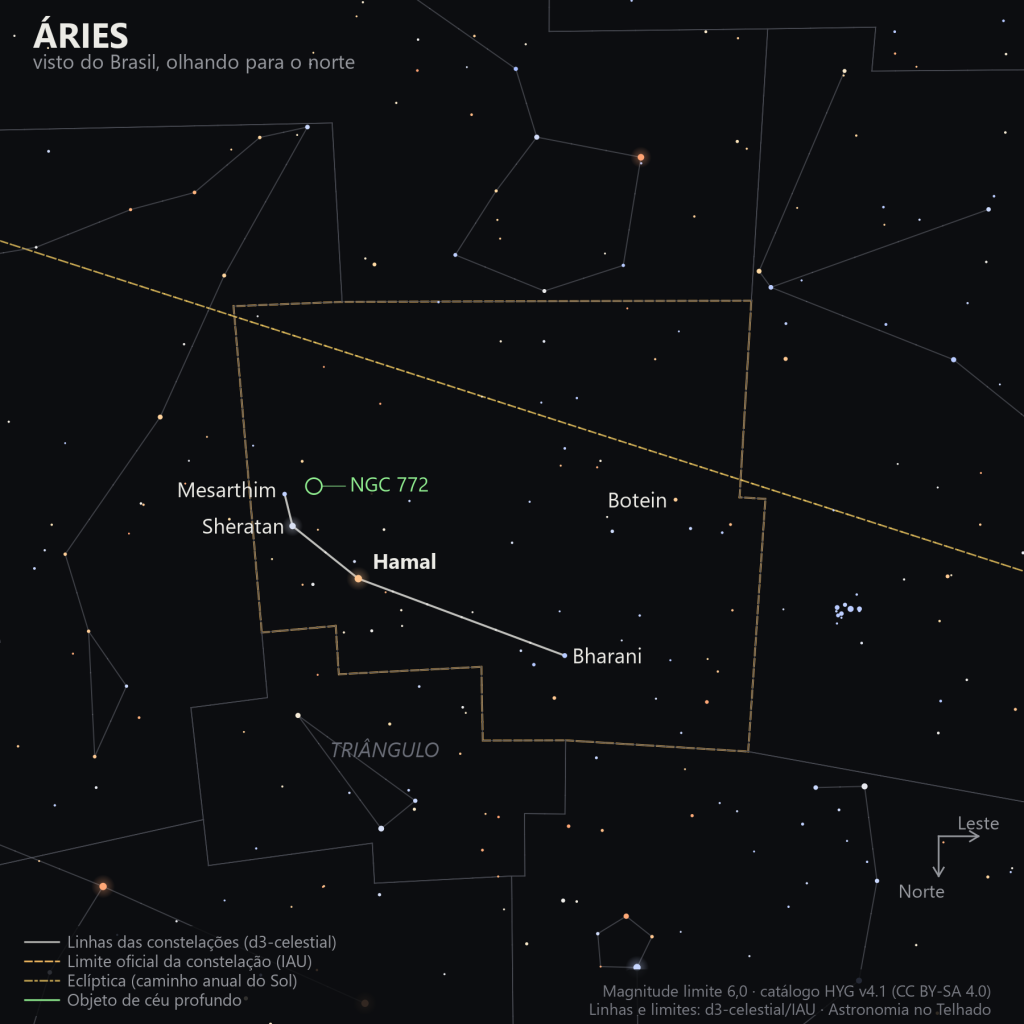
If you ask someone to point out the Ram in the sky, chances are they won't know where to look. Aries is small, discreet and has only one truly bright star. And yet few constellations weigh as heavily on the history of astronomy: the Babylonians opened their calendar with it, astronomers still measure right ascension from a point called the "first point of Aries," and the equinox that marks the start of spring in the northern hemisphere (and of autumn in ours) has not been inside it for a very long time. In this guide you will learn how to find it in Brazil's sky, get to know its stars (including a pair that the Englishman Robert Hooke discovered by accident), understand why the Aries "sign" does not match the constellation, and see what is worth aiming at there, from the naked eye to the telescope.
Text under review. This is a test article, written from reference sources; the sources are listed at the end.
A discreet constellation with an enormous history
Aries (Aries, abbreviation Ari) covers 441 square degrees of sky, between Pisces to the west and Taurus to the east (Mourão, entry Aries; Moore and Rees, constellation table). It is the first constellation in the list of the zodiac, and the reason is historical. According to Mourão, the Babylonians adopted the Ram to mark the start of the year because, around 2500 BC, the spring equinox (of the northern hemisphere) fell in the middle of the three stars that make up its head. Philip's Astronomy Encyclopedia says that around 150 BC the equinox was still inside the constellation, which is why it is still called, by tradition, the first point of Aries.
Anyone who looks at the Ram without that history behind it sees nothing exceptional: a curved line with three stars and a handful of faint points around it. The charm lies in knowing what it has preserved.
How to find Aries from Brazil
When. Constellations culminate (reach their highest point) around 21:00 local time in a month that depends on their position in the sky. Aries is centered near 2 h 40 min of right ascension, so it culminates at 21:00 in mid-December, and it is a constellation of the late-spring and summer sky: it can be seen well from November to January, and still early in the evening until February. Because the Sun crosses the region between late April and mid-May, it disappears in the twilight glow during the other half of the year.
Where to look. Aries lies north of the celestial equator and, from Brazil, culminates facing north. In Rio de Janeiro (latitude 23° S), Hamal passes at about 44° altitude and Mesarthim at about 48°: quite high, but with your body turned to the north.
| City | Maximum altitude, Hamal to Mesarthim | Comment |
|---|---|---|
| Manaus (AM) | 63° to 68° | near the zenith |
| Recife (PE) | 59° to 63° | high in the sky |
| Brasília (DF) | 51° to 55° | comfortable |
| Rio de Janeiro (RJ) | 44° to 48° | high |
| Porto Alegre (RS) | 37° to 41° | medium |
| Chuí (RS) | 33° to 37° | lower, but easy |
Altitudes calculated by us from the stars' declinations (SIMBAD) and each city's latitude, using the formula maximum altitude = 90° minus the difference between latitude and declination; values rounded.
Step by step.
- Start with the Pleiades (M 45 — as Plêiades), the easiest cluster in the region. From there, move toward Pisces (west): about 23 degrees later, at the same altitude, you reach Hamal.
- Another option: Hamal lies about 27 degrees east of Alpha Andromedae, the corner of the Great Square of Pegasus. Moore places Aries a little south of the line of Andromeda's stars; for us, looking north, that means above that line, closer to the zenith.
- Hamal is the only 2nd-magnitude star for many degrees around, with an evident orange color. To its left (west, for someone facing north) are Sheratan and Mesarthim, which form with Hamal the small flattened triangle that Mourão describes as the shape of the constellation.

The stars of the Ram
| Star | Position | Visual brightness (mag.) | Spectral type | Approximate distance |
|---|---|---|---|---|
| Hamal (alpha) | the brightest | 2.01 | K2 III (orange giant) | about 66 light-years |
| Sheratan (beta) | next to Hamal | 2.65 | A5 V (white) and companion | about 59 light-years |
| Bharani (41 Ari) | east of Hamal | 3.59 | B8 V (blue-white) | about 166 light-years |
| Mesarthim (gamma) | far west | 4.5 to 4.6 (each) | A0 V and A2 IV | about 170 light-years |
| Botein (delta) | east | 4.37 | G9.5 III (orange giant) | about 165 light-years |
| Lambda | west of Hamal, at the same altitude | 4.77 | F0 V | about 132 light-years |
Brightnesses, spectral types and parallaxes consulted in SIMBAD (CDS, Strasbourg). Distances come from parallaxes from the Hipparcos satellite; older books give different values (for example, 66 to 85 light-years for Hamal).
Hamal (Alpha Arietis) is an orange giant with twice the Sun's mass and about 15 solar diameters (Moore and Rees). Mourão gives it as a K2 star at 78 light-years, with the brightness of 60 suns; Hipparcos suggests a slightly smaller distance. The name comes from Arabic and originally designated the whole constellation, the "ram" (Mourão, entry Hamal). Hamal's orange hue is one of the few touches of color in the region.
Sheratan (Beta) means "the horns" in Arabic (Mourão, entry Sheratan). It is a spectroscopic binary: the companion, probably of type G, completes an orbit every 107 days, and that orbit is highly elongated (eccentricity 0.88, according to Moore and Rees). Because the two stars are so close together, no telescope separates them; the duplicity shows up only in the spectrum.
Bharani (41 Ari) has no Greek letter, and the reason is a map curiosity: it once belonged to a rejected constellation, Musca Borealis (the Northern Fly), and was left out of Bayer's system (Moore and Rees).
Mesarthim (Gamma) is the constellation's best telescope target, and deserves the next section.
Botein (Delta) is a fainter orange giant in the east of the constellation. A curious note from Moore and Rees: the star 53 Arietis (UW Ari) is one of three runaway stars believed to have been ejected from the Orion Nebula about two million years ago; the other two are AE Aurigae and Mu Columbae. In the sky it is magnitude 6.1 (SIMBAD), so it needs a good dark sky or binoculars.
Mesarthim, the pair Hooke found by accident
Gamma Arietis looks like a single star to the naked eye, of magnitude 3.9 with the two combined (Ridpath), but it is one of the easiest double stars in the sky. With a small telescope you see two white or blue-white stars, nearly identical, separated by about 7.6 to 7.8 arcseconds (Moore; Philip's Astronomy Encyclopedia). The magnitudes vary among sources: both around 4.6 in Philip's, 4.75 and 4.83 in Moore and Rees, and SIMBAD lists 4.59 and 4.52. Bakich calls it "car headlights," for the pair of equal brightnesses (Bakich, object no. 810).
The one who found the pair was Robert Hooke, in 1664, while looking for a comet. Moore tells us he discovered the duplicity by accident, and that there has been almost no relative change in the positions since then. Moore and Rees estimate the orbital period at more than 5,000 years, which is why almost nothing changes: the stars seem fixed relative to each other. A third star, of magnitude 9, appears at 221 arcseconds, but it has a different motion and probably does not belong to the system, even though catalogs still call it "Gamma Arietis C" (Moore).
The origin of the name is disputed. Bakich, citing Allen, lists two hypotheses: a link to a Hebrew word for "ministers," or an error by Bayer, who did not know the term referred to the lunar mansion of Gamma and Sheratan. Mourão records that another name for Mesarthim is "First Star in Aries." It is worth treating this origin as uncertain.
Lambda Arietis is a wider double: a star of magnitude 4.9 and a companion of 7.7, separated by about 37 arcseconds. It is easy in any small telescope, and it is a good pair for a "color test": Bakich notes that observers report different colors for the pair (yellow and blue, white and blue, orange and green), which shows that each eye responds to colors in its own way (Bakich, object no. 814).
A deep-sky object: NGC 772
Aries' deep sky is poor, and Philip's Astronomy Encyclopedia says bluntly that the brightest object is the 10th-magnitude galaxy NGC 772 — galáxia espiral. It lies about 1 degree east of Mesarthim, so you can hop from one to the other in the same finder field. It measures 7.3 by 4.6 arcminutes and interacts gravitationally with a very faint neighbor, NGC 770 (magnitude 13), about 3 arcminutes to the south-southwest; this interaction distorts the spiral in photographs. The nickname "Fiddlehead," given by O'Meara, comes from the brightest arm, which resembles a fern frond unrolling (Bakich, object no. 815).
For observing, be prepared for a diffuse object: a 250 mm telescope shows the bright center and a haze around it. In images, the interaction with the neighbor deforms the spiral, and that is what makes the pair interesting for astrophotography.
Mythology and history: the ram of the golden fleece
The myth most closely tied to the Ram is that of Colchis. Mourão tells it like this: Phrixus and Helle were children of Athamas, king of Thessaly, in a time of drought and famine. To appease the wrath of their stepmother Ino, their father decided to sacrifice the children. To save them, the god Mercury (Hermes) sent a miraculous ram that carried them in flight to Colchis. The Data Book adds that the animal flew, that Helle lost her balance and fell into the sea, in the stretch now called the Hellespont, and that Phrixus arrived safe and sound. After the ram's death, the golden fleece was hung in a sacred grove, from which it was taken by the Argonauts, led by Jason (Moore and Rees). The same myth explains the name of the ship Argo, which the sky later divided into Carina, Vela and Puppis (Mourão, entry Argo). Ridpath also mentions the golden fleece and the Argonauts when introducing the Ram.
As a constellation, the pattern is much simpler than the myth: Mourão says it is easy to locate because Alpha, Beta and Gamma form a small triangle, and Ridpath describes it as a crooked line of three stars. Moore and Rees call it "moderately conspicuous."
The zodiac, the Sun and the "first point"
The Sun seems to travel through the sky over the year along a path called the ecliptic, and it passes through twelve traditional constellations, Aries among them (Moore, Observer's Year). This is the belt we call the zodiac. On the chart above, the dashed golden line is the ecliptic: note that it crosses the Aries region.
When is the Sun inside Aries? By the constellation's official boundaries, defined by the IAU, the Sun crosses Aries from about April 20 to May 14, roughly 25 days (approximate dates). That is the time when Aries is behind the Sun and cannot be seen.
What is a "sign"? The books we use treat "sign" and "constellation" as different things. Mourão defines Aries as the first sign of the zodiac, linked to those born between March 21 and April 19, and the same work says that the vernal point is already in Pisces. These dates come from tradition, and they do not match the period when the Sun is actually in each constellation: the "sign" is a 30-degree division of the ecliptic, counted from the equinox. The constellation is the pattern in the sky, of unequal size, and the Sun spends 25 days in Aries by the IAU boundaries. As the Earth's axis changes direction, the two divisions have drifted apart over the centuries. Here we treat the signs as culture and history; astronomy predicts nothing with them.
Precession. The Earth's axis traces a slow circle in the sky, and one full cycle lasts about 25,800 years (Ridpath, p. 133). Because of this wobble, the point where the ecliptic crosses the equator, the March equinox, moves through the constellations. Ridpath says that, more than two thousand years ago, the vernal point passed near the boundary between Aries and Pisces, and that precession has shifted it almost to Aquarius. Mourão says that today it is in Pisces. Moore sums it up: the vernal point is also called the first point of Aries because, in ancient times, it lay in the constellation, and the name remains even though the point has moved into Pisces. The same holds for the "first point of Libra," which today is in Virgo (Observer's Year, nights of March 20 and May 13).
And this is not just historical curiosity. Right ascension, one of the two coordinates used to locate an object in the sky, is measured from the first point of Aries (Philip's Astronomy Encyclopedia). Every time an astronomy app shows "RA 2 h 07 min" for Hamal, it is counting from a point that is no longer even in the Ram.
Observing guide
| Instrument | What to see |
|---|---|
| Naked eye | The trio of Hamal, Sheratan and Mesarthim, with Hamal's orange tint, and Gamma Arietis as a single star. |
| Binoculars (10×50) | The trio of Hamal, Sheratan and Mesarthim in the same field, Hamal's color enhanced, the star UW Ari (magnitude 6.1) and, in the wide field, the Pleiades. |
| Small telescope (70 to 100 mm) | Mesarthim as two equal stars, Lambda with its companion and the color test. |
| 250 mm telescope | NGC 772 as a haze with a bright center, with a very faint NGC 770 beside it. |
| Astrophotography | NGC 772 and NGC 770 together in a long exposure, showing the interaction. |
Field tips:
- Choose a moonless night between November and January and look north, with a clear sky on the horizon side.
- Use the Pleiades or the Great Square of Pegasus as a starting point; Aries has nothing else bright nearby.
- Compare the color of Hamal with that of white Mesarthim: it is a good exercise for training the eye.
- For NGC 772, start at Mesarthim and move about 1 degree east.
References
- BAKICH, Michael E. 1,001 Celestial Wonders to See Before You Die. New York: Springer, 2010. Objects no. 810 (Gamma Arietis), no. 814 (Lambda Arietis) and no. 815 (NGC 772).
- MOORE, Patrick (ed.). Philip's Astronomy Encyclopedia. London: Philip's, 2002. Entries "Aries" (p. 26) and "first point of Aries" (coordinates, p. 76).
- MOORE, Patrick. The Observer's Year: 366 Nights of the Universe. 2nd ed. London: Springer, 2005. Nights of March 20 (first point of Aries, p. 87), May 13 (first point of Libra, p. 178) and October 29 (Aries, the Ram, p. 291-292); ecliptic and zodiac, p. 132-133.
- MOORE, Patrick; REES, Robin. Patrick Moore's Data Book of Astronomy. Cambridge: Cambridge University Press, 2011. Entry "Aries," p. 384; constellation table, p. 368.
- MOURÃO, Ronaldo Rogério de Freitas. Dicionário enciclopédico de astronomia e astronáutica. Rio de Janeiro: Nova Fronteira, 1987. Entries "Áries" (p. 56-57), "Hamal" (p. 358), "Sheratan" (p. 733), "First Star in Aries" (p. 303) and "Argo" (p. 56).
- RIDPATH, Ian. Astronomia (Guia Ilustrado Zahar). 4th ed. Rio de Janeiro: Zahar. The Ram and the first point of Aries, p. 171; precession, p. 133.
- VIEIRA, Fernando. Identificação do céu. The Ram, p. 77; precession of the equinoxes, p. 52-53.
- SIMBAD Astronomical Database. Centre de Données astronomiques de Strasbourg (CDS). Query for brightnesses, spectral types and parallaxes, on Sept. 21, 2026.
- HYG Database (v4.1), David Nash / Astronexus, CC BY-SA 4.0 license, used in the star chart; IAU constellation boundaries and d3-celestial lines.