September 24, 2026
Gemini: a guide to the constellation of Castor and Pollux, six suns and two discovered planets
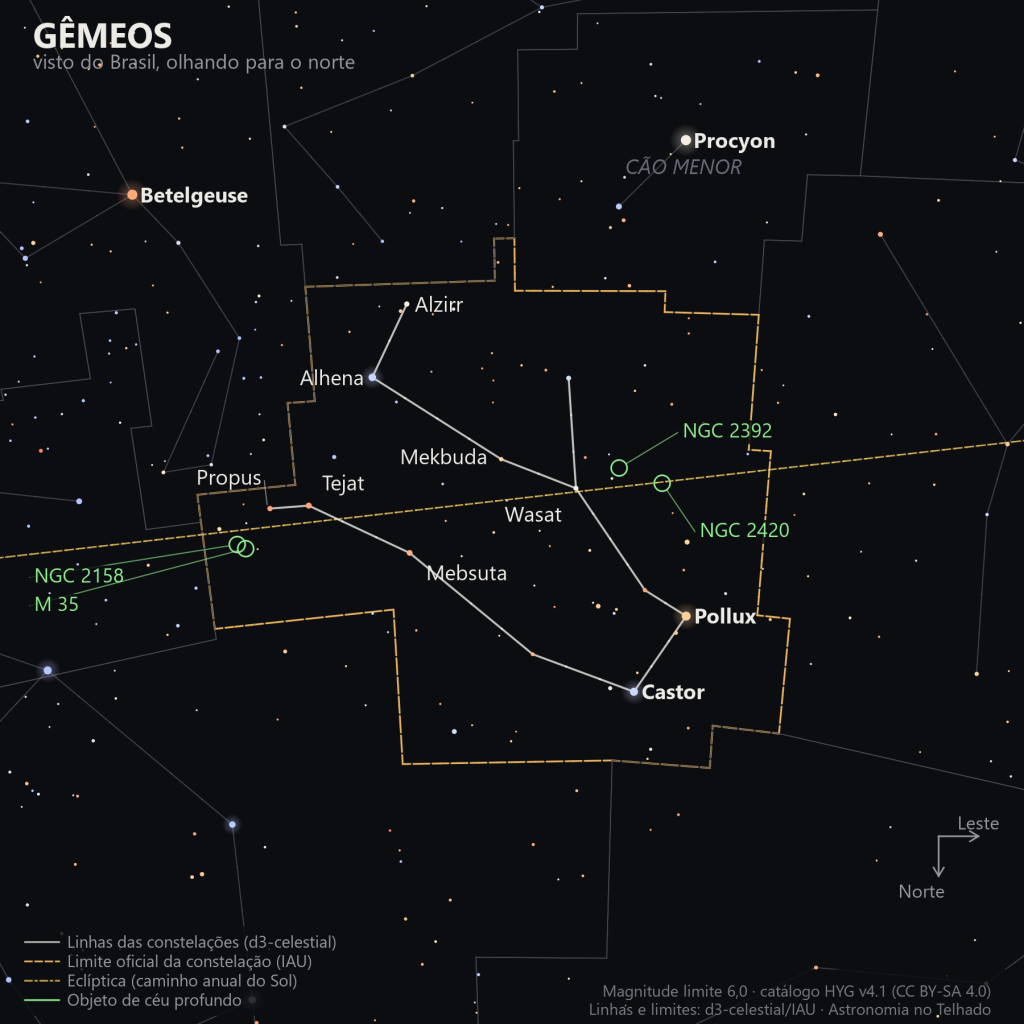
Two bright stars side by side, one white and one orange, called twins and yet not related at all: that is Gemini, one of the easiest constellations to recognize in the summer sky. Behind this simple appearance lie a six-star system, a cluster visible to the naked eye, a nebula that looks like a face in a hood, the most reliable meteor shower of the year and a fact few people know: two planets of the Solar System were discovered within its borders. In this guide you will learn how to find Gemini, get to know its stars and put together an observing plan for binoculars and telescope.
Text under review. This is a test article, written from reference sources; the sources are listed at the end.
How to find Gemini
Gemini (Gemini, abbreviated Gem) is the third constellation of the zodiac and is easy to find by its neighbor: it lies right next to Orion. According to Patrick Moore, it is the northernmost of the zodiacal constellations and one of the largest and most conspicuous; two parallel lines of stars run from Castor and Pollux toward Orion, and Alhena, almost first magnitude, sits between Pollux and Betelgeuse (Moore, The Observer's Year, nights of February 4 and 6). Mourão's dictionary describes it as a rectangle, formed on the east side by Castor and Pollux and on the west side by Gamma and Mu (Mourão, entry Gemini). Its area is 514 square degrees, between Taurus and Cancer.
The best season in Brazil runs from January to March: through the center of the constellation (right ascension of about 7 hours), it crosses the meridian at 9 p.m. around the end of February. Because it lies north of the zenith for anyone living in Brazil, look north. In Rio de Janeiro, Gemini appears at a comfortable height; the farther south you are, the lower it sits, and in the far south of the country you need a clear northern horizon. We calculated the maximum altitude of Castor, Pollux and the cluster M 35 for a few cities (90 degrees minus the difference between the latitude and the object's declination):
| City | Castor | Pollux | M 35 |
|---|---|---|---|
| Boa Vista (RR) | 61° | 65° | 69° |
| Manaus (AM) | 55° | 59° | 63° |
| Recife (PE) | 50° | 54° | 58° |
| Brasília (DF) | 42° | 46° | 50° |
| Rio de Janeiro (RJ) | 35° | 39° | 43° |
| Porto Alegre (RS) | 28° | 32° | 36° |
| Chuí (RS) | 24° | 28° | 32° |
Maximum altitudes calculated from the objects' declinations (SIMBAD) and each city's latitude; rounded values. Ridpath states that the constellation is visible from 90° N to 55° S.

Step by step to find the constellation: locate Orion (the Three Marys, that is, Orion's Belt, and Betelgeuse) and look north, a little below and to the right (east) of Betelgeuse; the two brightest stars that appear side by side are Castor and Pollux, with Pollux the brighter and more orange one. On the other side of the constellation (above it, on the chart), Procyon, in Canis Minor, helps confirm the spot. Then just follow the two lines of stars that run down toward Orion, forming the bodies of the twins.
The stars of Gemini
| Star | Visual brightness (mag.) | Spectral type | Approximate distance |
|---|---|---|---|
| Pollux (beta) | 1.14 | K0 IIIb (orange giant) | about 34 light-years |
| Castor (alpha) | 1.58 (combined) | A1 V + A2 Vm (plus four more stars) | about 51 light-years |
| Alhena (gamma) | 1.92 | A1.5 IV (binary) | about 109 light-years |
| Tejat (mu) | 2.87 | M3 III (red giant) | about 230 light-years |
| Mebsuta (epsilon) | 2.98 | G8 Ib (yellow supergiant) | 680 to 1,100 light-years (sources disagree) |
| Propus (eta) | 3.28 (variable, 3.1 to 3.9) | M2 III (red giant) | 350 to about 690 light-years (sources disagree) |
| Wasat (delta) | 3.53 | F2 V | about 61 light-years |
| Mekbuda (zeta) | 3.79 (variable, 3.6 to 4.2) | G1 Ib (Cepheid) | 1,060 to 1,400 light-years (sources disagree) |
Brightnesses, spectral types and parallaxes taken from SIMBAD (CDS, Strasbourg); distances in light-years come from parallaxes measured by the Hipparcos satellite, rounded. Older books give quite different values for several of them, which is why some appear as a range.
Twins that are not twins. Castor and Pollux look like sisters, but Moore points out that there is no real connection between them: Castor is about 10 light-years farther away (Moore, night of February 6). Color sets them apart: Castor is white and Pollux is decidedly orange, and the contrast shows to the naked eye and gets even better in binoculars. Because Pollux has a cooler surface, its spectrum is quite different from Castor's. Kambič puts Pollux's temperature at about 4,500 K and says it is the 17th brightest star in the sky, while Castor is 23rd. There is more: Pollux is called beta even though it is the brightest in the constellation. According to Moore, Ptolemy and the Arab astronomers gave both stars magnitude 2, Bayer (1603) called Castor alpha, and in 1700 Flamsteed still treated Castor as first magnitude; since the early 19th century, however, there has been no doubt about Pollux's superiority.
Castor, the Russian doll. This system is the constellation's main attraction. To the eye, it is one star; in a small telescope, two bluish stars, with magnitudes of about 1.9 and 2.9; and behind each of them there is yet another star. Castor A and Castor B orbit each other with a period of about 380 to 470 years, depending on the source, and their apparent separation ranges from 2.5 to 4.4 arcseconds (Moore; Kambič; Mourão), which a 3-inch telescope splits well. It was the first system recognized as a binary, by William Herschel in 1803, when he was trying to measure Castor's distance by parallax (Moore, night of February 8). Each of the two components is in turn a double star, with periods of 9.2 and 2.9 days, impossible to separate in a telescope and discovered only through their spectra. The family is completed by Castor C, about 71 arcseconds away, made up of two red dwarfs that eclipse each other every 19.5 hours and therefore carry a variable-star designation, YY Geminorum (Philip's, entry Castor; Kambič). In all, six stars: four hot and white, two cool and red.
The naked-eye variables. Gemini is a good constellation for starting to follow variable stars without instruments. Mekbuda (zeta) is a Cepheid: it pulsates regularly, with a period of 10.15 days, going from magnitude 3.6 to 4.2 (Kambič); you can compare it with Kappa and Upsilon, and also with Delta and Lambda (Moore). Propus (eta) is a semiregular red giant, varying from 3.1 to 3.9 in a cycle of roughly 233 days, without predictability; Mu (Tejat) and Xi serve as comparison stars (Moore). Propus also has a 6th-magnitude companion 1.8 arcseconds away, which only larger telescopes show (Kambič).
Deep-sky objects
M 35 — open cluster (NGC 2168)
In the region of the twins' "foot," about 2 degrees northwest of Propus (eta), lies M 35, one of the most beautiful open clusters in the sky. Under a dark sky it is visible to the naked eye as a faint patch, and binoculars show a large, bright patch with some of the brightest stars; it fits in the same field as Propus, which makes it much easier to find (Kambič; Moore). It has a combined brightness of magnitude 5.1 to 5.3 and spans about 25 to 28 arcminutes, almost the diameter of the full Moon. The number of stars depends on the criterion and the source: Allison speaks of more than 200; Kambič, of more than 1,000, of which 90 are brighter than magnitude 11. It lies about 2,700 to 3,000 light-years away (SIMBAD, using Gaia data, gives something near 2,900), which gives a true diameter of around 22 to 30 light-years, and it is about 110 million years old (Kambič). It was discovered by Chéseaux in 1745-46, and by Bevis, and Messier included it in his catalog in 1764 (Bakich, object no. 980).
NGC 2158 — open cluster
Just below M 35 (less than 1 degree south), NGC 2158 is a much smaller and fainter cluster, of magnitude 8.6 and about 5 arcminutes across; it is visible only in telescopes (Kambič). It seems stuck to M 35 only because of perspective: it is much farther away, at about 16,000 to 18,000 light-years, one of the most remote open clusters known (Kambič; SIMBAD). It is a good example of how the sky has depth.
NGC 2392 — Eskimo Nebula (Caldwell 39)
Between Kappa and Lambda, near Wasat (Delta), lies the Eskimo Nebula, a planetary nebula, that is, gas blown off by an old star, which has nothing to do with planets (Moore, night of February 11). Discovered by William Herschel in 1787, it has magnitude 9.2, about 45 arcseconds across and a central star of magnitude 10 to 10.5, easy to see. In the books it is 3,000 to 4,000 light-years away, although SIMBAD's parallax suggests a greater distance, around 6,000; Mobberley estimates the nebula's age at between 1,000 and 5,000 years (Mobberley). The name comes from its look: in photographs, the disk resembles a face surrounded by a fur hood. Visually the "face" does not show: with a 10 cm telescope and high magnification you see a bright center, an inner ring and a greenish halo; OIII and UHC filters help. To find it, start from Wasat and go about 2 degrees east and 1 degree south (Mobberley). Moore recalls that he never saw it in binoculars.
NGC 2420 — open cluster
Mobberley lists NGC 2420 as a neighbor of the Eskimo, about 2.5 degrees east-northeast. It has magnitude 8.3 and about 7 arcminutes across (SIMBAD) and calls for a telescope. It is a good "rest" target after the nebula.
Mythology and history
Castor and Pollux were twin sons of Leda, wife of Tyndareus, king of Sparta, and of Jupiter, who disguised himself as a swan (Mourão, entry Gemini). According to Moore, Pollux was immortal and Castor was not: when Castor died in battle, Pollux asked to share his immortality, and the two were taken to the sky together. Mourão adds that Castor was famous as a horse tamer and Pollux as a boxer, that the two freed Helen during the Trojan War and that they were considered protectors of sailors and travelers; for this reason, in antiquity, the constellation often appears as two stars above a ship. Vieira recalls that the twins were guardians of Rome, appearing on coins around the year 250 (Vieira). Mourão also records an older origin for the asterism, tied to the Sun in this region of the sky after the flooding of the Nile, with plant shoots in place of the twins in the tomb of Ramesses VI.
The zodiac: the Sun in Gemini and the difference between sign and constellation
The zodiac is the band of constellations, about 8 degrees on each side of the ecliptic, through which the Sun, the Moon and the planets seem to pass (Philip's, entry zodiac). The ecliptic is the Sun's apparent path over the year, and it is the dashed line crossing the chart above. Gemini is the third constellation in this band.
By the official boundaries of the International Astronomical Union, the Sun is inside Gemini from about June 22 to July 21 (approximate dates), near the June solstice, the start of winter in the Southern Hemisphere. At that time the constellation is on the same side of the sky as the Sun and disappears from view. Signs, however, follow a different calendar: Mourão records that the sign of Gemini corresponds to people born between May 21 and June 20. The difference exists because a sign is one of the 12 equal sections, of 30 degrees each, into which the zodiac was divided about two thousand years ago, when each sign contained the constellation of the same name. Since then, the precession of the equinoxes has shifted the reference point back by about 30 degrees, and the constellations have fallen out of step with the signs: Mourão gives the example of Taurus, which today lies in the sign of Gemini (Mourão, entry signo; Philip's, entry zodiac). In addition, the constellation boundaries have been redefined, and the constellations have very different sizes, while the signs are all equal. This text treats the signs as culture and history; astronomy predicts nothing from them.
A curiosity: two planets were born in Gemini
The constellation has a place of honor in the history of the planets. On March 13, 1781, William Herschel, examining with a reflector of about 15 cm the stars near H Geminorum, noticed an "object" larger than the others and took it for a comet; it was Uranus, the first planet discovered with a telescope (Philip's, entry Uranus; Moore and Rees, Data Book). Almost 150 years later, in 1930, Clyde Tombaugh found Pluto by comparing photographic plates from the Flagstaff Observatory; the brightest star in the field, shown in Mourão's dictionary, is Delta Geminorum, that is, Wasat (Mourão, entry Plutão; Vieira). Pluto was reclassified as a dwarf planet in 2006 (Ridpath). For this reason, anyone who looks at Wasat is looking at the same stretch of sky where the Solar System gained its seventh planet and, later, its "ninth."
The Geminids
In the first half of December, the radiant of the Geminids, the point in the sky from which the meteors seem to come, lies in Gemini, near Castor. It is the steadiest shower and one of the richest of the year, peaking around December 13 and 14. Philip's gives rates of up to 120 meteors per hour (ZHR), and Moore, in the 2005 edition of his book, cites 75, possibly reaching 90; the meteors have medium speed, about 35 km/s, and there are many fireballs (Moore, night of December 13; Philip's, entry Geminids; Mourão, entry Geminídeos). The origin is curious too: there is no known comet, but the orbit is that of the small asteroid 3200 Phaethon, about 5 km across, as if it were an "extinct comet" (Moore). The radiant is in the north, at an altitude of about 35 degrees in Rio de Janeiro in the early morning hours; start observing after dark and make the most of the small hours, with the Moon out of the sky and a clear northern horizon. December is cloud season, so have a plan B for another night.
Observing plan
| Instrument | What to see |
|---|---|
| Naked eye | Castor and Pollux and their color difference, the line of stars to Orion, the variables Mekbuda and Propus against the comparison stars, M 35 as a faint patch under a dark sky. |
| Binoculars (10×50) | M 35 resolved into stars, the orange and white contrast of Castor and Pollux, the field with Propus and M 35 together and the Milky Way crossing the western part of the constellation. |
| Small telescope (70 to 100 mm) | Castor split in two, NGC 2158 next to M 35, the Eskimo Nebula (center, ring and halo) with 100 mm or more and high magnification. |
| DSLR camera | M 35 and NGC 2158 with a telephoto lens, the Eskimo with a telescope (the face shape only shows up in the image), the whole constellation with a wide-angle lens and Orion alongside. |
Field tips:
- Always look north and pick a moonless night, with a clear northern horizon.
- Gemini is well placed from January to March at nightfall; in June and July, the constellation is on the same side of the sky as the Sun and disappears.
- Start with the naked eye, looking at the colors of Castor and Pollux, and only then use binoculars.
- To follow Mekbuda and Propus, note your estimated magnitude every two nights and make a light curve.
- On the Eskimo Nebula, use the highest magnification the sky allows; images reveal more than the eye.
References
- ALLISON, Michael. Star Clusters and How to Observe Them. London: Springer, 2006. M 35 and the clusters of Gemini, pp. 133-139.
- BAKICH, Michael E. 1,001 Celestial Wonders to See Before You Die. New York: Springer, 2010. Objects no. 43 (NGC 2392), no. 44 (Castor) and no. 980 (M 35).
- KAMBIČ, Bojan. Viewing the Constellations with Binoculars: 250+ Wonderful Sky Objects to See and Explore. New York: Springer, 2010. Chapter "Gemini", pp. 297-299.
- MOBBERLEY, Martin. The Caldwell Objects and How to Observe Them. New York: Springer, 2009. Caldwell 39 (NGC 2392), pp. 90-91.
- MOORE, Patrick (ed.). Philip's Astronomy Encyclopedia. London: Philip's, 2002. Entries "Castor" (p. 74), "Geminids" and "Geminga" (p. 157), "Pollux" (p. 316), "Uranus" (p. 412) and "zodiac" (p. 445).
- MOORE, Patrick. The Observer's Year: 366 Nights of the Universe. 2nd ed. London: Springer, 2005. Nights of February 4 and 6 (Gemini and "non-identical twins," pp. 46-48), February 8 and 9 (Castor and variables, pp. 49-51), February 10 (M 35, pp. 51-52), February 11 (Eskimo Nebula, p. 52) and December 13 (Geminids, p. 337).
- MOORE, Patrick; REES, Robin. Patrick Moore's Data Book of Astronomy. Cambridge: Cambridge University Press, 2011. Discovery of Uranus, p. 224.
- MOURÃO, Ronaldo Rogério de Freitas. Dicionário enciclopédico de astronomia e astronáutica. Rio de Janeiro: Nova Fronteira, 1987. Entries "Castor" (p. 151), "Gemini" and "Gêmeos" (p. 330), "Geminídeos" (p. 331), "Plutão" (pp. 634-635), "signo" (p. 736) and "Urano" (p. 819).
- RIDPATH, Ian. Astronomia (Guia Ilustrado Zahar). 4th ed. Rio de Janeiro: Zahar. Gemini, p. 174; Pluto, pp. 120-121.
- VIEIRA, Fernando. Identificação do céu. Gemini, pp. 73-74; the twins as guardians of Rome, p. 23.
- SIMBAD Astronomical Database. Centre de Données astronomiques de Strasbourg (CDS). Query for brightnesses, spectral types, parallaxes and coordinates, on September 21, 2026.
- HYG Database (v4.1), David Nash / Astronexus, CC BY-SA 4.0 license, used for the star chart; IAU constellation boundaries and d3-celestial lines.